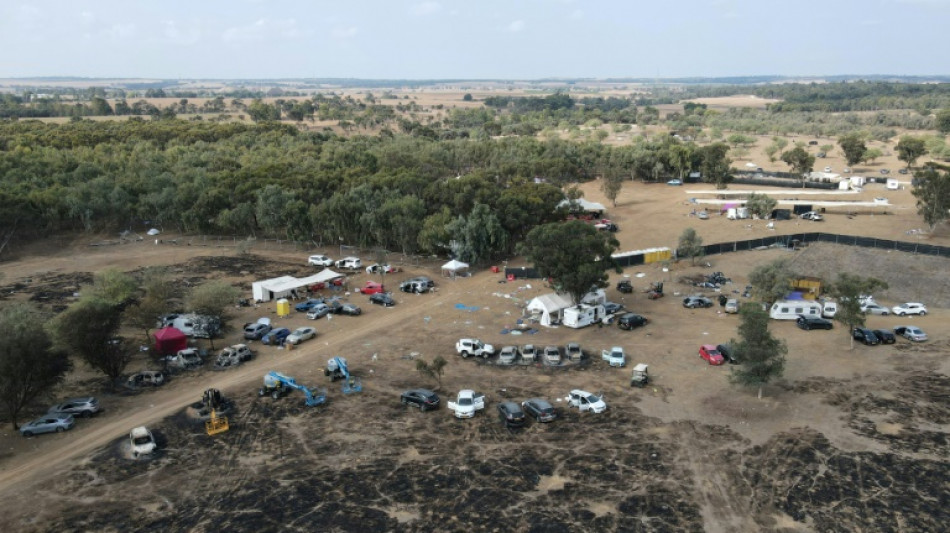
'Helpless': How a massacre unfolded at Israel music festival / Photo: Jack GUEZ - AFP

 EU vows AI rules will protect Europeans. Will they?

 Myanmar leader to visit Malaysia after migrant returns begin
 Germany's AfD poised to preside over state assembly for first time
 Australia's opposition vows 'largest cut to immigration' in country's history
 Ready, set, snooze: Sleep-deprived Japanese compete for best-rested

 Falcons thump Saints 45-24 as New Orleans marks Katrina anniversary

 Tuvalu govt adviser says Australia overstepped in pre-COP visit

 Asian stocks mixed despite tech-led Wall St record
 Tens of thousands expected in Paris for high school protests
 AI borrowing binge rattles US markets

 Young Canadians sue government over alleged climate failures

 White Sox down Guardians to take 2-0 series lead

 NHL record-breaker Ovechkin says current season will be his last
 France roar back in Nations League as Italy beat Turkey
 Messi readies for final farewell in Argentina send-off
 Esposito seals Italy win over Turkey in Nations League

 Russia downplays plague reports as Trump offers US help

 Trump says US moved bombers from UK base after 'threats'
 Brazilian stocks surge to record after Bolsonaro election lead
 Leaders to visit Pacific atoll at frontline of climate change

 ICC gives more details about arrest warrants for Taliban ministers

 Nigeria's Tinubu confirms 32 dead after military plane crash

 'Reckless' AI firms can't control models, says whistleblower

 Switching on brain cells: the Nobel-winning science of optogenetics
 Quebec votes as separatist surge poses test for Canada PM

Osher and Michael Waknin wanted to celebrate friendship, love and freedom. The twins in their 30s "organised parties all over Israel... They were always happy kids," their sister said.
Their last party, however, became the scene of horrific tragedy when it was targeted by the Hamas gunmen who launched the worst attack on Israel in its 75-year history.
Yet before the incomprehension that became terror under the rattle of automatic weapons, the festival had opened as a huge success.
From Friday onwards, some 3,500 electronic music fans -- from Israel and abroad -- flocked under brightly coloured canopies of the Supernova event just five kilometers (three miles) from the Gaza border.
Three stages, DJs from all over the world, a camping area, bars to cater for partygoers. Everything was in place for a weekend of dancing in the Negev desert.
But as dawn broke on October 7, the music suddenly stopped. It was around 6:30 am. In the distance, noises that had nothing to do with the party could be heard.
"Guys, red alert, regroup," warned the loudspeaker.
Sparks in the sky, followed by the explosion of rockets which were intercepted by Iron Dome, Israel's air defence system.
They were the first signal of the horror to come.
Ephraim Mordechayev, 23, is a young soldier who had come to celebrate the weekend, which coincides with the Jewish Sabbath.
At first, "we didn't comprehend the scope of the event," he told AFP back in his apartment in the northern city of Or Akiva, still wearing the festival wristband.
"We start to panic but we were calm, we are used to this. We are just used to rockets" launched from the enclave, which has been under Israeli blockade since Hamas took control in 2007.
The young man and his friends began to leave, but soon realised that something far beyond their comprehension was happening around them.
Gunmen were in the crowd -- they came on foot, by motorcycle or from the air accompanied by the rattle of automatic gunfire.
"There is a someone that is 20, 10 metres from you with guns and trying to kill you," he said.
- Scrambling for their lives -
The attackers killed anyone they came across.
The security guards and police present at the scene were quickly overwhelmed, and themselves targeted.
Everyone scrambled for their lives with some running towards the fields surrounding the site, while others tried to reach their vehicles in one of the festival's car parks.
But before long, a traffic jam formed.
"I looked back and saw that in the car behind me there were three corpses, and all the cars' windows were shattered," said Mordechayev.
There were just two options: hide or run for his life across the surrounding fields. Mordechayev chose the latter.
He ran from bush to bush, terrified, until an already packed car picked him up.
But Route 232, the only path away from suffering and death, was not much safer.
The road runs parallel to the border between Israel and the Gaza Strip, linking the neighbouring kibbutz of Re'im to the town of Sderot, some 30 kilometers to the north.
7:39 am: A camera aboard a car that managed to escape reveals how the trap closed on people there.
Bursts of gunfire from Hamas attackers behind embankments lining the roadway shattered the windshield, forcing the driver to stop, although it was not clear whether he was hit.
Another festival-goer, Gili Yoskovich, also decided to abandon her vehicle and make a run for it across the barren fields where there was almost no cover.
The young woman spotted a small orchard and ran for its shelter with the attackers following close behind.
Others too were scrambling for a place to hide.
For hours, as the crackle of automatic weapons grew ever closer, some concealed themselves behind cars or scattered when the gunmen neared.
Some even lay among the corpses in the hope of surviving.
- Leading away hostages -
Three hours after the assault began, Hamas gunmen continued their carnage without encountering any resistance.
Surveillance images timestamped 9:23 am show a man in a black cap, with body armour over his shoulders, leading away a hostage in a bloody T-shirt.
In the background, a young man who was playing dead suddenly stirs. It appears he believes the coast is clear for him to run.
But he didn't see the assailant coming up from behind. The attacker killed him at point-blank range.
Several survivors told the media that they had waited six, sometimes seven hours before finally being rescued by the Israeli army.
When the first rescue workers arrived on the scene, they were horrified to discover the scale of the carnage: some 270 people had been killed and dozens of burnt-out vehicles crowded the road to the site.
For hundreds of meters, sleeping bags, mattresses, shoes and coolers littered the ground, hastily abandoned.
"In each car there were two or three bodies, or just one body shot dead," Moti Bukjin, an Israeli volunteer who recovers corpses, told AFP.
"They had so much time till the security forces got there. Some of the cars, they burnt with people inside," he added.
Days after the massacre, there are still the dead to mourn, but also the anguish that gnaws at families searching for the missing.
Dozens are believed to have been kidnapped and taken back as hostages to Gaza, an enclave now under intense bombardment by Israel's forces.
One mother, Ahuva Mayzel, last heard from her 21-year-old daughter Adi, who was at the festival, an hour after sunrise.
Waiting for news of her child, Mayzel said "we are just helpless, completely helpless as her parents."
The family of Michael Waknin, one of the twin organisers of the party, has been asking: Is he alive and among the captives?
His sister Ausa wants to believe he is alive, but hasn't heard from him since the attack.
As for their brother Osher, witnesses saw him get out of his car to rescue people in the midst of the chaos.
His widow, Sunny Waknin, said he died a hero. He was laid to rest on Tuesday in Jerusalem.
G.Teles--PC