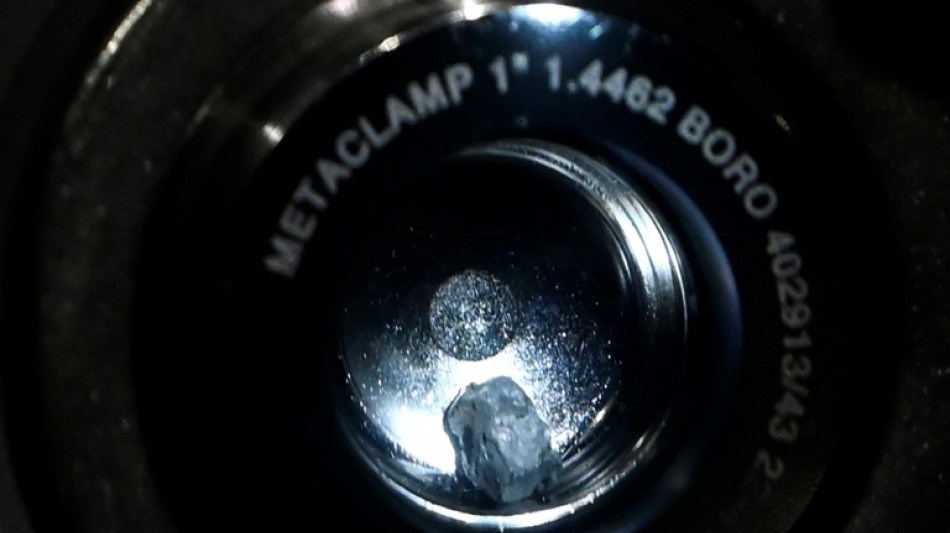
In US capital, selfies with asteroid hinting at Earth's origins / Photo: OLIVIER DOULIERY - AFP

 Moscow denies sanitary measures over plague reports

 Samoa look to recreate 2022 final run at Rugby League World Cup

 Asian stocks mostly up after tech-led Wall St record

 German factory orders plunge as recovery still fragile

 Coco Gauff calls out online racism following China open video review

 KVB Accelerates Middle East Footprint with Strategic MENA Regional Expansion

 Purple reign: Philippines seeks to keep grip on ube throne

 Seoul weighs steps to force North Korea landmine apology

 Yemen's Houthis say struck Riyadh airport, other Saudi sites

 Changer+ Launches Stablecoin-First Self-Custodial Wallet to Make Stablecoins Easier to Use

 White Sox down Guardians, Yankees on brink after Rays loss

 COP31 eyes modest steps as climate disasters multiply

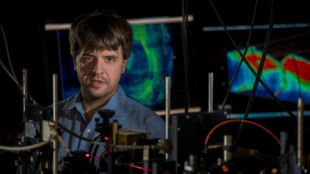 American Nobel laureate in medicine hopes to illuminate the brain

 Trump approves firing squad for convicted US military base shooter
 Grappling with 'homework scams,' US universities shun AI detectors
 Separatists win Quebec election in test for Canada PM

 Leaders visit Pacific atoll at frontline of climate change

 Yemen's Houthis claim striking Riyadh airport, other Saudi sites

 Best-selling British author Jeffrey Archer dies aged 86

 Military plane crash kills 32 in Nigeria

 Olise powers France to win over Belgium in Nations League

 High-flying Blazy turns to birdlife at Chanel

 Riyadh's allies pledge troops as Yemen, Saudi Arabia attack Houthis

 Clashes erupt outside Kosovo parliament over war crimes court
 Milan's Saelemaekers suffers ankle setback, faces lengthy spell out

In a hushed room of a museum in Washington, cameras and cell phones focus on a tiny piece of rock, no larger than a piece of gravel.
The fragment might seem insignificant, but it is a sample taken from the asteroid Bennu, which scientists are studying in the hope of discovering if asteroids actually brought the building blocks of life -- carbon and water -- to Earth.
Exhibited to the public on Friday for the first time at the Smithsonian in the US capital, the tiny stone is just visible inside its small capsule.
"This asteroid, now we know, has water crystals and carbon, two of the elements that produce ultimately life," said NASA boss Bill Nelson, a few minutes before the curtain rose on the dedication ceremony.
The new space venture is "part of our quest to understand, to try to understand, who we are, what we are, where we are, in the vastness of this cosmos," Nelson told journalists and space enthusiasts eager to whip out their cameras to snap an image of the rock fragment.
- 'Indescribable' -
Other museum visitors then come in and they too reach for their phones for a selfie with the little black rock.
Jenn Mann came from neighboring Virginia to take her grandson to "finally" see a piece of asteroid on Earth.
"I was afraid it was just a speck of dust, but it's actually much bigger than I thought," laughed the 64-year-old systems analyst.
"I was 10 years old when man first walked out on the Moon, and I think everyone in my generation is just really keen on all of that because you wouldn't remember all the excitement that was going on during that time," she said, before taking a photo for her daughter.
NASA's Osiris-Rex mission took the sample in 2020 from Bennu, an 4.5 billion-year-old asteroid 500 meters (1,640 feet) in diameter, which was more than 300 million kilometers (186 million miles) from Earth at the time.
The capsule containing the precious cargo returned successfully to Earth in September, landing in the American desert.
Since then, analysis has been underway at NASA's Johnson Space Center in Houston.
Even though she worked with the scientific team on the project, Nayi Castro, like the other visitors, was seeing a fragment of the sample with her own eyes for the first time.
"It's indescribable, I can't wait to bring my family and my friends to look at it," said the 36-year-old mission operations manager, proudly wearing the NASA logo on her t-shirt.
"To actually to look at this sample was super exciting cause it was so much work to get this sample back," she said, smiling.
- 'Dreamed of for 20 years' -
Tim McCoy, meteorite curator at the Smithsonian's National Museum of Natural History, described the discovery as a "milestone."
"Our planet has features that we haven't found on any other planet in the solar system or outside the solar system: we have continents, we have oceans, we have life," he told journalists.
"This is something I dreamed of for 20 years and today it comes to reality, but it's really just the first step," he said.
Even the operation to actually open the sample capsule is not complete. Due to the abundance of material found outside the collection mechanism itself, the main sample itself has not yet been opened.
The material already recovered was entrusted to a rapid analysis team, in order to obtain a first idea of the composition of Bennu.
P.Cavaco--PC