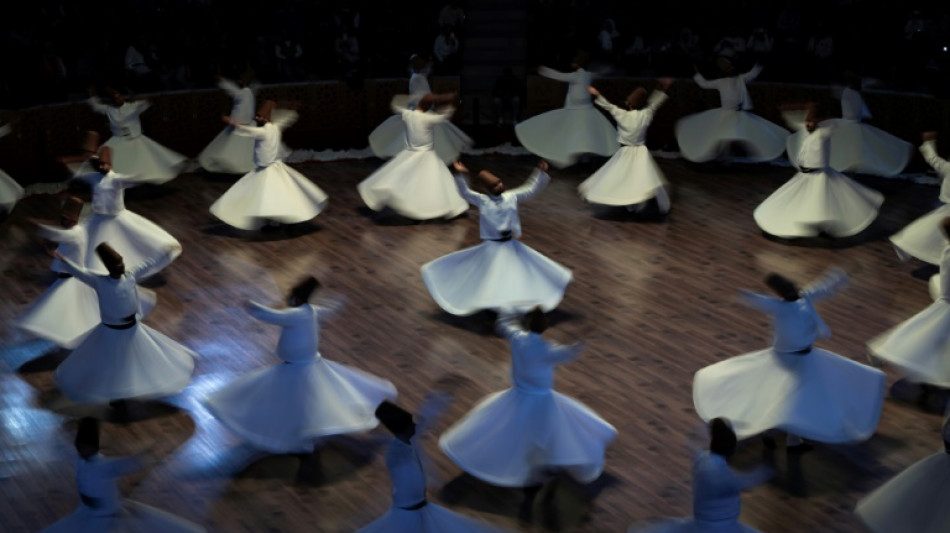
'Third way': Turkey's whirling dancers celebrate mystic Rumi's tolerance / Photo: Ozan KOSE - AFP

 FIFA chief Infantino hit by Norwegian double complaint

 Exiled Catalan separatist leader Puigdemont cleared to return to Spain

 Stock markets climb as oil prices retreat
 'No future': Thousands mass in France for high school protests

 Nobel physics prize honours work on 'ghostly messengers' from outer space

 Bulgaria searches for missing crew after drones hit two more ships in Black Sea

 Le Pen vows drastic cost savings to prevent French 'default'

 'Eats through a straw': French teens wounded in high school protests

 Thousands mass in France for high school protests

 Moscow denies sanitary measures over plague reports

 Samoa look to recreate 2022 final run at Rugby League World Cup

 Asian stocks mostly up after tech-led Wall St record

 German factory orders plunge as recovery still fragile

 Coco Gauff calls out online racism following China open video review

 KVB Accelerates Middle East Footprint with Strategic MENA Regional Expansion

 Purple reign: Philippines seeks to keep grip on ube throne

 Seoul weighs steps to force North Korea landmine apology

 Yemen's Houthis say struck Riyadh airport, other Saudi sites

 Changer+ Launches Stablecoin-First Self-Custodial Wallet to Make Stablecoins Easier to Use

 White Sox down Guardians, Yankees on brink after Rays loss

 COP31 eyes modest steps as climate disasters multiply

 American Nobel laureate in medicine hopes to illuminate the brain
 Trump approves firing squad for convicted US military base shooter

 Grappling with 'homework scams,' US universities shun AI detectors

 Separatists win Quebec election in test for Canada PM

The skirts of whirling dervishes twirl in a symphony of disco colours celebrating mystic Sufi poet Rumi at a cultural centre in central Turkey's Konya.
Every year, the "Seb-i Arus" ("Wedding Night") festival honouring Rumi's death on December 17, 1273, draws so many people that traditional venues are not large enough to contain the crowds.
Pilgrims, tourists, meditation enthusiasts and the curious flock to this vast Anatolian city, where Rumi -- or Mevlana as he is known in Turkey -- spent most of his life after being driven out of modern-day Afghanistan in the 12th century by Mongol invaders.
His writings have gradually spread well beyond central Asia and won acclaim in the West. Pop legend Madonna adapted one of Rumi's poems and Beyonce named her daughter after him.
"Rumi's works have been translated into almost every language, and in the United States alone more than 250 books are dedicated to him," said Nuri Simsekler, a specialist in Persian literature at Konya's Selcuk University.
"Rumi speaks to all humans, telling us about ourselves," Simsekler said of Rumi's enduring popularity seven centuries after his death.
- Dance ritual -
The "sema" rituals -- which honour Rumi's legacy -- are performed by whirling dervishes who don a tall light brown hat, with their arms elegantly spread.
The order was established after Rumi's death by his son and descendants.
To the sounds of reed flutes and tambourines, the dervish takes off his long black cloak to dance, but keeps his cylindrical felt hat on. The "sikke" represents the tombstone which will one day stand at the head of his grave.
Then the dance begins. Extending his right hand toward the sky and his left towards the ground, the whirling dervish forms a link between the two.
"Rumi is the first person on Earth whose death is not mourned but celebrated," Simsekler said.
From her office window, Esin Celebi Bayru has a clear view of the turquoise dome that tops the mausoleum of her illustrious ancestor.
Large crowds from Turkey and Iran -- where the poet is also a national icon -- but also Britain and Singapore are expected to celebrate Rumi's 750th "Wedding Night" with God at his tomb.
Such a major anniversary of his death was "an opportunity to make him even better known," said Celebi Bayru, a 22nd generation descendant of the Sufi poet.
She and her brother co-chair the Mevlana International Foundation, created in 1996 in Konya to perpetuate Rumi's legacy.
"In these times of war, Mevlana's word is like a light for us," she said of his many appeals for tolerance and peace. "People come here from all over the world."
- Prayer or meditation-
Celebi Bayru said she has recently been invited to lecture in places as distant as Hawaii, Australia, India and Pakistan.
Every year, she also receives film scripts, and hopes one day to see a biopic of Rumi brought to the screen.
Everywhere in Konya, souvenirs bearing the image of Rumi and dervishes fill stalls.
Ironically, the most famous master of Sufism -- who taught tolerance with the words "come, come, whoever you are, wanderer, worshipper, lover of leaving" -- is honoured in a city with one of Turkey's most staunchly conservative Sunni traditions.
In front of his immense green and gold tomb, a grumpy Sunni pilgrim curses as Rumi's followers sit on the ground, eyes closed, fingers pointing to the sky.
"This is not a place for meditation, it's for prayer," the Sunni pilgrim complained.
The incident only makes sheikh Mehmet Fatih Citlak smile.
Under a headdress lined with 20 metres of braided green ribbons, he presides over more spiritual "semas" at the Irfan Study and Research Centre in Konya, where prayers are interspersed with music and songs.
"We don't just twirl around all day," laughed the sheikh, who was recently invited to perform at Oxford University by its art history department.
"But as long as we stick to our discipline, we don't mind the public," he added, saying that "between art and love, Mevlana offered us a third way.
"Everyone interprets him in their own way," he said.
"But if he were better understood, would the world be in the state it is in today?"
M.Gameiro--PC