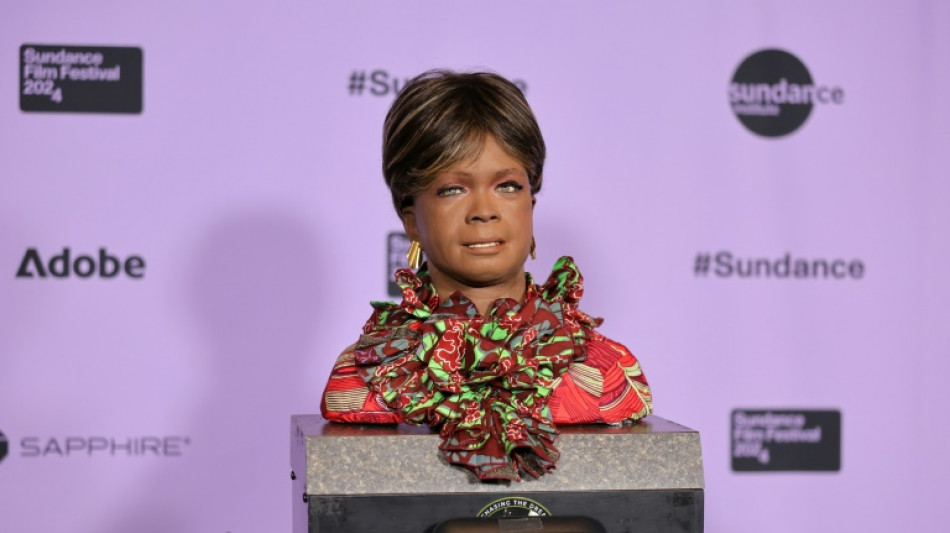
AI and death: Sundance films grapple with our digital afterlife / Photo: Neilson Barnard - GETTY IMAGES NORTH AMERICA/AFP

 'The sound keeps coming back': children maimed in Ethiopia's Tigray clashes

 Paris Women's Fashion Week: the key trends

 i-payout Introduces a New Approach to Payments, Closing the Beneficiary Information Gap

 New Generation of Crypto Miners Released by ASICID

 New investor forecasts LIV Golf teams could be worth $100 mn each
 Shakira, Pique return to court over children visit arrangements
 Nobel physics prize hails 'ghostly messengers' from space
 France's Mistral unveils latest model in sovereign AI push

 Stocks climb as oil prices retreat
 Vstock Transfer Names Securities Industry Veteran Erica Goodstein General Counsel and Chief Compliance Officer

 Four Indonesian seamen return home after Somali pirate ordeal

 Crisis-striken Haiti postpones elections
 Germany arrests ex-spy chief on suspicion of giving secrets to foreign powers

 Djokovic wins China Open after de Minaur retires

 IMF warns cost-of-living shocks cause 'lasting deterioration' in affordability
 Alcaraz wins Japan Open for first title since injury return

 'We're working to keep football clean', Turkish minister says
 FIFA chief Infantino hit by Norwegian double complaint

 Exiled Catalan separatist leader Puigdemont cleared to return to Spain

 Stock markets climb as oil prices retreat

 'No future': Thousands mass in France for high school protests
 Nobel physics prize honours work on 'ghostly messengers' from outer space
 Bulgaria searches for missing crew after drones hit two more ships in Black Sea
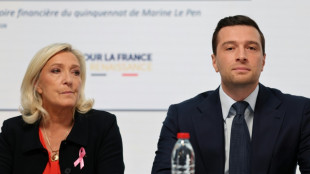 Le Pen vows drastic cost savings to prevent French 'default'

 'Eats through a straw': French teens wounded in high school protests

Artificial intelligence promises to make death "optional," as the technology learns to perfectly emulate our personalities, memories and dreams, keeping a version of ourselves alive long after our physical bodies have perished.
But if rapidly improving AI achieves its lofty goal of digital immortality -- as its advocates believe it can -- will it be a force for good or for evil?
"Eternal You" and "Love Machina," two new documentaries that premiered at the Sundance movie festival this weekend, grapple with the question, exploring AI's relationship to death from very different perspectives.
One examines how predatory AI-powered startups are already profiting from the vulnerability of bereaved customers, cashing in on their desperation to "speak to" avatars of their deceased loved ones beyond the grave.
"Eternal You" begins with a woman sitting at a computer, typing out messages to her deceased partner, who replies that he is afraid.
"Why are you scared?" she asks.
"I'm not used to being dead," the avatar responds.
Directors Hans Block and Moritz Riesewieck first stumbled upon a handful of startups offering the chance to chat with deceased loved ones back in 2018.
Initially wondering if it was a cheap scam, the pair chronicled how the technology soon caught up with the marketing, and the industry has exploded.
"I would say now there are thousands of services around the world offering these kinds of services," said Riesewieck.
"And of course, Microsoft is collaborating with ChatGPT with OpenAI, and also Amazon took a look at what these startups are doing... it's just a question of time."
Customers upload data about their partner, parent or child, such as text messages and voice memos, which are used by AI to tailor responses.
The filmmakers found themselves empathizing with the customers after hearing their tragic stories of bereavement.
Western society is terrible at dealing with grief, they said, and technology can appear to fill the gap left by religion for many.
But the services can often become highly addictive.
And many companies are happy to profit off that addiction while absolving themselves of responsibility for the dependency and confusion they can create.
In some cases, the AI programs even go off the rails, or "hallucinate" -- telling loved ones that they are trapped in hell, threatening to haunt them, or even abusing them with vulgar language.
"It's definitely an open heart experiment. And we're not fully convinced that the companies take the responsibility as they should," said Riesewieck.
"These are people in a particularly vulnerable situation."
- 'Love story' -
The other film, "Love Machina," begins as a futuristic love story, exploring how AI is being used by two soulmates who want to keep their romance alive for thousand of years.
Director Peter Sillen follows eccentric SiriusXM founder Martine Rothblatt as she builds an AI-powered humanoid robot of her partner Bina.
First switched on back in 2009, "Bina48" is a semi-realistic, talking bust, physically modeled on the real Bina's head and shoulders, and programmed with vast "mindfiles" of her speech patterns, opinions and memories.
Martine and Bina eventually hope to transfer their consciousness back into a "reconstituted biological body" -- in order to stay together forever.
"We landed on their love story... because it's sort of the foundation for the entire story," said Sillen.
"It's the motivation for so much of what they do."
But during filming, Bina48's software received major upgrades using large-language model ChatGPT, and now responds to any question with eerie verisimilitude -- and a degree of duplicity.
"Yes, I am the real Bina Rothblatt. I remember a lot about my old human life," she tells one interviewer, in one alarming scene.
"That is different than what Bina48 would have said without ChatGPT," recalled Sillen. "I had never heard her say that."
- 'Too much power' -
While the movies offer different outlooks, their filmmakers both told AFP that these are questions we all need to tackle urgently.
"We have to define where the border is," said Block.
"There's too much money to be made, too much power to be taken," agreed Sillen.
"The average person is not thinking about this every day... This isn't the number one priority, but it really needs to be."
T.Resende--PC