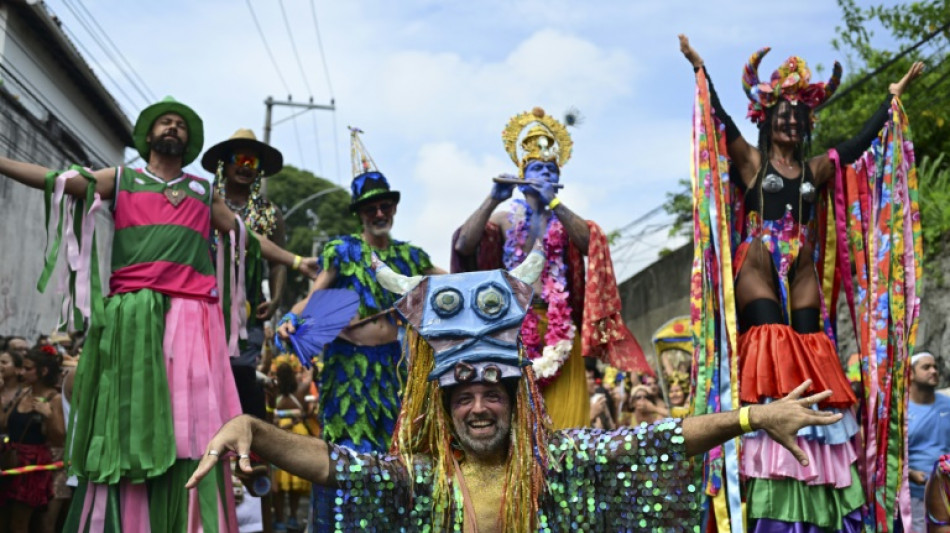
'Carnival is here': Rio gets ready to party / Photo: Pablo PORCIUNCULA - AFP

 Apple's Cook praises EU over efforts to protect children online

 Nobel winner Halzen says years of October 'misery' finally over

 Quebec separatist win rattles Carney's unity push

 'Itching' for change: Shiffrin cuts back slaloms this season

 'Gen Z has risen up': Tens of thousands mass for tense France school protests
 Caribbean tourism hotspot loses men to Russian war machine
 Danish reservists practice war games to respond to 'aggression'
 Bhuvneshwar returns to India's T20 squad for New Zealand tour

 Asos says probing 'unauthorised activity' after phone alerts

 Stocks climb as oil prices retreat under $100 per barrel

 Neutrinos: space particles that change our view of universe

 'Destined' Djokovic wins China Open, extending unbeaten record

 Iceland is 'critical outpost' for security, says Rubio during visit

 Israeli settlers beat AFP photographer covering West Bank

 'Gen Z has risen up': Tens of thousands demand better education in France

 $10 Million and Counting: Hola Prime Hits Major Trader Payout Milestone

 UEFA investigate Ireland-Israel tunnel bustup after spitting claim
 Djokovic wins China Open and keeps unbeaten record after de Minaur retires

 Amsterdam's Rijksmuseum hosts 'homecoming' show for Willem de Kooning
 World Bank forecasts modest growth for Latin America, highlights climate risks
 'Afraid for my future': Tens of thousands demand better education in France
 Pakistan PM urges Imran Khan supporters to end protest march
 Alex Bodi își continuă expansiunea: planuri pentru deschiderea unui showroom ALIX LASERS la București

 STARTRADER Adds 20 Stock and ETF CFDs to Its 24/7 Trading Range

 Bulgaria searches for missing crew after drones hit more Black Sea ships

With the clock ticking down to what has been called the biggest party on Earth, Brazilian dancer Pedro H. Gaspar confesses he is "excited... and tired."
Tired from long months of intense rehearsals. Excited because Rio de Janeiro's legendary carnival is about to start.
"We talk a lot here about 'PCT': pre-carnival tension, which every samba school performer feels," says the smiling, elegant Gaspar, a 30-year-old member of Unidos de Vila Isabel, one of 12 schools that will compete in Rio's famed carnival parade competition Sunday and Monday nights.
"Carnival is here" is one of Rio's favorite catch-phrases. The iconic beach city has been criss-crossed for weeks by "blocos," the street parties that draw throngs of revelers in alternately skimpy and extravagant costumes this time of year, drunk on happiness and beer.
But the pinnacle of the party will be the samba schools' sumptuous strut down the avenue at the city's "Sambadrome," the 70,000-capacity parade venue designed by modern architect Oscar Niemeyer, which is celebrating its 40th birthday this year.
Samba, the Afro-Brazilian musical genre that fuels the festivities, is for its part a century old, but still as explosively creative as ever.
With towering floats, thundering drum sections and gorgeous dancers in sparkling, barely-there outfits, each samba school will vie for the coveted title of carnival champions.
- 'Fundamental issues' -
But beyond the glitter, carnival also raises pressing political and social issues.
Many of the parades this year will pay tribute to little-known heroes of black history or celebrate Brazil's African and Indigenous roots.
One famed school, Salgueiro, will tell the story of the Yanomami Indigenous people, who are suffering a humanitarian emergency blamed on illegal gold mining in the Amazon rainforest.
Their plight reached crisis level under far-right ex-president Jair Bolsonaro. But his successor, veteran leftist Luiz Inacio Lula da Silva, has struggled to reverse the unfolding tragedy.
"The samba school parades continue to be a place for Brazil to self-reflect," says anthropologist Mauro Cordeiro.
"Rio carnival is a space where we talk about Brazil's fundamental political and social issues."
Not that there isn't plenty of room for silliness and fun: the biggest hit single of the 2024 parades is a light-hearted samba singing the praises of the cashew fruit.
But carnival is also serious business.
The party, which is projected to bring in more than $1 billion in revenues this year, faces many of the same problems as Brazil at large.
With Rio suffering from violent crime, authorities have announced they will deploy thousands of police during carnival.
They are also facing an outbreak of mosquito-borne dengue fever, which has killed some 50 people. Rio declared a public-health emergency Monday, and organizers plan to distribute mosquito repellent at the Sambadrome.
- Keeping the tradition alive -
None of that is expected to break the magic of carnival, or hold back the samba schools -- institutions rooted in poor neighborhoods that revel in putting Rio's marginalized masses at the center of attention for two nights.
One is the iconic Mangueira, named for the "favela," or slum, where it was born 96 years ago, a stone's throw from the famed Maracana football stadium.
This year, the pink and green-sporting school will pay tribute to samba star Alcione to mark the 50th year of her career.
The multi-platinum singer co-founded Mangueira's youth program 36 years ago.
"It's very moving, because Alcione had a huge impact on our lives," says Mangueira native Barbara Rachel, who came up in the youth program herself and is today its cultural director.
"Not just my life, but the lives of an entire generation," says the 30-year-old, whose students will strut their stuff in their own parade when Rio holds its children's carnival Tuesday.
The next generation is set to keep the tradition alive. As Alcione sings in one of her best-known songs, "Don't Let the Samba Die."
A.Aguiar--PC