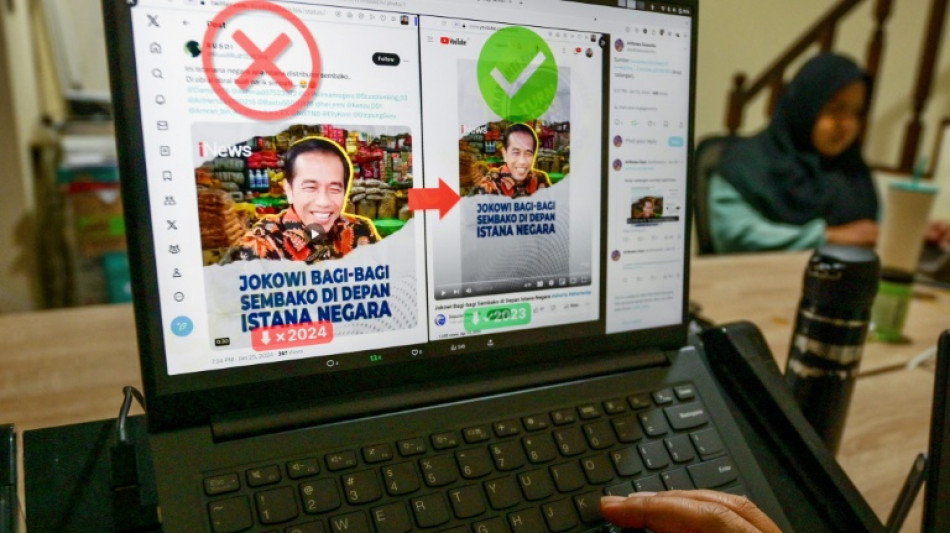
'One-sided war': Indonesians join forces to bust election disinfo / Photo: BAY ISMOYO - AFP

 Apple's Cook praises EU over efforts to protect children online
 Nobel winner Halzen says years of October 'misery' finally over

 Quebec separatist win rattles Carney's unity push

 'Itching' for change: Shiffrin cuts back slaloms this season

 'Gen Z has risen up': Tens of thousands mass for tense France school protests

 Caribbean tourism hotspot loses men to Russian war machine

 Danish reservists practice war games to respond to 'aggression'

 Bhuvneshwar returns to India's T20 squad for New Zealand tour

 Asos says probing 'unauthorised activity' after phone alerts

 Stocks climb as oil prices retreat under $100 per barrel

 Neutrinos: space particles that change our view of universe

 'Destined' Djokovic wins China Open, extending unbeaten record

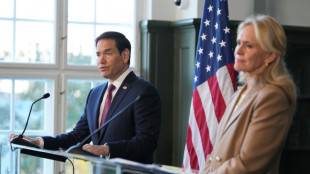 Iceland is 'critical outpost' for security, says Rubio during visit

 Israeli settlers beat AFP photographer covering West Bank

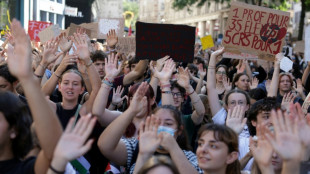 'Gen Z has risen up': Tens of thousands demand better education in France

 $10 Million and Counting: Hola Prime Hits Major Trader Payout Milestone
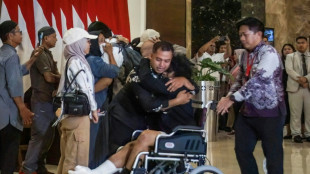
 UEFA investigate Ireland-Israel tunnel bustup after spitting claim
 Djokovic wins China Open and keeps unbeaten record after de Minaur retires

 Amsterdam's Rijksmuseum hosts 'homecoming' show for Willem de Kooning

 World Bank forecasts modest growth for Latin America, highlights climate risks

 'Afraid for my future': Tens of thousands demand better education in France

 Pakistan PM urges Imran Khan supporters to end protest march
 Alex Bodi își continuă expansiunea: planuri pentru deschiderea unui showroom ALIX LASERS la București

 STARTRADER Adds 20 Stock and ETF CFDs to Its 24/7 Trading Range

 Bulgaria searches for missing crew after drones hit more Black Sea ships

On a typical workday, Vinanda Febriani starts her morning in Indonesia scrolling on her phone. But her goal is slightly different than most Gen Zers -- she is scanning for disinformation posts.
By 6:00 am the Central Java resident has found five pieces of misinformation on a WhatsApp group, forwarding them with evidence to a group of fact-checkers who debunk false election-related information.
Small armies of grassroots fact-checkers like Febriani and her fellow volunteers are battling a wave of election misinformation in the world's third-largest democracy, dedicating spare time to debunk posts before next week's presidential vote.
"Many people will be fanatics about their chosen candidate pairs. So usually they don't care whether information is true or not," the 23-year-old graduate said.
"I'm worried about that."
One of the posts Febriani found claimed police openly declared support for presidential front-runner Prabowo Subianto.
"I checked the video and found it was... unrelated to the election," she said.
The freelance administrative assistant discussed the post with her friends and wrote a debunk for a site created by Mafindo, one of the country's largest grassroots fact-checking networks.
The site's reports are used by thousands of volunteers in more than 40 cities across the Southeast Asian archipelago nation to debunk posts.
- Fighting falsehoods -
Weeks before the vote, the number of fake posts was lower than found in the 2019 election, which experts say is due to greater knowledge about misinformation, a less divisive race than previous votes and better monitoring by authorities.
There were 714 misinformation issues then compared to 204 before this year's vote, Idham Holik, a commissioner of the General Elections Commission (KPU) told AFP, citing government data.
But the numbers still present a challenge, with new technology and platforms emerging such as TikTok and SnackVideo.
"It is a completely unbalanced and one-sided war," Mafindo founder Harry Sufehmi told AFP.
Social media monitoring has become harder too with platforms such as X, formerly known as Twitter, now allowing users to verify themselves in return for a fee.
"We cannot monitor hundreds of thousands of new posts every day, only machines can," said Sufehmi.
Volunteers often face hurdles when sharing information with the public too.
In 2019, Roesda Leikawa, 37, was labelled pro-government in her community after she responded to a fake WhatsApp post about President Joko Widodo with a Mafindo report.
"I told them we're not only debunking hoaxes about Jokowi, we also debunk hoaxes about Prabowo. I shared the debunk links. They went quiet after that," she said, using the president's nickname.
- Deepfake fears -
A new trend has emerged making their job even harder -- footage created using artificial intelligence.
While Subianto has used a cartoon of himself for his campaign created with generative AI, the technology is being used online to spread misinformation harmful and helpful to the candidates.
A video emerged online last year of candidate Anies Baswedan giving a speech in Arabic, earning him praise in the Muslim-majority nation and more than two million views.
Users called him "really smart" and "very intelligent" but the former governor of Jakarta does not speak the language.
Deepfakes showing Subianto and Widodo speaking other languages have also emerged.
AFP Fact Check found this year's election was Indonesia's first to feature deepfakes.
"We did not see deepfake disinformation in early 2023," said Aribowo Sasmito, Mafindo co-founder.
AFP, along with more than 100 other fact-checking organisations, is paid by TikTok and Facebook parent Meta to verify videos that potentially contain false information.
Indonesian deepfakes on TikTok have been viewed more than seven million times since October, AFP Fact Check found. They have also been shared on Facebook, Instagram and X.
A TikTok spokesperson said it takes "robust action against synthetically manipulated content that misleads viewers". Meta did not respond to a request for comment.
Many of the false posts handled by the fact-checkers target state bodies such as the police, anti-graft and election commissions.
A viral fake post debunked by AFP Fact Check claimed Jakarta had issued more than 13,000 ID cards to Chinese citizens so they could vote.
Sasmito said he still finds misinformation he has debunked being reshared, but refuses to give in to the deluge.
"I keep telling myself the most important thing is I've done my part in this battle," he said.
A.Aguiar--PC