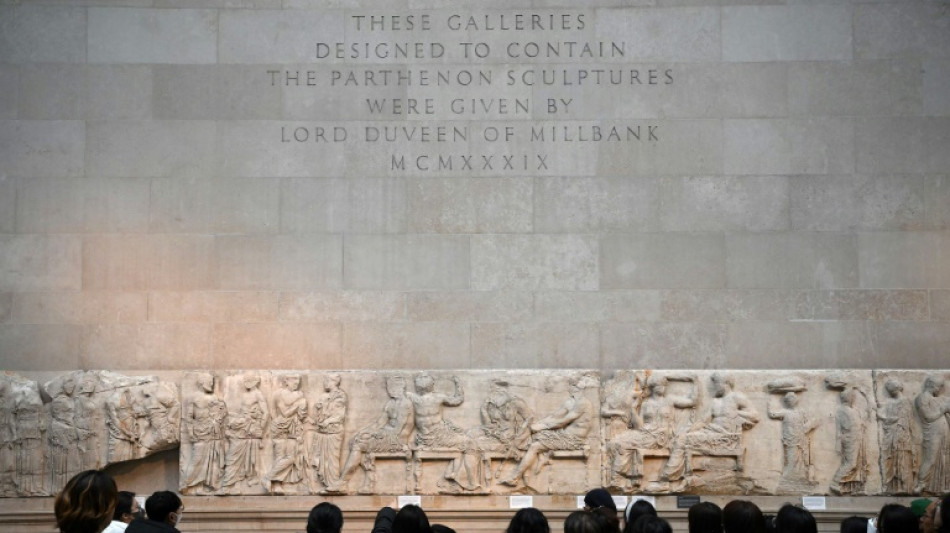
Law and politics hamper UK museum artefacts returns / Photo: Daniel LEAL - AFP/File

 Apple's Cook praises EU over efforts to protect children online

 Nobel winner Halzen says years of October 'misery' finally over

 Quebec separatist win rattles Carney's unity push

 'Itching' for change: Shiffrin cuts back slaloms this season

 'Gen Z has risen up': Tens of thousands mass for tense France school protests

 Caribbean tourism hotspot loses men to Russian war machine

 Danish reservists practice war games to respond to 'aggression'

 Bhuvneshwar returns to India's T20 squad for New Zealand tour

 Asos says probing 'unauthorised activity' after phone alerts

 Stocks climb as oil prices retreat under $100 per barrel

 Neutrinos: space particles that change our view of universe

 'Destined' Djokovic wins China Open, extending unbeaten record

 Iceland is 'critical outpost' for security, says Rubio during visit

 Israeli settlers beat AFP photographer covering West Bank

 'Gen Z has risen up': Tens of thousands demand better education in France

 $10 Million and Counting: Hola Prime Hits Major Trader Payout Milestone

 UEFA investigate Ireland-Israel tunnel bustup after spitting claim
 Djokovic wins China Open and keeps unbeaten record after de Minaur retires

 Amsterdam's Rijksmuseum hosts 'homecoming' show for Willem de Kooning

 World Bank forecasts modest growth for Latin America, highlights climate risks

 'Afraid for my future': Tens of thousands demand better education in France

 Pakistan PM urges Imran Khan supporters to end protest march

 Alex Bodi își continuă expansiunea: planuri pentru deschiderea unui showroom ALIX LASERS la București

 STARTRADER Adds 20 Stock and ETF CFDs to Its 24/7 Trading Range

 Bulgaria searches for missing crew after drones hit more Black Sea ships

British museums, like others across Europe, are under pressure to return artworks taken during the colonial era, including Bronzes from Benin, royal treasures from Ghana and friezes from Greece.
However, politicians have little appetite to change the legal framework that is currently blocking full restitutions by national museums, campaigners say.
After half a century of discussions, the British Museum and the Victoria and Albert Museum (V&A) recently reached an agreement to loan Ghana gold and silver objects from the Ashanti royal court taken during the colonial era in 1874.
The loan of these 32 pieces could last up to six years, according to the Manhyia Palace in Kumasi, seat of the Ashanti kingdom in now modern-day Ghana.
But Nana Oforiatta Ayim, special advisor to the Ghanaian government on culture, felt that the gesture was not enough.
"Someone comes in to your home, and steals something from your house, keeps it in their house, and then X amount of years later comes up and says 'I'm going to lend you your things back'. It doesn't make any sense," she told the BBC.
Some UK museums have managed to return artefacts, such as the 72 pieces -- including 12 Benin bronzes -- returned to Nigeria in 2022 by the Horniman Museum in London.
But British laws dating from the 1960s and 1980s prevent national museums, such as the British Museum and the V&A, from making such restitutions.
This is particularly relevant in the long-standing and symbolic quarrel between London and Athens over the future of the Parthenon friezes.
British authorities say the sculptures, on display at the British Museum, were legally acquired in 1802, while Greece maintains they were looted when the country was under Ottoman rule.
- Loan 'risk' -
By offering loans rather than restitution, national museums are trying to respond to demands without transferring ownership of objects, Tatiana Flessas, associate professor of law at the London School of Economics (LSE), told AFP.
But the British Museum would not "risk" lending the Parthenon marbles, "because it's completely evident that the Greeks will hold on to them," she added.
It would be possible, in theory, to change the law, said Flessas, in a similar way to how artworks looted by the Nazis were returned after WWII.
But Britain's Conservative government refuses to do so, even if public opinion is in favour.
Some 64 percent of Britons support their return, according to a YouGov poll commissioned last June by the Parthenon Project, a group that believes the marbles should reside in Greece.
Another YouGov poll in November found 49 percent in support, as opposed to 15 percent against, with the remainder either indifferent or undecided.
"The government is absolutely out of step with the rest of the population", Lewis McNaught, founder of Returning Heritage, which campaigns for restitution, told AFP.
"It is absolutely fixed on this idea that anything which removes objects from state collections is wokeish."
- Not a priority -
Opponents of restitution fear a domino effect, with cascading demands emptying British museums.
The conservative Daily Telegraph last month argued that, after the announcement of the loan of Ghanaian treasures, it was now British museums which risk being "looted".
But McNaught said that the number of objects potentially affected was limited, and would apply to less than one percent of the eight million objects in the British Museum.
"The problem is some of those items are very high profile," he added.
On mainland Europe, many countries have set up independent commissions on the issue, including Switzerland, "which never even had a colony," said McNaught.
But not the UK, which according to him remains wedded to a system created at the beginning of the 19th century.
And at the start of an election year in the UK, none of the main parties sees the issue as a priority.
"But times have changed, society has changed," he added.
O.Gaspar--PC