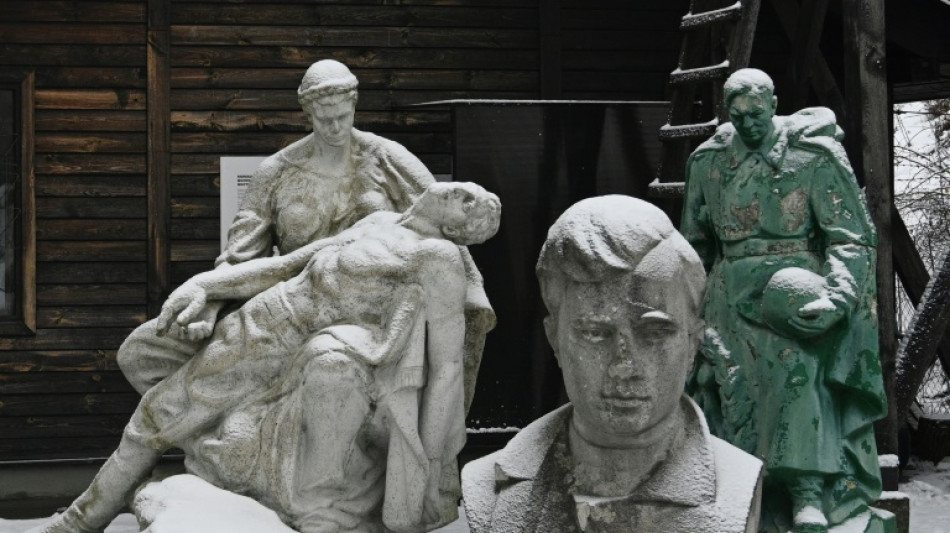
Ukraine debates future of downed Soviet monuments / Photo: YURIY DYACHYSHYN - AFP

 Apple's Cook praises EU over efforts to protect children online
 Nobel winner Halzen says years of October 'misery' finally over
 Quebec separatist win rattles Carney's unity push
 'Itching' for change: Shiffrin cuts back slaloms this season
 'Gen Z has risen up': Tens of thousands mass for tense France school protests
 Caribbean tourism hotspot loses men to Russian war machine
 Danish reservists practice war games to respond to 'aggression'
 Bhuvneshwar returns to India's T20 squad for New Zealand tour

 Asos says probing 'unauthorised activity' after phone alerts

 Stocks climb as oil prices retreat under $100 per barrel

 Neutrinos: space particles that change our view of universe

 'Destined' Djokovic wins China Open, extending unbeaten record
 Iceland is 'critical outpost' for security, says Rubio during visit
 Israeli settlers beat AFP photographer covering West Bank

 'Gen Z has risen up': Tens of thousands demand better education in France

 $10 Million and Counting: Hola Prime Hits Major Trader Payout Milestone
 UEFA investigate Ireland-Israel tunnel bustup after spitting claim
 Djokovic wins China Open and keeps unbeaten record after de Minaur retires
 Amsterdam's Rijksmuseum hosts 'homecoming' show for Willem de Kooning
 World Bank forecasts modest growth for Latin America, highlights climate risks
 'Afraid for my future': Tens of thousands demand better education in France
 Pakistan PM urges Imran Khan supporters to end protest march
 Alex Bodi își continuă expansiunea: planuri pentru deschiderea unui showroom ALIX LASERS la București
 STARTRADER Adds 20 Stock and ETF CFDs to Its 24/7 Trading Range
 Bulgaria searches for missing crew after drones hit more Black Sea ships

In Ukraine's westernmost city of Lviv, a statue of the first woman in space, Valentina Tereshkova, sprawls on the ground, red paint splashed around her helmet.
The region bordering the European Union claims it was the first in Ukraine to topple all its Soviet monuments, in a nationwide ouster of symbols glorifying Kremlin rule.
But the removal of hundreds of statues has raised the difficult question of what to do with their remains, at a time when Russia's invasion has sparked a cultural and historical reckoning.
"In Ukrainian society, there's an ongoing debate: if we should preserve these monuments, what we should do with them," said Liana Blikharska, a historian and researcher at the Territory of Terror museum in Lviv.
Outside the museum, which features accounts of Soviet repressions and deportations of Jews, lie several downed statues -- stylised metal figures and severed body parts.
Blikharska said staff relented when local authorities asked them to house the relics since there was little other choice.
"There's no other museum or place to store them, so we said yes."
- 'Shared history' -
Downing statues is not new in Ukraine. The country toppled thousands honouring the Bolshevik revolutionary Vladimir Lenin and other Soviet monuments in the 1990s.
A new wave of removals began in 2014 after Russia annexed the Crimean peninsula, and then redoubled after the 2022 invasion.
Then last year, Ukraine passed a "decolonisation" law on renaming streets and removing monuments linked to Moscow.
Governor Maksym Kozytsky announced last month that Lviv had taken down 312 monuments, crossing the finish line first in the race to "de-communise."
One among them was that of Tereshkova, now an 86-year-old pro-Kremlin lawmaker. It was installed in 1983 and removed in November from a Lviv street formerly named after her.
For Andriy Godyk, the head of the regional working group on monuments, the campaign represents the "ideological front" of the war with Russia.
"Our generation is doing the work of our parents, which should have been done in the early 1990s," the 35-year-old said.
Anna Gerych, a journalist and co-founder of a group called Decommunisation of the Lviv Region, backed the campaign because she felt it was unacceptable for the monuments to remain when "people are dying at the hands of these same occupiers".
- Local opposition -
Lviv was part of Poland until World War II and had a relatively small quantity of Soviet architecture and symbols. Russian is not widely spoken.
But still, Godyk conceded they had encountered opposition in getting rid of Soviet monuments.
"There are indeed times when people stand in front of our equipment and say 'we will not allow this to be dismantled'," he said.
He said locals were hesitant to remove war memorials, especially those bearing relatives' names.
Others brought trucks and tractors to rip down monuments for free, he said.
Across the country, authorities have differed in their approach to the problem.
Officials in the capital Kyiv have moved monuments -- including statues of Russian poet Alexander Pushkin -- to a closed airfield.
Godyk said Lviv's decision to move monuments to a museum was "debatable," since thousands in the region died from Soviet repression.
The museum may take a few more monuments, "but that's enough for me," he said.
-'Story about people'-
Adding another layer of complexity to an already difficult issue, the Lviv museum staff said they were unsure how to display the monuments.
"We don't have a precise concept (of) how we should work with them," said Blikharska.
Senior researcher Yuriy Kodenko argued that people need to view such monuments to "inoculate" themselves against totalitarianism and prevent "erasing of memory".
The museum chose the "most important" monuments or ones by known artists, Blikharska said.
Space-themed monuments were among the last to go: in 2021, Lviv's city legislature decided the Tereshkova monument was non-ideological.
The museum also has parts of a 30-metre-long Monument to Military Glory from 1970.
One of the sculptors, Yaroslav Motyka, told Ukrainian TV its removal was "no great tragedy".
Blikharska said displaying the monuments helped tell the stories of those who created them, including members of the intelligentsia whose relatives were repressed under Soviet rule.
"We should preserve some of the monuments because of their cultural value but also because of the people who made them -- because of the artists," she said.
"It's always a story about people."
Godyk said Ukraine should have started systematically removing Soviet statues earlier because it would have undermined the Kremlin's argument that its troops were defending "Russian history or our common history".
"We have common history, but we don't have a common future."
G.M.Castelo--PC