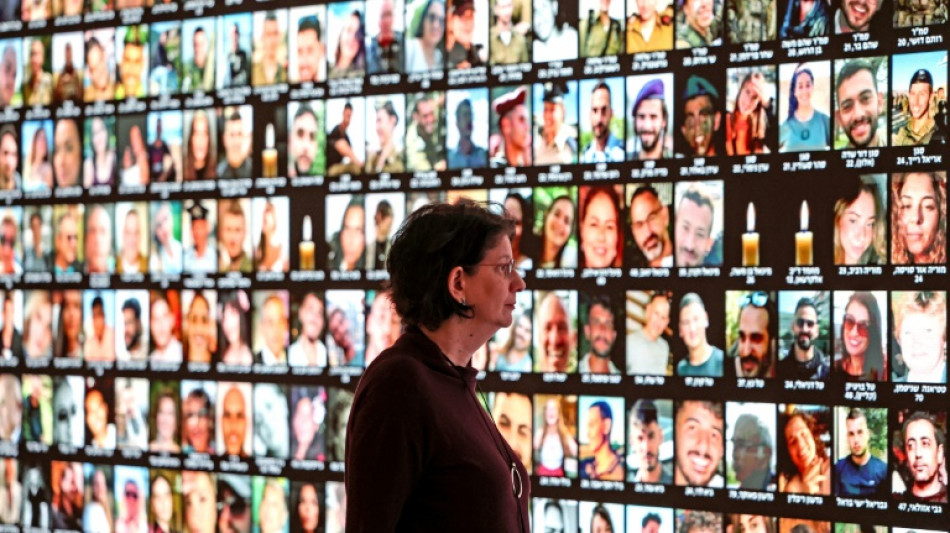
October 7 evidence pieced together in Israel, one terabyte at a time / Photo: AHMAD GHARABLI - AFP

 Apple's Cook praises EU over efforts to protect children online
 Nobel winner Halzen says years of October 'misery' finally over
 Quebec separatist win rattles Carney's unity push

 'Itching' for change: Shiffrin cuts back slaloms this season

 'Gen Z has risen up': Tens of thousands mass for tense France school protests
 Caribbean tourism hotspot loses men to Russian war machine
 Danish reservists practice war games to respond to 'aggression'

 Bhuvneshwar returns to India's T20 squad for New Zealand tour

 Asos says probing 'unauthorised activity' after phone alerts

 Stocks climb as oil prices retreat under $100 per barrel

 Neutrinos: space particles that change our view of universe

 'Destined' Djokovic wins China Open, extending unbeaten record
 Iceland is 'critical outpost' for security, says Rubio during visit

 Israeli settlers beat AFP photographer covering West Bank

 'Gen Z has risen up': Tens of thousands demand better education in France

 $10 Million and Counting: Hola Prime Hits Major Trader Payout Milestone
 UEFA investigate Ireland-Israel tunnel bustup after spitting claim
 Djokovic wins China Open and keeps unbeaten record after de Minaur retires
 Amsterdam's Rijksmuseum hosts 'homecoming' show for Willem de Kooning
 World Bank forecasts modest growth for Latin America, highlights climate risks
 'Afraid for my future': Tens of thousands demand better education in France

 Pakistan PM urges Imran Khan supporters to end protest march
 Alex Bodi își continuă expansiunea: planuri pentru deschiderea unui showroom ALIX LASERS la București
 STARTRADER Adds 20 Stock and ETF CFDs to Its 24/7 Trading Range

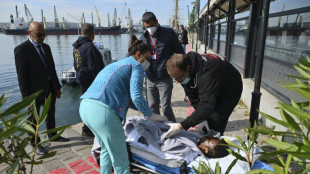 Bulgaria searches for missing crew after drones hit more Black Sea ships

Rockets at dawn, gunfire outside, hours of anxiety: a survivor of the October 7 attack shared his account of the day Gaza militants stormed his southern Israeli community, speaking into a video camera.
Arnon Avni's story is one of several hundred witness accounts of the deadly Hamas attack being collected by Israel's national library in partnership with local and international initiatives.
He was speaking recently at Nirim kibbutz, about two kilometres (a mile) from the Gaza Strip, often interrupted by the sound of nearby fighting more than four months into the Israel-Hamas war.
Avni, 70, a graphic designer and caricaturist, said he had spent 10 hours hiding in a safe room with his grandchildren as militants rampaged through the small village, killing five kibbutz residents, kidnapping five others and torching homes.
Three of those captives have been freed, while Nirim -- like most Israeli communities near the Gaza border -- has remained largely deserted since the devastating attack.
Avni, who had spent his entire life in Nirim, chose to return more than a month ago, joining just a handful of kibbutz residents.
"I'm not a hero," Avni told AFP. "It's my place here."
He was sharing his story with volunteers with "Edut 710", or "Testimony October 7", one of several projects gathering witness accounts, online videos, photographs and even WhatsApp messages that tell the story of the attack.
During the interview, Avni recalled a moment of joy, snapping a selfie with his granddaughter on his shoulders right after Israeli soldiers had finally rescued them.
"We were smiling, because we still didn't know what had happened," he said. A few minutes later, he saw other survivors crying at the kibbutz's community centre.
- 200,000 videos -
The "Edut 710" project is one of several dozen initiatives feeding a "massive" database set up by the National Library of Israel, said Raquel Ukeles, the institution's head of collections.
"After October 7, when we recovered from the initial shock and we realised the enormity of the catastrophe that had befallen this country, we started to collect," Ukeles told AFP.
On that day, Palestinian militants breached the heavily militarised Gaza border, launching an attack that resulted in the deaths of more than 1,160 people, mostly civilians, in Israeli towns, villages, army bases, a desert rave and other sites, according to an AFP tally based on official figures.
About 250 Israelis and foreigners were abducted into Gaza, of whom Israel says 130 remain in captivity including two from Nirim. Thirty are presumed dead.
Israel responded with a massive military campaign in the Hamas-ruled Gaza Strip which has killed more than 29,000 people, most of them women and children, according to the territory's health ministry.
Testimonies of the October 7 attack -- the deadliest in Israel's 75-year history -- as well as images of torture and killing captured on Hamas fighters' body cameras and phones were widely shared on social media almost instantly.
Collecting the vast online material was an urgent task "because we realised that they were disappearing", said Ukeles.
In the first three weeks after October 7, the library had received 200,000 video clips, she said.
Ukeles expects a total of around 60 terabytes of material to be collected, analysed and archived -- a task that would take years to complete.
- Battling 'denial' online -
Some of the digital evidence includes messages sent by victims as the attack unfolded.
One of the projects partnering with the national library, "Memorial 710", has also collated some of the frenzy of WhatsApp messages sent by panicked residents moments before they were killed in Beeri kibbutz, the hardest hit community with nearly 100 deaths.
As times passes and the initial shock gradually subsides, more witnesses are willing to speak.
Steven Spielberg's USC Shoah Foundation, one of the Israeli national library's international partners, has recorded the testimonies of about 400 people who had witnessed mass killings and abductions.
It was "a mass atrocity", said Robert Williams, executive director of the foundation and UNESCO chair on anti-Semitism and Holocaust research.
"It's the largest anti-Semitic attack since the Shoah," he said, using another term for the Holocaust.
To him, it is imperative to collect evidence of the brutality of the attack, saying he was "shocked and surprised at how quickly denial of these events began to appear on social media".
Ukeles said that the "massive amount of documentary evidence of what actually happened is in itself the evidence against those who deny".
"If we do our work well", she added, "the people who want to make the case for history can do their work well".
P.Serra--PC