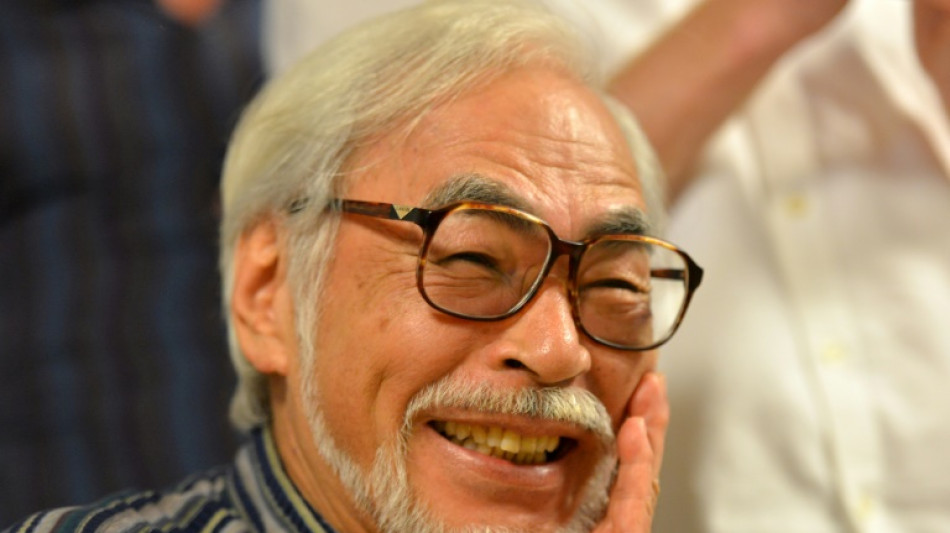
Hayao Miyazaki: anime great behind Studio Ghibli / Photo: YOSHIKAZU TSUNO - AFP/File

 Ronaldo opens door for Portugal return, apologises for walkout

 'Nobody seems to care': Russian city shrugs off plague reports

 Hundreds arrested in French school protests as Macron summons ministers

 WADA seeks tough anti-doping stance from Kenya
 German ex-spy chief arrested for suspected espionage, treason
 Furyk vows US will 'do more' to end Ryder Cup losing streak

 Iyer hits ton as India hammer West Indies in T20 opener

 Mandhana named India women's team captain after Kaur quits

 'The sound keeps coming back': children maimed in Ethiopia's Tigray clashes

 Paris Women's Fashion Week: the key trends

 i-payout Introduces a New Approach to Payments, Closing the Beneficiary Information Gap

 New Generation of Crypto Miners Released by ASICID

 New investor forecasts LIV Golf teams could be worth $100 mn each
 Shakira, Pique return to court over children visit arrangements

 Nobel physics prize hails 'ghostly messengers' from space
 France's Mistral unveils latest model in sovereign AI push

 Stocks climb as oil prices retreat

 Vstock Transfer Names Securities Industry Veteran Erica Goodstein General Counsel and Chief Compliance Officer

 Four Indonesian seamen return home after Somali pirate ordeal

 Crisis-striken Haiti postpones elections

 Germany arrests ex-spy chief on suspicion of giving secrets to foreign powers

 Djokovic wins China Open after de Minaur retires

 IMF warns cost-of-living shocks cause 'lasting deterioration' in affordability

 Alcaraz wins Japan Open for first title since injury return

 'We're working to keep football clean', Turkish minister says

An Oscar win two decades ago introduced the world to Japanese anime great Hayao Miyazaki, and now the Studio Ghibli co-founder, aged 83, has done it again.
Miyazaki's "The Boy and the Heron" -- potentially his last film -- took the Academy Award for best animated feature on Sunday, the same category won by Ghibli classic "Spirited Away" in 2003.
Enthralling viewers of all ages with his extraordinary imagination, the animator has built a cult following through films depicting nature and machinery in fantastical detail.
The beloved characters dreamt up by Miyazaki include cuddly yet mysterious spirit creature Totoro -- the mascot of his celebrated production house.
But despite becoming one of Japan's top cultural exports and helping take anime mainstream, he describes his work as an agonising struggle and has retired several times, albeit unsuccessfully.
Miyazaki's 1997 breakout feature "Princess Mononoke", the tale of a girl raised by wolves in a forest threatened by humans, set him apart from rivals such as Disney, who tend to focus on the battle between good and evil.
The director said at the time that he "didn't want to say what's right and what's wrong" in the film.
On another occasion, the aviation-loving pacifist said that making a film was not a logical process.
"I start to descend into the well of my unconscious. Then a lid at the bottom of the brain opens. This allows new directions to emerge, which were unimaginable when I was thinking with just the brain's surface," he told reporters in France.
"But it's better not to open it. It'll almost always pose problems to your family and social life."
- 'Fantasy is necessary' -
Born in 1941 to a well-heeled Tokyo family, Miyazaki grew up an avid fan of manga comics. He was at high school when Japan's first colour anime film came out, and said he was so moved by it he cried all night.
After studying politics and economics at university, he launched his career as a staff animator at Toei, a major studio.
His debut feature "The Castle of Cagliostro" was released in 1979, and told the story of the grandson of fictional French thief Arsene Lupin. Miyazaki's fame grew with "Nausicaa of the Valley of the Wind" in 1984.
The following year, he and fellow animator Isao Takahata founded Studio Ghibli, which grew into Japan's premier anime studio, revered by fans worldwide.
The studio's name Ghibli is an Italian word derived from the Arabic for a hot Saharan wind. It is also the name of a type of military plane and was chosen to symbolise their desire to breathe new life into the animation world.
Miyazaki reached global stardom with "Spirited Away", about a girl who gets lost in a mysterious world and tries to save her parents who are turned into pigs.
Like many Miyazaki films, "Spirited Away" features a female protagonist, and blends themes of nostalgia, greed and interaction with the natural world.
"Fantasy is necessary for children in order to escape from the tough reality they face," he told the Asahi Shimbun that year.
- Perfectionist -
Miyazaki is a prominent liberal figure in Japan, and made headlines in 2015 when he criticised then-prime minister Shinzo Abe for saying future generations need not apologise for the country's war record.
He urged Japan's leaders "to say clearly that aggressive war was completely wrong, having brought enormous damage to the Chinese people".
The heavy smoker announced in 2013 he would no longer make feature-length films as he could not maintain the hectic intensity of his perfectionist approach to work, citing "various" health problems.
However, in an about-turn four years later, Miyazaki's production company said he was coming out of retirement to make "his final film, considering his age".
That movie -- "The Boy and the Heron", originally titled "How Do You Live?" in Japanese -- was released last year.
It tells the story of a boy who moves to a countryside during World War II after the death of his mother in the fire-bombing of Tokyo, and struggles to accept his new life with his father and pregnant stepmother, who goes missing.
Everything changes when he meets a heron and embarks on a journey to an alternate universe where the living and the dead appear to co-exist.
"The truth about life isn't shiny, or righteous. It contains everything, including the grotesque," Miyazaki said in a recent NHK documentary, in which he was visibly affected by the 2018 death of Ghibli co-founder Takahata.
"It's time to create a work by pulling up things hidden deep within myself."
Nogueira--PC