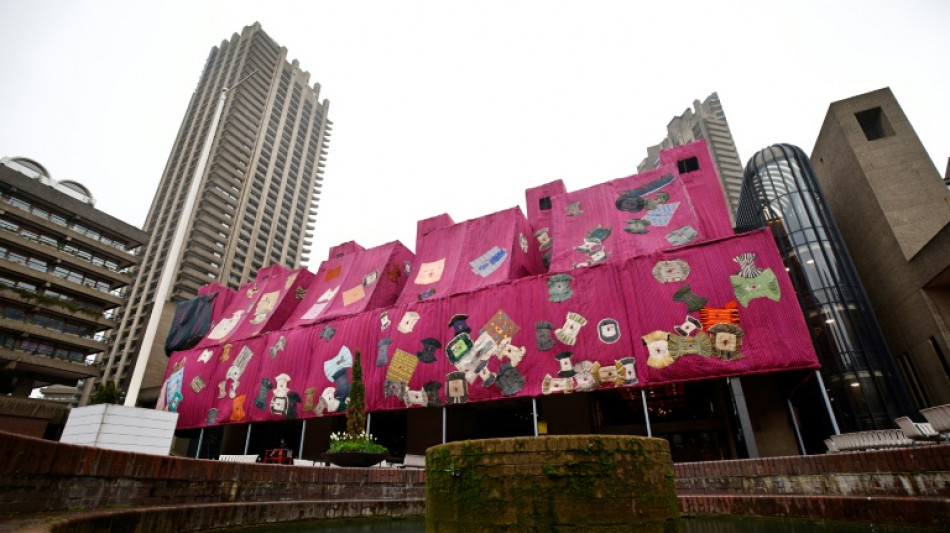
Ghanaian artist Ibrahim Mahama adds splash of colour to London complex / Photo: BENJAMIN CREMEL - AFP

 Australia probes app used in cheap smart glasses over privacy fears

 England needed to 'move on' from World Cup pain, says Tuchel

 O'Neill to stay at Celtic after period of "reflection"

 Kane marks 125th England cap with Wembley Nations League double

 Quebec's incoming separatist leader wants to block Crown from swearing-in

 Emmys gala will now stream its premier television awards

 Paramount completes Warner Bros takeover, creating Skydance
 Trump blames France unrest on Islam, migration
 Apple's Cook praises EU over efforts to protect children online

 Nobel winner Halzen says years of October 'misery' finally over

 Quebec separatist win rattles Carney's unity push

 'Itching' for change: Shiffrin cuts back slaloms this season

 'Gen Z has risen up': Tens of thousands mass for tense France school protests

 Caribbean tourism hotspot loses men to Russian war machine

 Danish reservists practice war games to respond to 'aggression'
 Bhuvneshwar returns to India's T20 squad for New Zealand tour

 Asos says probing 'unauthorised activity' after phone alerts

 Stocks climb as oil prices retreat under $100 per barrel

 Neutrinos: space particles that change our view of universe
 'Destined' Djokovic wins China Open, extending unbeaten record
 Iceland is 'critical outpost' for security, says Rubio during visit

 Israeli settlers beat AFP photographer covering West Bank

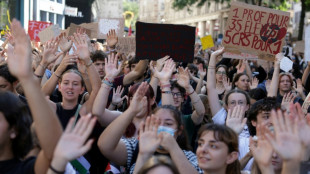 'Gen Z has risen up': Tens of thousands demand better education in France

 $10 Million and Counting: Hola Prime Hits Major Trader Payout Milestone

 UEFA investigate Ireland-Israel tunnel bustup after spitting claim
An installation by Ghanaian artist Ibrahim Mahama wrapping part of a brutalist central London cultural complex in pink-purple woven cloth and urine-stained robes was unveiled Tuesday.
The public commission at the Barbican Centre's Lakeside Terrace, named "Purple Hibiscus" after Chimamanda Ngozi Adichie's eponymous 2003 novel, has been hand-sewn in collaboration with hundreds of craftspeople in Ghana.
The 2,000 square metres (2,1528 square feet) of brightly coloured fabric panels feature scores of traditional robes, known as "batakaris", previously worn and cherished by everyone from Ghanaian royals to everyday people.
Passed down from generation to generation, Mahama began collecting them more than a decade ago for eventual use in his artworks.
Known internationally for creating massive installations that clad buildings, "Purple Hibiscus" is his first large-scale UK public commission.
For it, he worked with networks of female weavers in his native Ghana to embroider the robes onto the striking fabric now draped over a sliver of the famously grey concrete Barbican complex.
"I've always been interested in labour, the conditions of labour, the history of labour, and also how labour is inflicted on bodies," Mahama told AFP about conceptualising the artwork.
Some of the robes have been urinated on or had "other things" doused on them by their previous owners, because "the idea is to break the soul away from the material," he explained.
"They somehow believe that their soul, of the family, is somehow contained within the cloth," the artist added, noting it had often been difficult to convince people to hand over the valued items.
Sometimes adorned with amulets, they were once mythically thought of as armour to protect against the bullets of colonial soldiers.
On display in the Barbican until mid-August, the exhibit resonates with the district's history of mass destruction during World War II and as a one-time home to the cloth trade.
The light and bright purple and pink fabric, stitched with the history-laden fragile robes, deliberately contrast with the hard-edged surroundings and typically grey London sky overhead.
"It's supposed to somehow allow us... to reflect on the human condition, and beyond the human condition, also into the question of life," said Mahama.
The artist appears unconcerned by the potential impact of London's notoriously wet weather on his painstakingly assembled installation.
"It will last as long as it can last," he said.
"Once you produce any art piece that is supposed to be in the public, the artist has to be ready to accept the fact that anything can happen to it."
T.Resende--PC