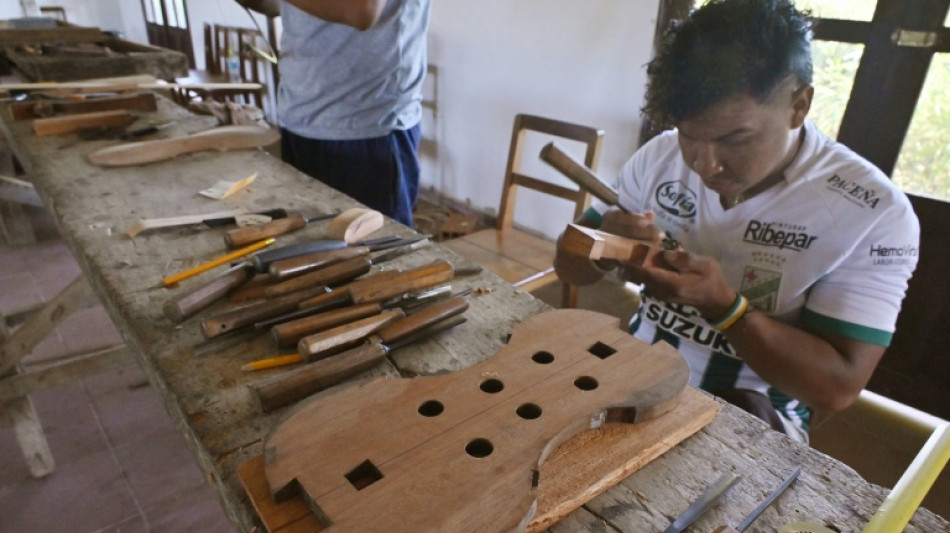
Violin village: Artisanal hub in Bolivian Amazon / Photo: AIZAR RALDES - AFP

 N. Korea's Kim pledges 'invariable support' in Putin birthday letter

 OGRD Alliance Advances PLPC Multi-Asset Platform Following APHELAR Milestone, Expanding Licensing and Strategic Capital Frameworks

 Emotion, tears as Messi prepares for Argentina farewell

 Kane eyes Ronaldo record after matching England cap mark

 Spain fight back to beat Croatia, Kane adds to record for England

 Merino double helps Spain beat Croatia, reach Nations League quarters

 US stocks hit fresh records as oil stabilizes on rising supplies

 As Messi bows out, Argentines say 'thank you'

 Ronaldo opens door for Portugal return, apologises for walkout

 'Nobody seems to care': Russian city shrugs off plague reports

 Hundreds arrested in French school protests as Macron summons ministers

 WADA seeks tough anti-doping stance from Kenya

 German ex-spy chief arrested for suspected espionage, treason
 Furyk vows US will 'do more' to end Ryder Cup losing streak

 Iyer hits ton as India hammer West Indies in T20 opener

 Mandhana named India women's team captain after Kaur quits

 'The sound keeps coming back': children maimed in Ethiopia's Tigray clashes

 Paris Women's Fashion Week: the key trends

 i-payout Introduces a New Approach to Payments, Closing the Beneficiary Information Gap

 New Generation of Crypto Miners Released by ASICID

 New investor forecasts LIV Golf teams could be worth $100 mn each
 Shakira, Pique return to court over children visit arrangements

 Nobel physics prize hails 'ghostly messengers' from space
 France's Mistral unveils latest model in sovereign AI push

 Stocks climb as oil prices retreat

Nestled in the Bolivian Amazon, the small, majority-Indigenous town of Urubicha has become an unexpected hub of violin makers, also known as luthiers.
Out of a population of some 8,000 people, most of whom are native Guarayos, some 40-50 work directly in the trade, local resident Waldo Papu tells AFP.
"I have not seen a place where so many violins are made," he said.
Papu heads up the Urubicha Institute of Artistic Training, Choir and Orchestra -- one of the most well-known baroque music schools in Bolivia with about 600 students.
About 20 or so students are learning to make violins, carrying on the tradition practiced by elders such as Hildeberto Oreyai.
The master craftsman, 76, tells AFP he was led into the practice by his father.
He takes two weeks to make a classical four-stringed instrument.
"You have to work with the instrument. It is done with patience, so that it comes out well," he said in a mixture of Spanish and Guarayo, one of Bolivia's 37 official Indigenous languages.
Each violin is made from cedar or mara -- a local hardwood -- and sells for the equivalent of about $580.
- Roots in tradition -
A widower with five children and several grandchildren, Oreyai speaks little and has had hearing problems for a while.
With his luthier's ear impaired, he tunes practically by heart.
"I really like to play," he says, sitting outside his rustic workshop.
Unlike some others in the town, Oreyai has been unable to convince any descendants to take up the violin-making trade he first learned from his grandfather.
Urubicha lies over 300 kilometers (200 miles) north of the departmental capital Santa Cruz.
In the early 19th century, Franciscan missionaries arrived in the area of current-day Guarayo and noticed that the Indigenous peoples were skilled artisans and, above all, musically talented.
Anthropologists believe that may be rooted in the Guarayos' beliefs around death.
For one's soul to reach the Great Ancestor, as they identify their god, it must sing and play the "tacuara" or bamboo flute, historian Juan Uranavi says.
The soul rides on a caiman to the ancestor, but if it does not know how to play the tacuara well, "because of some carelessness in his life," the caiman tips him over into the river to devour him, Uranavi told AFP.
Taking advantage of their musical proclivities, the Franciscans used the violin as a tool to evangelize the local population.
At first, the instruments could only be played in church, but later "the natives themselves learned from the missionaries" to make and play them, Papu said.
One student learning the violin-making trade is 38-year-old Hernan Yarita, who is soon to graduate as a luthier.
He tells AFP he wants his violins to reach his fellow villagers first.
"There are children who do not have a violin and we have this vision of making them for ourselves, for our relatives," Yarita says.
P.Serra--PC