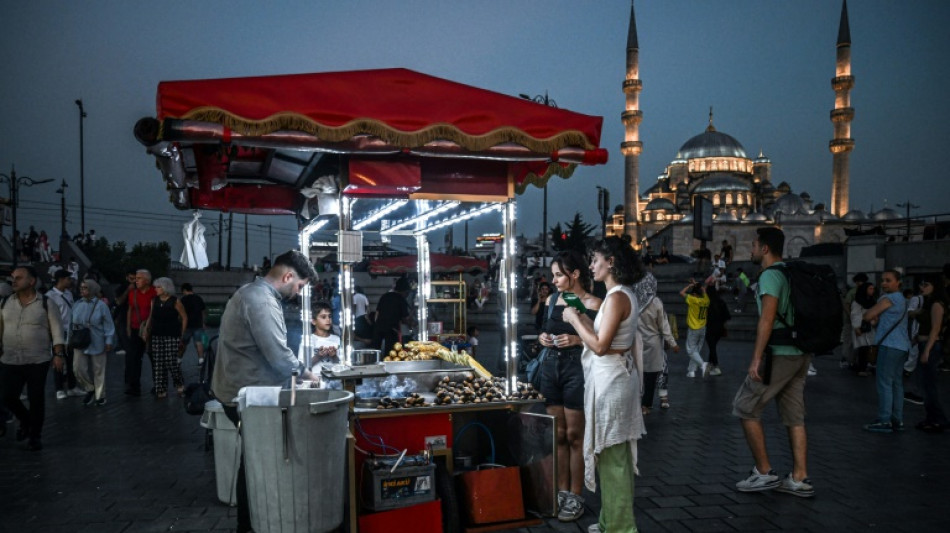
Hungry times for Istanbul's street food sellers / Photo: Ozan KOSE - AFP

 Stocks climb as oil prices retreat

 Vstock Transfer Names Securities Industry Veteran Erica Goodstein General Counsel and Chief Compliance Officer

 Four Indonesian seamen return home after Somali pirate ordeal

 Crisis-striken Haiti postpones elections

 Germany arrests ex-spy chief on suspicion of giving secrets to foreign powers
 Djokovic wins China Open after de Minaur retires

 IMF warns cost-of-living shocks cause 'lasting deterioration' in affordability

 Alcaraz wins Japan Open for first title since injury return

 'We're working to keep football clean', Turkish minister says

 FIFA chief Infantino hit by Norwegian double complaint

 Exiled Catalan separatist leader Puigdemont cleared to return to Spain

 Stock markets climb as oil prices retreat

 'No future': Thousands mass in France for high school protests

 Nobel physics prize honours work on 'ghostly messengers' from outer space

 Bulgaria searches for missing crew after drones hit two more ships in Black Sea

 Le Pen vows drastic cost savings to prevent French 'default'

 'Eats through a straw': French teens wounded in high school protests

 Thousands mass in France for high school protests

 Moscow denies sanitary measures over plague reports

 Samoa look to recreate 2022 final run at Rugby League World Cup

 Asian stocks mostly up after tech-led Wall St record

 German factory orders plunge as recovery still fragile

 Coco Gauff calls out online racism following China open video review

 KVB Accelerates Middle East Footprint with Strategic MENA Regional Expansion

 Purple reign: Philippines seeks to keep grip on ube throne

The enticing smell of grilled corn and chestnuts wafted from Hakan Deniz's red and gold food cart near a mosque in Istanbul's old city. But local customers are hard to come by these days.
With Turkey mired in sky-high inflation, Istanbul's ubiquitous street vendors, who have been part of the cityscape since the Ottoman Empire, are worried about their future.
"Our tomorrows are uncertain," said Deniz, 18, after pushing his cart past the Rustem Pasha mosque.
"I have lost almost half of my customers because of inflation," Deniz said as he weighed and handed a bag of chestnuts to an American tourist.
He wondered aloud if vendors like him would "still exist in the future".
Inflation rose across the world after the Covid pandemic and soared further after Russia invaded Ukraine in 2022, but it has been particularly bad in Turkey.
Officially, it rocketed to 85 percent in October 2022 before slowing and rising again to reach 75 percent in May this year. Inflation has since fallen, with data on Tuesday showing it at 52 percent in August.
- 'Ottoman tradition' -
The streets of Istanbul, a metropolis of 16 million people, would not be the same without its street vendors.
At night, mobile stalls with bright neon signs form constellations of light along the picturesque city's streets.
They fill the air with an array of smells -- from stuffed mussels to simit, rings of delicious sesame-encrusted bread.
The merchants enjoy a "positive image" in general, said Osman Sirkeci, a researcher at the Izmir University of Economics.
Some, such as sellers of the sweet toffee paste known as macun, are seen as heirs of an "Ottoman tradition", Sirkeci said.
Their ranks grew after the Covid pandemic, with one million people becoming street vendors, the researcher said.
Turkey now counts seven million street vendors, working legally or illegally, he said.
Inflation, however, has hit professions already known for low wages and small margins very hard.
"The expenses of mobile merchants are much lower than those of traditional shops because they don't have rent or electricity bills to pay," Sirkeci said.
But they have other high costs such as raw materials that they get from intermediaries who pass on the cost of inflation, instead of buying them directly from producers.
"The price of sesame has skyrocketed. Same for flour. Everything is too expensive," said Nuri Geyik, a 54-year-old simit seller.
He used to sell his bread for one lira a piece a few years ago.
"Now I'm forced to sell them for 15 lira," he said.
Mithat Atilgan sells fruits and vegetables that are grown in Bursa, a region around 150 kilometres (90 miles) south of Istanbul.
"The cost of transport has also increased," Atilgan said.
"Sales are bad," he added, noting that Turkish customers cannot keep up with the price increases.
"Only the rich can buy my fruits today," said Atilgan, who sells figs from his cart.
- 'I'm ashamed' -
Mustafa Demir wondered for how much longer his usual Turkish customers would buy his jars of pickles.
"I'm ashamed of selling the jars for 40 liras to my loyal customers," he said, recalling how he used to sell them for 15 cents.
Deniz said his customers were mostly Turkish in the past.
"It's not the case anymore. Now 70 percent are tourists," Deniz admitted.
While Sirkeci, the researcher, believes that street vendors will survive, Deniz is not so sure.
"This job will disappear," he said. "Look at the sellers of boza (a fermented cereal drink). There are almost none of them left in Istanbul."
A.Aguiar--PC