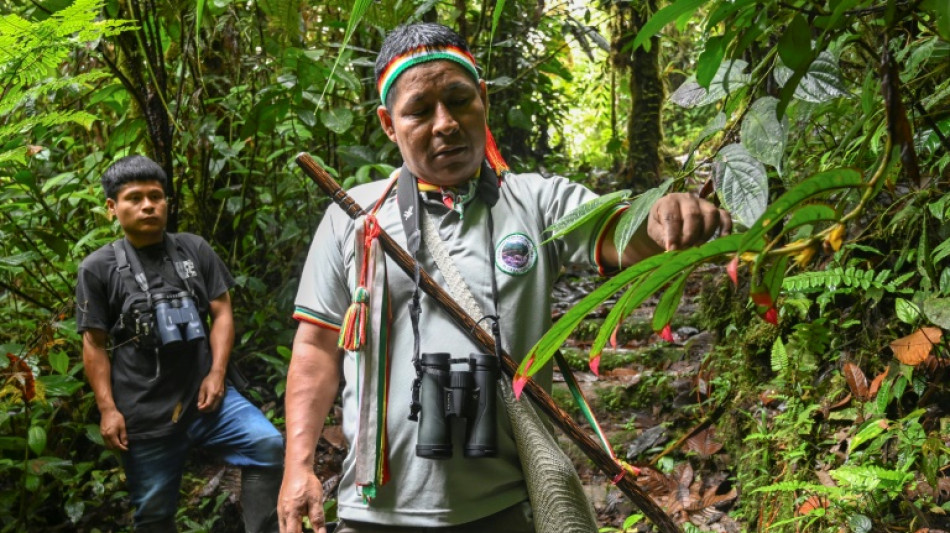
Colombia's Awa people resist violence, maintain 'spiritual bond' with nature / Photo: JOAQUIN SARMIENTO - AFP

 Kenya reports first-ever Ebola death

 Tennis world No.1 Sinner's season over due to knee injury

 Yemen's Houthis claim attack on Riyadh airport, deny losing territory

 7-Eleven exits India amid mounting competition

 The alleged murder by US marine on Okinawa: five things to know

 End of an era as Messi prepares to hang up Argentina boots

 Superstar duo headline strong New Zealand squad for Rugby League World Cup

 South Korea warns of possible AI use in banking hacks

 EU vows AI rules will protect Europeans. Will they?

 Myanmar leader to visit Malaysia after migrant returns begin
 Germany's AfD poised to preside over state assembly for first time
 Australia's opposition vows 'largest cut to immigration' in country's history
 Ready, set, snooze: Sleep-deprived Japanese compete for best-rested

 Falcons thump Saints 45-24 as New Orleans marks Katrina anniversary

 Tuvalu govt adviser says Australia overstepped in pre-COP visit

 Asian stocks mixed despite tech-led Wall St record

 Tens of thousands expected in Paris for high school protests

 AI borrowing binge rattles US markets

 Young Canadians sue government over alleged climate failures

 White Sox down Guardians to take 2-0 series lead

 NHL record-breaker Ovechkin says current season will be his last
 France roar back in Nations League as Italy beat Turkey

 Messi readies for final farewell in Argentina send-off
 Esposito seals Italy win over Turkey in Nations League

 Russia downplays plague reports as Trump offers US help

The Awa of Colombia are an Indigenous people who have been threatened by armed groups in the country's southwestern rainforests for decades, but insist on protecting the environment they say they are "connected" to.
As environmental policy leaders gather for a major biodiversity meeting in the South American nation, the Awas embody the struggle for survival of native peoples and the defense of the jungle.
"The Awa people have been resisting for 500 years. Against invasion, discrimination, armed groups, forced recruitment and displacement, acculturation," said Olivio Bisbicus, one of the leaders of this community of nearly 50,000.
"Being an Awa chief is complicated and dangerous," he said. "Drug trafficking brings vice, territorial disharmony and the destruction of our culture and nature."
The group's full name, Inkal Awa, means "People of the jungle" in their ancestral language.
They live in the mountainous rainforest of Colombia and in neighboring Ecuador.
"Three armed groups are fighting over this strategic border region, a drug trafficking corridor to the Pacific" that is also dotted with illegal gold mines, Alex Javier Gonzalez, an official with the Narino governorate, told AFP.
The situation is "critical for the Awas," he said.
- 'Risk of extinction' -
The Colombian justice system has documented 25 years of violence against the Awas, who have been caught up in the conflict with the FARC guerrilla army, warning of a "risk of physical, cultural and spiritual extermination."
Between 1990 and 2016, the guerrillas killed 185 Awas. The murders continued after a 2016 peace agreement.
At least 22 members of the group were killed in 2022, including a prominent leader who was shot dead by the men with whom he was supposed to negotiate.
Many of Colombia's Indigenous communities "are at risk of extinction" due to pressure from criminal groups involved in drug cultivation and trafficking, Jan Egeland, secretary general of the Norwegian Refugee Council, told AFP.
"The violent competition for the land is so fierce," he said.
In early 2023, the ombudsman's offices of Colombia and Ecuador issued a joint warning regarding the future of the Awa people.
The Colombian Constitutional Court has repeatedly called for their protection.
But fresh violence claimed the lives of three more Awa men at the end of August, according to Unipa, an organization representing them.
"And yet they are holding on," Gonzalez said. "The Awas have managed to maintain control over their lands."
- 'Spiritual bond' -
Gilles Bertrand, the European Union ambassador to Colombia, describes their group's struggle as "emblematic."
"They show great courage," he said.
Armed with only sticks and an ethos of non-violence, the Unipa Indigenous guard, made up of 2,000 volunteers, works to protect nature.
"In the face of weapons, we are empty-handed. But we have dialogue, and our ancestral knowledge, our identity, our authorities, our presence here for centuries," Bisbicus said.
"We have been able to maintain the unity of our people, and demand respect for our territory. Our land is not a battlefield," he added.
The Awas are also characterized by what they call a "spiritual bond" with their land.
"The territory is a living space, where we coexist with nature, animals and spirits. Nature is our mother," said Wilmer Rigoberto Bisbicus, a coordinator in Nutria, a private nature reserve.
At almost 1,000 meters (3,300 feet) above sea level, La Nutria hides an enchanting waterfall overlooking a lush valley.
"Here it rains a lot. This water is life," said Alvaro Pai, a guide at the reserve.
"The waterfall listens and heals you," he said.
Described by the European Union's ambassador as an "ambitious peace and ecotourism project," Nutria's 365 hectares are home to 185 species of birds, butterflies and frogs.
"We must take care of the earth, because we come from it, learn from it, and we will return to it," Olivio Bisbicus said.
"The further we move away from it, the more we harm ourselves."
A.S.Diogo--PC