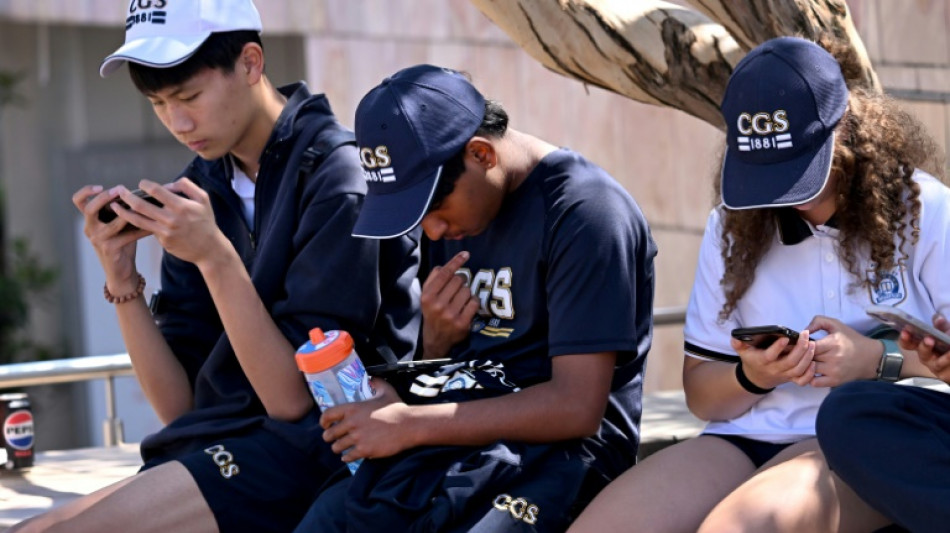
Social media companies slam Australia's under-16 ban / Photo: William WEST - AFP

 Moscow denies sanitary measures over plague reports
 Samoa look to recreate 2022 final run at Rugby League World Cup

 Asian stocks mostly up after tech-led Wall St record

 German factory orders plunge as recovery still fragile
 Coco Gauff calls out online racism following China open video review

 KVB Accelerates Middle East Footprint with Strategic MENA Regional Expansion
 Purple reign: Philippines seeks to keep grip on ube throne

 Seoul weighs steps to force North Korea landmine apology

 Yemen's Houthis say struck Riyadh airport, other Saudi sites

 Changer+ Launches Stablecoin-First Self-Custodial Wallet to Make Stablecoins Easier to Use

 White Sox down Guardians, Yankees on brink after Rays loss

 COP31 eyes modest steps as climate disasters multiply

 American Nobel laureate in medicine hopes to illuminate the brain

 Trump approves firing squad for convicted US military base shooter

 Grappling with 'homework scams,' US universities shun AI detectors

 Separatists win Quebec election in test for Canada PM

 Leaders visit Pacific atoll at frontline of climate change

 Yemen's Houthis claim striking Riyadh airport, other Saudi sites

 Best-selling British author Jeffrey Archer dies aged 86

 Military plane crash kills 32 in Nigeria

 Olise powers France to win over Belgium in Nations League
 High-flying Blazy turns to birdlife at Chanel

 Riyadh's allies pledge troops as Yemen, Saudi Arabia attack Houthis

 Clashes erupt outside Kosovo parliament over war crimes court
 Milan's Saelemaekers suffers ankle setback, faces lengthy spell out

Social media giants on Friday hit out at a landmark Australian law banning them from signing up under-16s, describing it as a rush job littered with "many unanswered questions".
The UN children's charity UNICEF Australia joined the fray, warning that it was no "silver bullet" and could push kids into "covert and unregulated" spaces online.
Prime Minister Anthony Albanese said the ban may not be implemented perfectly -- much like existing alcohol restrictions -- but it was "the right thing to do".
The crackdown on sites like Facebook, Instagram and X, approved by parliament late Thursday, will lead to "better outcomes and less harm for young Australians", he told reporters.
Platforms have a "social responsibility" to make children's safety a priority, the prime minister said.
"We've got your back, is our message to Australian parents."
Social media firms that fail to comply with the law face fines of up to Aus$50 million (US$32.5 million).
Meta -- owner of Facebook and Instagram -- and other companies said that despite the law's perceived shortcomings, they were keen to engage with the government on shaping how it would be implemented in 12 months.
"We are concerned about the process, which rushed the legislation through while failing to properly consider the evidence, what industry already does to ensure age-appropriate experiences, and the voices of young people," Meta said in a statement.
- 'Unanswered questions' -
The legislation offers almost no details on how the rules will be enforced -- prompting concern among experts that it will simply be an unenforceable, symbolic piece of legislation.
Meta called for consultation on the rules to ensure a "technically feasible outcome that does not place an onerous burden on parents and teens".
A Snapchat spokesperson said the company had raised "serious concerns" about the law and there remained "many unanswered questions" about how it would work.
But the company said it would engage closely with government to develop an approach balancing "privacy, safety and practicality".
"As always, Snap will comply with any applicable laws and regulations in Australia," it said.
UNICEF Australia policy chief Katie Maskiell cautioned that the ban was not a "silver bullet".
Young people need to be protected online but they also need to be included in the digital world, Maskiell said.
"This ban risks pushing children into increasingly covert and unregulated online spaces as well as preventing them from accessing aspects of the online world essential to their wellbeing," she said.
- Global attention -
One of the biggest issues will be privacy -- what age-verification information is used, how it is collected and by whom.
Social media companies remain adamant that age-verification should be the job of app stores, but the government believes tech platforms should be responsible.
Exemptions will likely be granted to some companies, such as WhatsApp and YouTube, which teenagers may need to use for recreation, school work or other reasons.
The legislation will be closely monitored by other countries, with many weighing whether to implement similar bans.
Lawmakers from Spain to Florida have proposed social media bans for young teens, although none of the measures have been implemented yet.
China has restricted access for minors since 2021, with under-14s not allowed to spend more than 40 minutes a day on Douyin, the Chinese version of TikTok.
Online gaming time for children is also limited in China.
C.Cassis--PC