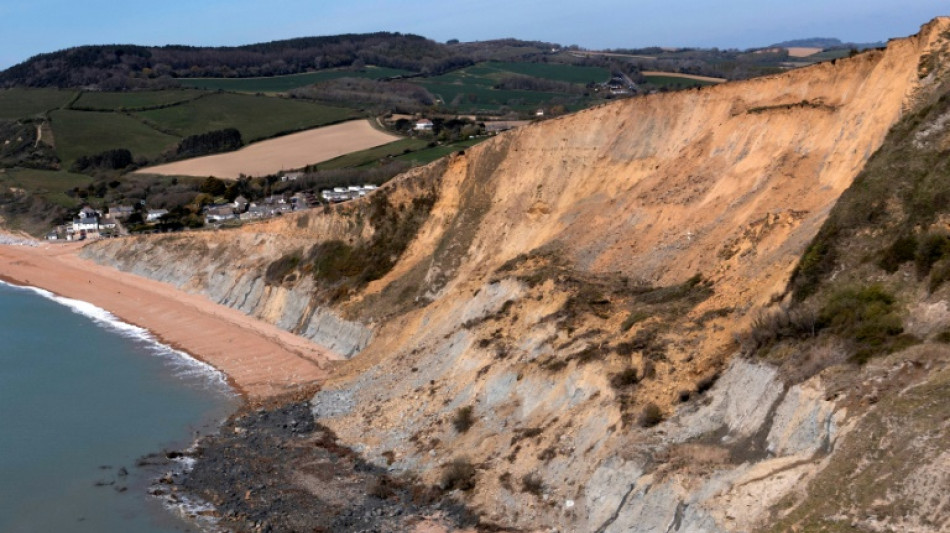
Society centred around women in UK during Iron Age: scientists / Photo: BEN STANSALL - AFP/File

 Ready, set, snooze: Sleep-deprived Japanese compete for best-rested

 Falcons thump Saints 45-24 as New Orleans marks Katrina anniversary

 Tuvalu govt adviser says Australia overstepped in pre-COP visit

 Asian stocks mixed despite tech-led Wall St record
 Tens of thousands expected in Paris for high school protests

 AI borrowing binge rattles US markets

 Young Canadians sue government over alleged climate failures

 White Sox down Guardians to take 2-0 series lead

 NHL record-breaker Ovechkin says current season will be his last
 France roar back in Nations League as Italy beat Turkey

 Messi readies for final farewell in Argentina send-off
 Esposito seals Italy win over Turkey in Nations League

 Russia downplays plague reports as Trump offers US help
 Trump says US moved bombers from UK base after 'threats'
 Brazilian stocks surge to record after Bolsonaro election lead

 Leaders to visit Pacific atoll at frontline of climate change

 ICC gives more details about arrest warrants for Taliban ministers
 Nigeria's Tinubu confirms 32 dead after military plane crash

 'Reckless' AI firms can't control models, says whistleblower

 Switching on brain cells: the Nobel-winning science of optogenetics
 Quebec votes as separatist surge poses test for Canada PM

 Euro slides as concerns about French debt mount

 Former Trump press secretary Leavitt joins Fox News

 Djokovic advances to China Open final as Medvedev out for hitting fan with ball

 Disgraced former US House speaker dies at 84
Scientists analysing 2,000-year-old DNA have revealed that a Celtic society in the southern UK during the Iron Age was centred around women, backing up accounts from Roman historians, a study said Wednesday.
When historians such as Tacitus and Cassius wrote about Rome conquering Britain from around AD 44 to 84, they described women holding positions of power.
These include the famous warrior queen Boudica, who started an uprising against Roman occupation, sacking and burning several cities including Londinium -- which would one day become London. There was also Cartimandua, the 1st-century queen of the Brigantes people in northern England.
Julius Caesar, in his account of the Gallic Wars written more than more than century earlier, also described Celtic women participating in public affairs, exercising political influence -- and having more than one husband.
"When the Romans arrived, they were astonished to find women occupying positions of power," said Miles Russell, an archaeologist at Bournemouth University and co-author of the new study in Nature.
Some had doubted these accounts, suggesting "that the Romans exaggerated the liberties of British women to paint a picture of an untamed society," he told AFP.
"But archaeology, and now genetics, implies women were influential in many spheres of Iron Age life," he said.
"Indeed, it is possible that maternal ancestry was the primary shaper of group identities."
- Men moved on, women stayed put -
For the study, the team of researchers analysed more than 50 genomes extracted from burial sites in the village of Winterborne Kingston in southern England's Dorset county, which was populated before and after the Roman conquest.
Iron Age cemeteries with well-preserved burial sites are rare in Britain, perhaps because the dead were often cremated, stripped of their flesh and organs, or simply "deposited in wetlands", the researchers wrote.
However the Durotriges tribe, which occupied the southern central coastal region of England between 100 BC and AD 100 -- and gave their name to Dorset -- were an exception, burying their dead in cemeteries.
Excavations carried out at these sites since 2009 had already yielded some clues about the high social status women held in the tribe.
The "well-appointed graves across the Dorset Iron Age" containing drinking vessels, mirrors, beads and other goods were all female -- except for one that included a sword, said Russell, who led the excavations.
The DNA analysis showed that most of the people buried at the site were related through their maternal line, going "back to a single woman, who would have lived centuries before", said lead study author Lara Cassidy of Trinity College Dublin.
However there were almost no connections down the paternal line.
"This tells us that husbands moved to join their wives' communities upon marriage, with land potentially passed down through the female line," Cassidy said in a statement.
Societies centred around women -- which ethnographers call a "matrilocality" -- are rare throughout this period of history.
Yet the researchers trawled through previous research and "found signatures of matrilocality in a number of cemeteries across Britain dating to the Middle and Late Iron Age," from around 400 BC onwards, Cassidy said.
"However, it is quite possible this system was also common in the early Iron Age or perhaps even earlier."
L.E.Campos--PC