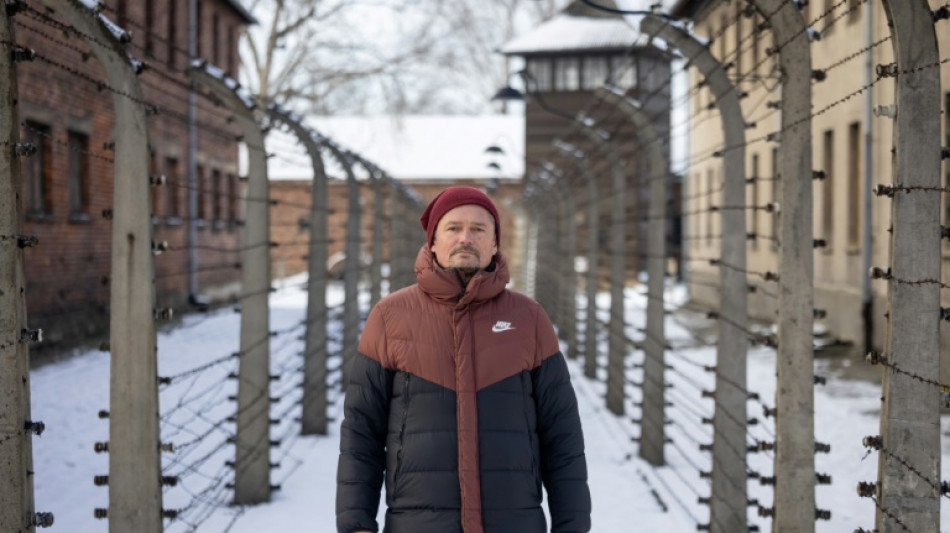
'Our mission': Auschwitz museum staff recount their everyday jobs / Photo: Wojtek RADWANSKI - AFP

 Ready, set, snooze: Sleep-deprived Japanese compete for best-rested

 Falcons thump Saints 45-24 as New Orleans marks Katrina anniversary

 Tuvalu govt adviser says Australia overstepped in pre-COP visit

 Asian stocks mixed despite tech-led Wall St record
 Tens of thousands expected in Paris for high school protests
 AI borrowing binge rattles US markets

 Young Canadians sue government over alleged climate failures

 White Sox down Guardians to take 2-0 series lead

 NHL record-breaker Ovechkin says current season will be his last
 France roar back in Nations League as Italy beat Turkey
 Messi readies for final farewell in Argentina send-off
 Esposito seals Italy win over Turkey in Nations League

 Russia downplays plague reports as Trump offers US help

 Trump says US moved bombers from UK base after 'threats'
 Brazilian stocks surge to record after Bolsonaro election lead
 Leaders to visit Pacific atoll at frontline of climate change

 ICC gives more details about arrest warrants for Taliban ministers

 Nigeria's Tinubu confirms 32 dead after military plane crash

 'Reckless' AI firms can't control models, says whistleblower
 Switching on brain cells: the Nobel-winning science of optogenetics
 Quebec votes as separatist surge poses test for Canada PM

 Euro slides as concerns about French debt mount
 Former Trump press secretary Leavitt joins Fox News

 Djokovic advances to China Open final as Medvedev out for hitting fan with ball
 Disgraced former US House speaker dies at 84

Barbed wire lines the road to work for Pawel Sawicki, deputy spokesman of the Auschwitz museum at the site of the former Nazi death camp that was liberated 80 years ago this month.
More than one million people died at the Auschwitz-Birkenau camp built by Nazi Germany when it occupied Poland in World War II -- most of them Jews, but also non-Jewish Poles, Roma and Soviet soldiers.
Around 850 people work at the museum to preserve their memory, a job with more emotional baggage than your usual nine-to-five.
"They say that when you start working here, either you leave very quickly because the history is too much or you stay for a long time," said Sawicki, who is in charge of social media at the museum and has worked there for 17 years.
"It helps if you find some meaning to the mission," the 44-year-old told AFP.
Sawicki's office is located inside a former hospital for the Nazis' notorious SS.
Behind the building there is an old gas chamber and farther on stands the camp's "Arbeit Macht Frei" (Work Will Set You Free) gate.
To cope with the heavy emotional toll of working at Auschwitz, Sawicki said he has put up "a sort of professional barrier" that keeps him sane, even if it cracks from time to time.
- Not a word -
Jacek Paluch, a longtime Auschwitz tour guide, said he makes sure to leave his "work at work" to avoid going crazy.
"But it's a special job, and a special place. It's impossible to leave all the history behind and not take it home with you," he told AFP.
The 60-year-old said he leads up to 400 groups of visitors each year around the former death factory.
More than 1.8 million people from across the world visited Auschwitz last year.
The museum offers tours of the site in more than 20 languages, led by around 350 guides.
The hardest, most emotional moments for Paluch are his encounters with former prisoners.
Once, Paluch came across a man sitting silently -- and unresponsive to questions -- on a bench, his arm tattooed with his former inmate number.
"His whole life, he never spoke a word to his family about what had happened here. Then, suddenly, at one Sunday breakfast, he began to talk," Paluch said.
"They stopped him and took him here so that he could tell his story where it happened," he continued.
"But when he walked through the 'Arbeit Macht Frei' gate, the memories came back. He went quiet again and no longer wanted to talk about any of it."
- 'Importance as evidence' -
Paluch said he knows when the job has taken its toll.
"A sign of fatigue, not necessarily physical but more mental, is when I have dreams at night that I'm leading groups," he said.
"That's when I realise I need to take some time off."
Wanda Witek-Malicka, a historian at the museum's research centre, had for years focused on child inmates of Auschwitz. But she had to abandon the difficult subject when she became a mother.
"At that moment, this particular aspect of Auschwitz history -- children, pregnant women, newborns -- I was in no state to handle it," she told AFP.
"The emotional weight of the site and the history was too much for me," the 38-year-old added.
Were the museum staff to reflect on the site's history round the clock "we'd probably be unable to get any work done".
Elsewhere at the site, conservator Andrzej Jastrzebiowski examined some metal containers once filled with Zyklon B, the poison gas used to kill inmates at Auschwitz.
He recalled his anger early on -- he has worked at the museum for 17 years -- when he had to conserve objects that had belonged to the Nazis.
"Later, I realised these objects had importance as evidence of the crimes committed here, and maintaining them is also part of our mission here," the 47-year-old told AFP.
- 'Give them a voice' -
Jastrzebiowski and his colleagues at the high-tech conservation department are responsible for preserving hundreds of thousands of items, including shoes, suitcases, metal pots, toothbrushes, letters and documents.
Most of the items had belonged to inmates before being confiscated upon arrival.
The conservators are also responsible for preserving the camp barracks, the barbed wire, and the remnants of the blown up crematoriums and gas chambers and other ruins at the site.
It is work of utmost importance, especially at a time when the number of living former inmates is dwindling fast.
"Soon there will be no more direct witnesses to testify and all that will remain are these items, and they will have to tell the history," said Jastrzebiowski.
"Our job is to give them a voice."
When he works on an item, he tries to discover the object's peculiarities to keep the job from becoming a mindless routine.
"It helps me to think of the items' owners, their stories," he told AFP.
"Most of all, it's the opposite of what the Nazis had wanted -- that their memory vanish, that they disappear forever."
E.Paulino--PC



