
With new 'Aida' staging, Met tries out grandiose opera for the contemporary age / Photo: ANGELA WEISS - AFP

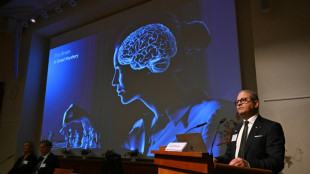
 American Nobel laureate in medicine hopes to illuminate the brain
 Trump approves firing squad for convicted US military base shooter

 Grappling with 'homework scams,' US universities shun AI detectors

 Separatists win Quebec election in test for Canada PM

 Leaders visit Pacific atoll at frontline of climate change

 Yemen's Houthis claim striking Riyadh airport, other Saudi sites

 Best-selling British author Jeffrey Archer dies aged 86

 Military plane crash kills 32 in Nigeria

 Olise powers France to win over Belgium in Nations League

 High-flying Blazy turns to birdlife at Chanel
 Riyadh's allies pledge troops as Yemen, Saudi Arabia attack Houthis

 Clashes erupt outside Kosovo parliament over war crimes court

 Milan's Saelemaekers suffers ankle setback, faces lengthy spell out

 Rubio arrives in Iceland to push for greater US presence in Arctic

 Putin allows Italy's UniCredit to sell part of Russian business

 Djokovic into China Open final as Medvedev out for hitting fan with ball

 ICC unseals arrest warrants for Taliban education ministers

 Modric hopes fans back Croatia against Spain after England shame

 Bolsonaro rides right-wing surge into Brazil's election runoff

 Turkey blocks X account of British reporter

 Ukraine says using AI robot guns to shoot down new Russian drones

 At Oct 7 memorial, Netanyahu says will be no Hamas rule in Gaza
 Ukraine blames Russia for deadly sinking of Turkish ship in Black Sea
 UN rights council slams Taliban's 'oppression' of women

 Norway eyes partial ban of smart glasses
"Aida" has long epitomized opera at its most extravagant -- think sweeping sets, luxurious costumes and even real-live horses, an experience intended to transfix the audience with grandeur.
A beloved version of that scale helmed the Met for more than three decades -- so staging a new production of "Aida," a tale of love, war and loyalty set in ancient Egypt, was a tall order.
"Because Aida is so big and so expensive... I did definitely feel the pressure of that," director Michael Mayer told AFP in a recent interview of his production that premiered this month, adding that "I knew that there were audiences who wanted the big spectacle."
Verdi's "Aida" also has long faced criticism of Orientalism, that it offers an exoticized, reductive view of Egypt through an othering Western lens.
Addressing that was among Mayer's tasks -- to "acknowledge, even in a gentle way, the kind of imperialism and colonialism associated with a kind of fetishization of ancient Egypt," he told AFP.
"When you look at the history of Grand Opera, you see a lot of operas that are set in exotic locales," he said, citing "Aida" along with "Madama Butterfly," set in Japan, and "Turandot," set in China, as prime examples.
"There's the sense that that those cultures could be fetishized. We appreciate the beauty of them, but in modern times now, I think we're all much more conscious of Orientalism and colonialism and imperialism and the idea that these cultures were taken apart and reappropriated -- and potentially inappropriately so," Mayer said.
"And I think that contemporary audiences are not going to just swallow it hook, line and sinker, without some kind of acknowledgement that there's a complexity involved."
- 'Fresh and new' -
Mainstream critics of the new production have been, well, critical -- but refreshing a pillar of traditional opera is a delicate balance, Mayer said.
And part of that balance is toeing the line between reaching new opera-goers and satisfying the old guard -- or, how to revamp a traditional opera for a contemporary age, without losing what made it adored to begin with.
And on top of that, it has to have staying power -- a staple of the repertoire that can satiate audiences for seasons to come.
Mayer's approach to the piece involves presenting it through the eyes of a team of archaeologists unearthing an ancient tomb, before the tale of star-crossed lovers, warring empires and treason unfolds in full color.
At one point, the archaeologists are seen looting the tomb of its treasures, a reminder of the colonial context.
"I feel like my job was to be able to deliver the beautiful spectacle that audiences who love that about 'Aida' could get" he said, while also aiming to "contextualize it."
"My dream is that I can give everyone enough that it will turn them on, maybe for the first time," said Mayer, a director who in addition to working in opera has long worked on Broadway.
"I feel like if someone's coming to the opera for the first time, and they're seeing this 'Aida,' and they're like, 'Oh my God, that's like a Broadway show on crack, I can't wait to come back' -- then I feel like mission accomplished," he said.
Capturing the hearts of those audiences is vital for the art -- and the bottom line of institutions like the Met.
"The future of the opera in America is really in the hands of the young people," Mayer said.
"They have to feel like they're seeing something fresh and new," he continued, "and not living their fear, which is that they're going to go and see a museum piece that has nothing to say to them and has nothing to say to the moment that we're in."
A.Motta--PC