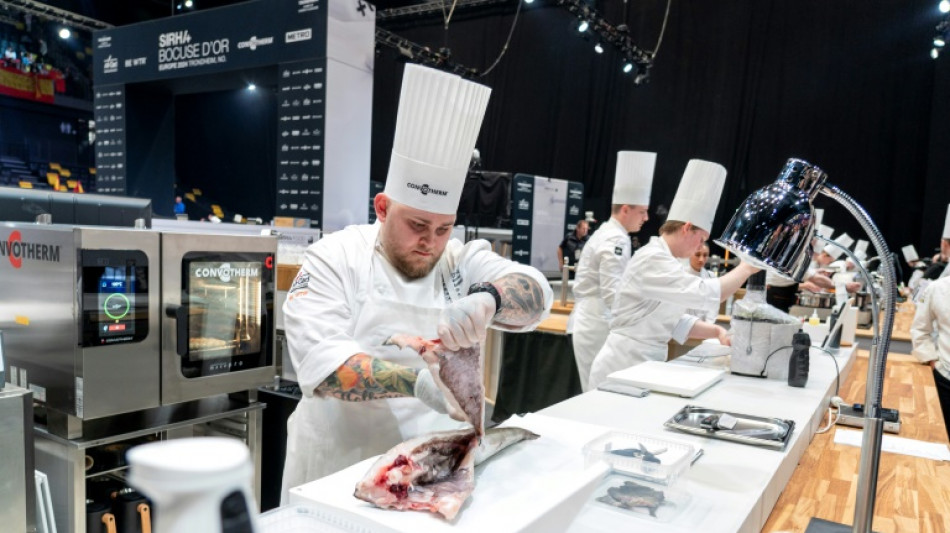
Denmark's Sebastian Holberg sets sights on Bocuse d'Or win / Photo: Gorm Kallestad - NTB/AFP

 Thanksgiving storms disrupt thousands of US flights

 T.J. Lang criticises Aaron Rodgers over comments about Mike McCarthy

 Qatar Tourism and Uber Sign Five-Year Mobility Partnership

 U2 pays tribute to Dolly Parton during Thanksgiving Eve NFL show

 Rare yellow-bellied sea snake found on Southern California beach

 Second-generation Mini Cooper SE set for India launch with 402km range

 Filmasia 2026: 16 Films Across Prague, Brno, and České Budějovice

 Kojey Radical Launches Burger Collaboration at Dallas Burger Joint in Shoreditch

 Kelly Stafford Reflects on Matthew's Lions Thanksgiving Era Ahead of Rams' Netflix Debut

Danish chef Sebastian Holberg Svendsgaard struggled at school as a child but loved competing -- a skill he'll put to the test when he goes for gold at gastronomy's Olympic Games, the Bocuse d'Or.
"Now it is my time to shine," the 25-year-old with tattooed arms told AFP before the competition in Lyon, France, on Monday involving 24 hopefuls.
Holberg has been a member of Denmark's Bocuse d'Or team since 2019 and won the European title in 2024.
Raised in a small town southwest of Copenhagen, the youngest contestant in this year's competition said he was often bored at school.
"I was not good in school, not at all. I was in the bottom," he said.
"I was dyslexic, I had to get a lot of help. So I had to find my passion. I had to find something I was good at."
He spent a lot of time with his father, a butcher and amateur hunter, and eventually his calling dawned on him.
"When my dad shot a deer, at home we tried to cook it a fun way. I think I was 12 when I figured out, OK, I have to be a chef," he recalled.
Holberg left school in his mid-teens to enrol in culinary school.
While on a study trip, he discovered his love of cooking competitions at student contests.
"I remember the intensity... I said to myself, one day I have to be standing there."
Danish chefs have won the Bocuse d'Or three times, placing Denmark third in the overall standings behind France, with eight wins, and Norway, with five.
This year, the competition's theme is "gastronomic heritage".
The requirements for the dishes the contestants must prepare are very detailed and restrictive this year, he noted.
"But of course, the creativity can still be there."
- Months of preparation -
Holberg attributes Scandinavia's culinary success to its chefs' respect for flavours.
"For example, take an apple. We'll figure out the best an apple can taste in respect of the apple.
"But what makes apple better? Maybe a bit of horseradish, maybe a bit of kohlrabi. So we're trying to keep the same flavour but give it the energy back," he explained.
For competition day, which lasts five and a half hours, Holberg insists he has "moved the limits for what is possible" -- and has left nothing to chance.
"We're going to make all the food on the day but everything has been tested for seven months," he said.
"So by that time, the food is perfect. We know when we're boiling a potato slice, we'll slice it perfectly every time, three millimetres."
Christophe Parisot, France's ambassador to Denmark, said he was impressed by the Danes' dedication to the competition.
"It's interesting to see just how much effort Danes put into it," he told AFP.
"They've understood the power and influence that gastronomy can have on a country," he said, adding that haute cuisine "conveys a very positive image of France".
- Viking adaptability -
Francis Cardenau, a Denmark-based French chef and head of the Danish delegation at the Bocuse d'Or, said Denmark's gastronomic breadth boils down to its chefs' ability to adapt.
"Scandinavians are very flexible, malleable. They're Vikings. They're used to travelling," he said.
"They go to other countries to see what tool boxes are being used, then they see if there is something they can bring back and use in their own tool box."
This curiosity and adaptability enables them to develop a food culture in a region that has little gastronomic tradition.
"We are building the country's culture," Cardenau said.
Once the Bocuse d'Or is over, Holberg has vowed to spend more time on life outside the kitchen.
"This is the biggest thing I can do for myself and I can do in my professional career as a chef. I have to be good in Lyon!" he said.
But after that, he will focus on a new chapter.
"Afterwards, the new dream is to do everything for my son."
C.Amaral--PC
