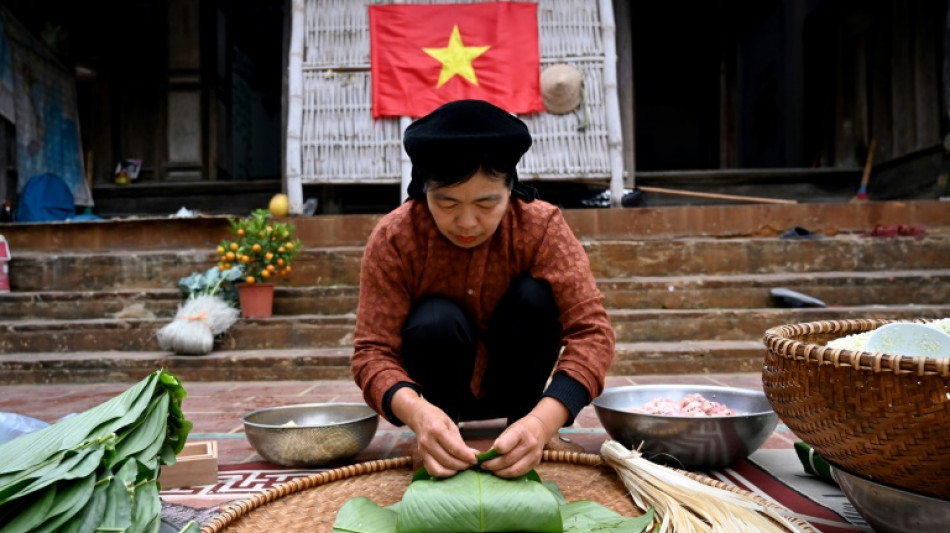
Sticking with tradition: Vietnam's glutinous 12-hour Tet cake / Photo: Nhac NGUYEN - AFP

 Thanksgiving storms disrupt thousands of US flights

 T.J. Lang criticises Aaron Rodgers over comments about Mike McCarthy

 Qatar Tourism and Uber Sign Five-Year Mobility Partnership

 U2 pays tribute to Dolly Parton during Thanksgiving Eve NFL show

 Rare yellow-bellied sea snake found on Southern California beach

 Second-generation Mini Cooper SE set for India launch with 402km range

 Filmasia 2026: 16 Films Across Prague, Brno, and České Budějovice

 Kojey Radical Launches Burger Collaboration at Dallas Burger Joint in Shoreditch

 Kelly Stafford Reflects on Matthew's Lions Thanksgiving Era Ahead of Rams' Netflix Debut

Exhausted after 12 hours of cooking, Nguyen Thi Thuy Hong gently unpeels the last of five leaves encasing a squishy, sticky rice cake known as "banh chung" -- a Lunar New Year delicacy in Vietnam.
The wrapped cakes of glutinous rice, green beans and pork belly have for centuries been one of several dishes prepared in a frenzy at home specially for Tet, the Vietnamese New Year which begins on Wednesday.
Hong, 55, has laboured over the dish -- which must be boiled for 12 hours over a wood fire -- almost every year for the last four decades.
"We can buy ready-made banh chung but it doesn't create that Tet atmosphere," she said, explaining she enjoyed the process of cleaning leaves, soaking rice and pre-cooking beans in the very early morning.
"It keeps me busy, and it's tiring, but I still love making the cake myself."
According to an oft-told legend, the banh chung recipe was first prepared thousands of years ago by a Vietnamese prince who wanted to impress his father in a bid for the throne.
Pleased with the cake's flavour and impressed with his son's demonstration of respect, the king duly handed down his crown.
The banh chung are often laid at family altars as an offering to ancestors, who are widely venerated in Vietnam -- a communist country that is officially atheist but still steeped in Confucian social mores.
Many families no longer make them from scratch but for those that keep the tradition, the work usually falls to the elders of the family.
Hong's 23-year-old son Nguyen Dao Anh Khoi is already fretting over taking the helm.
"Our generation has so many other things to worry about, so I am not sure I can keep this up," he told AFP as he rinsed a mound of rice under an outside tap at their Hanoi home.
For now, he is happy to enjoy the rich and comforting cooking of his mother.
A self-described healthy eater who often prefers Western dishes, Khoi makes an exception for banh chung.
"It's a bit fatty and too starchy," he said. But "it's also delicious."
"I can't imagine a Tet without banh chung."
P.L.Madureira--PC
