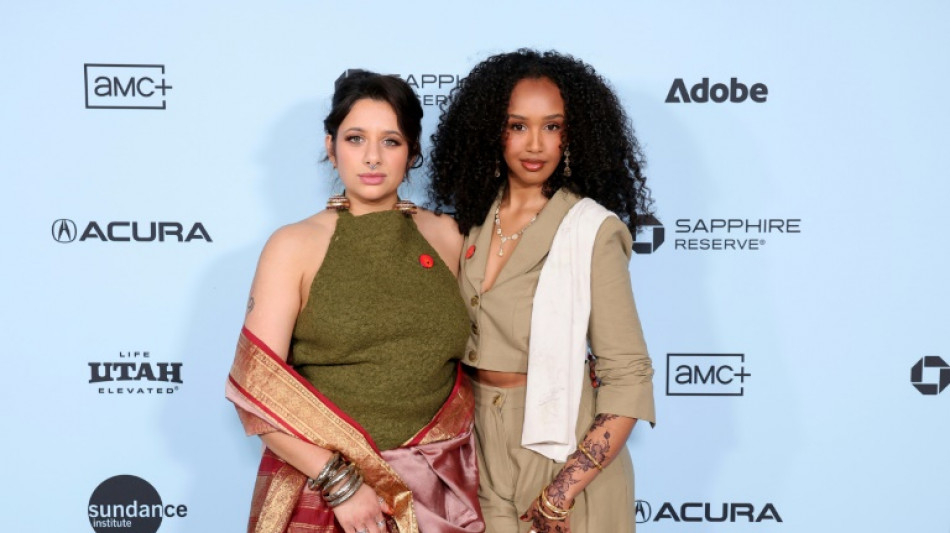
New film explores radicalization from perspective of IS 'Brides' / Photo: Maya Dehlin Spach - GETTY IMAGES NORTH AMERICA/AFP

 American Nobel laureate in medicine hopes to illuminate the brain
 Trump approves firing squad for convicted US military base shooter

 Grappling with 'homework scams,' US universities shun AI detectors

 Separatists win Quebec election in test for Canada PM

 Leaders visit Pacific atoll at frontline of climate change

 Yemen's Houthis claim striking Riyadh airport, other Saudi sites

 Best-selling British author Jeffrey Archer dies aged 86

 Military plane crash kills 32 in Nigeria

 Olise powers France to win over Belgium in Nations League

 High-flying Blazy turns to birdlife at Chanel

 Riyadh's allies pledge troops as Yemen, Saudi Arabia attack Houthis

 Clashes erupt outside Kosovo parliament over war crimes court
 Milan's Saelemaekers suffers ankle setback, faces lengthy spell out
 Rubio arrives in Iceland to push for greater US presence in Arctic
 Putin allows Italy's UniCredit to sell part of Russian business
 Djokovic into China Open final as Medvedev out for hitting fan with ball

 ICC unseals arrest warrants for Taliban education ministers
 Modric hopes fans back Croatia against Spain after England shame

 Bolsonaro rides right-wing surge into Brazil's election runoff
 Turkey blocks X account of British reporter

 Ukraine says using AI robot guns to shoot down new Russian drones

 At Oct 7 memorial, Netanyahu says will be no Hamas rule in Gaza
 Ukraine blames Russia for deadly sinking of Turkish ship in Black Sea

 UN rights council slams Taliban's 'oppression' of women
 Norway eyes partial ban of smart glasses
It has been 10 years since a teenage Shamima Begum and two friends secretly left Britain to marry Islamic State group fighters in Syria.
Over the past decade Nadia Fall, a British theater director of Muslim heritage, has watched the polarizing and vitriolic debate about Begum's infamous case, online radicalization, and who is to blame.
"We kept thinking 'well these are girls, these are children really, legally,'" said Fall, who began work on a film project with writer Suhayla El-Bushra.
"The stories never really were (told) from their point of view."
The resulting new drama, "Brides," which premiered at the US-based Sundance festival and is loosely inspired by their story, is an attempt to change that.
As much a road movie about friendship as it is political, the film follows two fictional Muslim teenagers on their journey through Turkey, to Syria.
"Brides" does not concern itself so much with what happens in Syria, but how and why the girls traveled there in the first place.
Doe and Muna suffer racist bullying at school. They live in a neighborhood where graffiti scrawled on the wall says "Behead All Muslims." Their parents are abusive, emotionally or physically.
They convince each other that the men waiting for them in Syria will treat them with more respect than they experienced back home.
"This is not an apologist film," said Fall.
But "teenage brains are hardwired to take risks," and the girls "were duped" by shadowy online voices who falsely purported to represent Islam, she said.
- 'Empathize' -
The subject matter continues to be divisive.
Last year, Begum lost a high-profile bid to appeal the stripping of her British citizenship.
She was 15 years old when she travelled to Syria. Now 25, Begum has not been able to return from a refugee camp in northern Syria.
Tabloid newspapers, who have consistently called Begum a "vile fanatic" who has "no place on our soil," celebrated the latest court ruling.
Rights groups argue that Begum should answer for any crimes in her home country.
While the film's characters are not specifically based on Begum, the influence is clear.
Actress Safiyya Ingar grew up in London's Hackney, "ten minutes from where those girls are from."
Co-star Ebada Hassan listened to a BBC podcast to study Begum's infamous case.
"I thought it was imperative to get a person's point of view who'd been through that, instead of just using what I've seen in the media for this portrayal," she said.
"It was nice to hear her voice. I tried to empathize with her before filling these shoes.
But, she added, "I'm not trying to pretend to be her -- at all."
- 'Monsters' -
Fall believes that young people including Begum have been treated differently by the UK government, legal system and media due to their faith and skin color.
"We didn't want to regurgitate stories about radicalization and so on. But we just thought it was our story to tell," said Fall.
Like most films at Sundance, the movie is up for sale to potential distributors.
Fall believes the subject remains urgent, as the divisive forces that drove the girls' terrible decisions are stronger than ever.
"It's not gone away, this idea of 'us versus them', 'these people are different,' and trying to exploit other people feeling marginalized,'" said Fall.
"It doesn't have to be Syria," she warned.
A.F.Rosado--PC