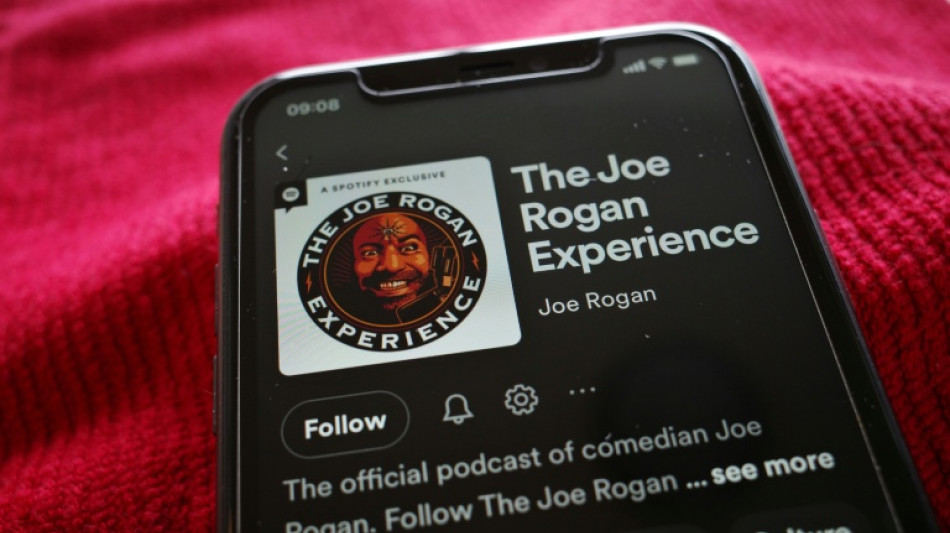
Influential podcasts fuel 'harmful' health misinformation / Photo: MANDEL NGAN - AFP

 American Nobel laureate in medicine hopes to illuminate the brain

 Trump approves firing squad for convicted US military base shooter

 Grappling with 'homework scams,' US universities shun AI detectors

 Separatists win Quebec election in test for Canada PM

 Leaders visit Pacific atoll at frontline of climate change

 Yemen's Houthis claim striking Riyadh airport, other Saudi sites

 Best-selling British author Jeffrey Archer dies aged 86

 Military plane crash kills 32 in Nigeria

 Olise powers France to win over Belgium in Nations League

 High-flying Blazy turns to birdlife at Chanel

 Riyadh's allies pledge troops as Yemen, Saudi Arabia attack Houthis

 Clashes erupt outside Kosovo parliament over war crimes court
 Milan's Saelemaekers suffers ankle setback, faces lengthy spell out

 Rubio arrives in Iceland to push for greater US presence in Arctic

 Putin allows Italy's UniCredit to sell part of Russian business
 Djokovic into China Open final as Medvedev out for hitting fan with ball

 ICC unseals arrest warrants for Taliban education ministers

 Modric hopes fans back Croatia against Spain after England shame

 Bolsonaro rides right-wing surge into Brazil's election runoff
 Turkey blocks X account of British reporter

 Ukraine says using AI robot guns to shoot down new Russian drones
 At Oct 7 memorial, Netanyahu says will be no Hamas rule in Gaza
 Ukraine blames Russia for deadly sinking of Turkish ship in Black Sea

 UN rights council slams Taliban's 'oppression' of women

 Norway eyes partial ban of smart glasses
Unfounded cancer cures, dubious anti-vaccine narratives, and false claims that neurological disorders can be "reversed" through diets: influential American and European podcasters are peddling harmful health misinformation while largely escaping scrutiny, researchers say.
The problem will come under the spotlight this week as Robert F. Kennedy Jr, a vaccine skeptic with a longstanding reputation of promoting health misinformation, faces US Senate grilling over his nomination to be President Donald Trump's health secretary.
Falsehoods on podcasts, which experts warn are fueling mistrust in conventional medicine, often go unchecked as fact-checkers must sift through hours of transcripts.
They can quickly be amplified when short clips extracted from podcasts ricochet across social media.
Earlier this month, actor and director Mel Gibson said on the Joe Rogan Experience -- the number two podcast on Spotify in the United States -- that some of his friends had overcome stage four cancer after taking the antiparasitic drugs ivermectin and fenbendazole.
The Canadian Cancer Society said those treatments were "not scientifically proven," adding that such misinformation was "dangerous" as it gives false hope to people battling the disease.
The podcast garnered millions of views, while posts focused on Gibson's claim spread across platforms such as Facebook, X, and Instagram, AFP's fact-checkers reported.
- 'Off the cuff' -
With podcasts easy to launch, huge volumes of audio content are being produced.
"The nature of medium itself makes it challenging to detect misinformation and also makes it more likely that false claims will circulate," Valerie Wirtschafter, a fellow at the Brookings Institution in Washington, told AFP.
"Often these conversations are really off the cuff, which is part of their authentic appeal, longer than your average media clip, and more frequent -- sometimes for hours, multiple times a day."
A study she published in 2023 examined over 36,000 episodes produced by 79 prominent podcasters. It found that one out of every 20 episodes -- and more than 70 percent of those podcasters -- included at least one "unsubstantiated or false claim."
And with the popularity of podcasts soaring around the world, the phenomenon is not limited to the United States.
In December, a BBC investigation found that prominent host Steven Bartlett was amplifying health misinformation on "Diary of a CEO," his top-ranked podcast on Spotify.
Its analysis of 15 health-related episodes found that each contained an average of 14 "harmful health claims."
Flight Studio, the podcast production company owned by Bartlett, told the broadcaster their guests were offered "freedom of expression" and were "thoroughly researched."
- 'Duty of care' -
One London-based fitness coach, Richard Holley, told AFP he was drawn to a "Diary of a CEO" episode that featured a guest advocating for a keto diet to treat cancer.
Holley said he did not feel the need to "fact-check" the dubious claim, floated casually as a lifestyle recommendation rather than scientific fact, but added in hindsight that "one has to be cautious."
Podcasts reaching millions of listeners are a lucrative business, with Bartlett telling UK media his show was expected to generate 20 million pounds ($25 million) last year, mainly from advertising.
Some leading podcasters regularly featuring guests accused of undermining evidence-based medicine -- and failing to challenge them -- have created financial incentives to amplify misinformation, experts say.
"Prominent podcasters have invested in wellness and health ventures at the same time as they have given airtime to health misinformation," Cecile Simmons, a researcher at the Institute for Strategic Dialogue, told AFP.
Last year, a Rogan-backed health supplement company was hit with a lawsuit over false advertising about one of its products, which was regularly promoted on his podcast.
Researchers say the medium, which has also strongly influenced political discourse, has long been poorly regulated for accuracy.
In a rare action in 2023, YouTube removed a video of podcaster Jordan Peterson interviewing Kennedy for violating its policy prohibiting vaccine misinformation.
"Given podcasts' reach and popularity, we need to think about how to ensure duty of care towards users, while preserving some of the creative freedoms that the medium allows," said Simmons.
burs-ac/des/sms
C.Amaral--PC