'Incomprehensible': Red Cross museum fears closure amid Swiss funding cuts / Photo: Fabrice COFFRINI - AFP

 American Nobel laureate in medicine hopes to illuminate the brain
 Trump approves firing squad for convicted US military base shooter

 Grappling with 'homework scams,' US universities shun AI detectors
 Separatists win Quebec election in test for Canada PM

 Leaders visit Pacific atoll at frontline of climate change

 Yemen's Houthis claim striking Riyadh airport, other Saudi sites

 Best-selling British author Jeffrey Archer dies aged 86

 Military plane crash kills 32 in Nigeria

 Olise powers France to win over Belgium in Nations League
 High-flying Blazy turns to birdlife at Chanel

 Riyadh's allies pledge troops as Yemen, Saudi Arabia attack Houthis
 Clashes erupt outside Kosovo parliament over war crimes court

 Milan's Saelemaekers suffers ankle setback, faces lengthy spell out

 Rubio arrives in Iceland to push for greater US presence in Arctic
 Putin allows Italy's UniCredit to sell part of Russian business
 Djokovic into China Open final as Medvedev out for hitting fan with ball

 ICC unseals arrest warrants for Taliban education ministers
 Modric hopes fans back Croatia against Spain after England shame
 Bolsonaro rides right-wing surge into Brazil's election runoff

 Turkey blocks X account of British reporter

 Ukraine says using AI robot guns to shoot down new Russian drones
 At Oct 7 memorial, Netanyahu says will be no Hamas rule in Gaza
 Ukraine blames Russia for deadly sinking of Turkish ship in Black Sea

 UN rights council slams Taliban's 'oppression' of women
 Norway eyes partial ban of smart glasses
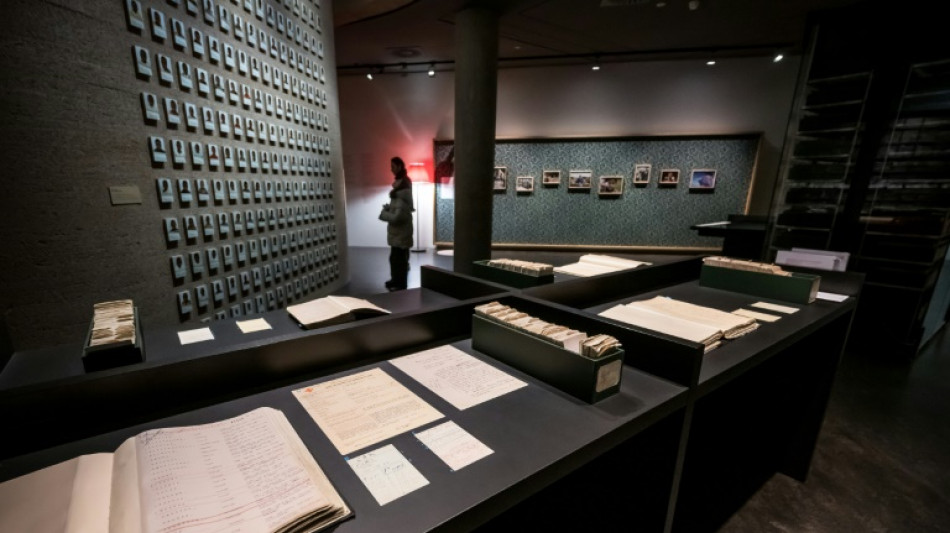
The Red Cross museum in Geneva is warning that it risks closure after its funding was axed in a broad government cost-cutting plan, with some suggesting it could be moved to Abu Dhabi.
The International Red Cross and Red Crescent Museum has been a national institution in Switzerland for nearly four decades, playing a key role in promoting and explaining international humanitarian law and principles in the birthplace of the Geneva Conventions.
Museum director Pascal Hufschmid said he was shocked to learn last September that the fate of the museum was, apparently inadvertently, being threatened by a small administrative measure in a government savings drive.
"It jeopardises the very existence of the museum," the Swiss historian, who took the helm of the institution in 2019, told AFP in a recent interview.
The museum, built adjacent to the International Committee of the Red Cross (ICRC) headquarters, opened in 1988. It welcomes around 120,000 people annually, ranging from elementary school classes to visiting dignitaries.
It keeps a collection of around 30,000 objects, including the first Nobel Peace Prize medal, given in 1901 to Red Cross founder Henry Dunant, an award shared with the French pacifist Frederic Passy.
It also houses the archives of the ICRC's International Prisoners of War Agency, established to restore contact between people separated during World War I, which have been listed on UNESCO's Memory of the World Register.
- 'Incredible heritage' -
"Through this incredible heritage," Hufschmid said, the aim is to create "a dialogue on what humanitarian action means on a daily basis".
He said the Swiss government had long recognised the value of the museum, and its role in telling "the story of an idea born in Switzerland, of major figures of Swiss history", like Dunant.
Since 1991, the private museum has received an annual subsidy from the Swiss foreign ministry of 1.1 million francs ($1.2 million), accounting for about a quarter of its overall budget.
But a general cost-cutting measure, proposed by a group of experts and approved by the government last September, included the decision to transfer responsibility for subsidising the museum to the culture ministry.
At first, Hufschmid said he was not too concerned at what appeared to be merely an administrative change, until he realised "the transfer actually meant a major reduction of the subsidy".
This was because the culture ministry requires museums seeking its funding to take part in a competition, facing off against hundreds of other museums.
When successful, Hufschmid said, museums typically obtain a subsidy of "between five and seven percent of their expenses, (which) in our case would mean approximately 300,000 francs".
- 'Structural deficit' -
"Suddenly, I understood that we would be facing a structural deficit starting 2027, (and) that we would have to close," he said, calling the situation "totally incomprehensible".
He said the government decision was taken as Switzerland marked the 75th anniversary of the adoption of the Geneva Conventions, and amid warnings of dwindling respect for international humanitarian law.
Hufschmid has since been lobbying parliamentarians and decision-makers with ideas to save the museum.
The Geneva canton has stepped up its support, and parliamentarians both at the regional and national levels have voiced support for the institution -- but so far the threat of closure remains.
Hufschmid has proposed nationalisation among other possible solutions.
Others have raised the possibility of moving the museum, with suggestions that Abu Dhabi, which hosts other museums including an outpost of the Louvre, could house its collection.
But Hufschmid said such a move "doesn't make any sense".
"We were shocked when we heard that, because we are so deeply connected to Swiss identity, to Swiss heritage, to ideas born in Switzerland... (as) the depository state of the Geneva Conventions," he said.
"We are a Swiss museum and we will stay in Switzerland."
V.F.Barreira--PC