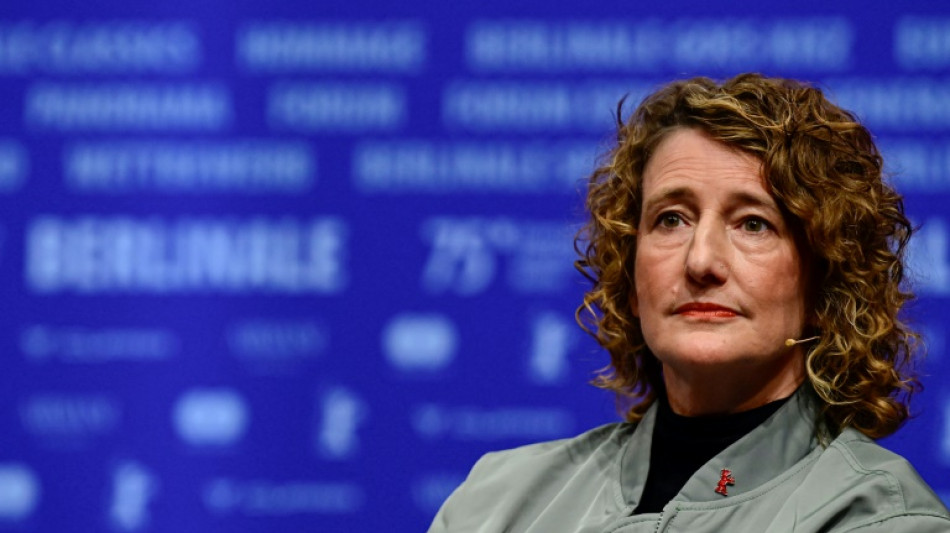
Cinema can be a 'refuge', Berlin film festival director says / Photo: John MACDOUGALL - AFP

 Malaysia Sues Google for $146m Over Harmful Content

 Black Wind Turbine Blades Reduce Bird Deaths by 74% in Spain Study

 Brazil’s Landless Movement Partners with China to Build Affordable Tractors for Family Farms

 Twickenham Grounds Team Prepares Pitch for Six Matches in Three Days

 Luxembourg Pay Rise Delayed as Regional and World Headlines Develop

 Audience to Choose the Set List at Luxembourg's First FAMIL Jukebox Night

 Raheem Sterling Receives Suspended Sentence After Lamborghini Crash

 Black Friday Discounts Cut Prices on Two Top-Rated Wiper Blades

 Arizona Gun Regulation Battle Intensifies Under New Democratic Legislative Majority
The new director of the Berlin film festival, Tricia Tuttle, spoke to AFP ahead of the opening, saying it would be an artistic "refuge" in the alarming age of Donald Trump.
She spoke about this year's selection of films competing for the Golden Bear, Germany's national election which falls on the final Sunday of the festival, as well as building up the impact of an event known for supporting arthouse productions.
- The Berlinale is often a very political festival. Do you want to keep that way or change it? -
I really want people talking about cinema. The news agenda has dominated every cultural event all over the world, particularly music. I don't think we can and should shy away from films that look at how troubled the world is and reflect that back to us.
I also think that I would love to have the films do the talking because I think that films can communicate with a complexity that we often lose in words. But I think it's people's right to speak freely as well.
- Do you fear that the German election campaign could interfere with the festival? -
I'm really trying to keep the festival insulated from that a little bit and not confronting election politics directly. The festival wants to not have that overshadow the films and filmmakers. I think what's important for us is that we encourage people to go out and exercise their democratic right to vote.
I will say that what we stand for is inclusion. I don't like the rise in parties all around the world which are expressing a lot of fear and stirring up a lot of fear against the kind of diversity and the pluralism that we've always stood for as a festival.
- Do you think that festivals like Berlin could serve as a shelter for artists in the age of US President Donald Trump? -
It's been three weeks of the Trump presidency. To say we're all alarmed is the biggest understatement. I don't think we've ever seen anything like this in our lifetimes, the rights disappearing so quickly and support systems for people disappearing so quickly.
I hope we can be a refuge of sorts. I think cinema, independent cinema is a refuge.
When choosing this year's movies, did you find the directors were especially pessimistic about the world?
No, not necessarily. I think in terms of world views, there's a lot of engagement with how complex the contemporary world is. Not so much with geopolitics specifically but just how complex it is.
It's so varied, but what I think I see in competition is filmmakers who are grappling with a very dark world and deciding to see some light and making a conscious choice to see some light in the world.
- What were your first words to jury president and director Todd Haynes? How would you define his mission ?
I've already spoken to him and we really hope that he and the jurors enjoy this selection as much as we did. I tried to free them a little bit from this idea that we are always saying about ourselves that we are a political festival.
I don't want to direct them not to make political choices, but I just want to make sure that they know that I think any jury must express a very personal response to those films.
We all see cinema in different ways and we want different things from our cinema and when you get seven people together I'm very interested in seeing what they choose for their Golden Bear.
How do you convince directors to come to Berlin, and not to the rival Venice or Cannes festivals?
I definitely think that in the last 10 years, there's been a shift towards the Anglophone awards season in the autumn. It's going to be a process of convincing major producers and major rights holders that we can help them launch some of their bigger titles as well.
The whole industry is geared towards the last six months of the year right now. But, you know, Cannes is a big and beautiful festival and Venice is a big and beautiful festival. I think there's room in the universe for all of us to launch really exciting films into the world.
X.M.Francisco--PC