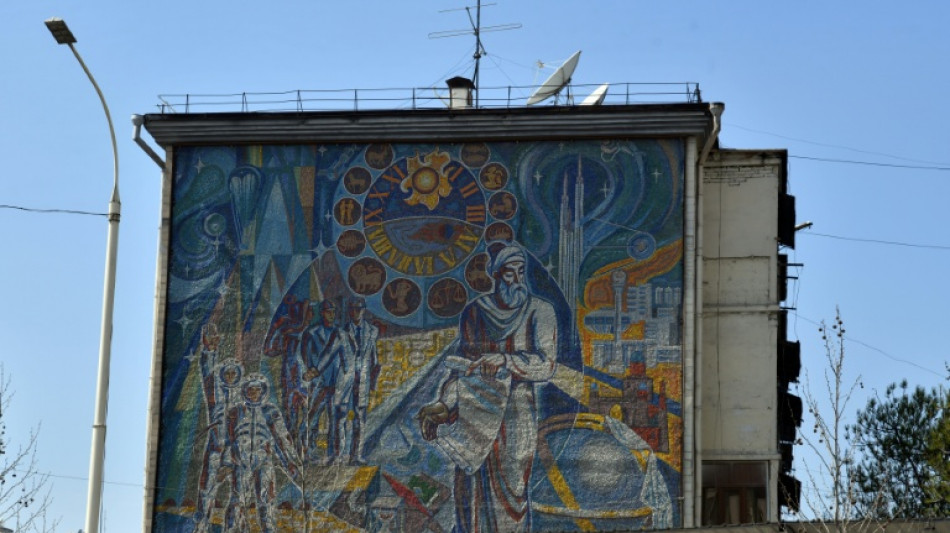
Soviet architecture vanishes as Central Asia drifts from Moscow / Photo: STRINGER - AFP

 'Glad it's over': Kim powers to Games gold and military exemption

 After 11 World Cups, football finally comes home for one Indian fan

 Marc Marquez wins sprint at Japan MotoGP, Martin grabs pole
 Alcaraz fends off Arnaldi to reach Japan Open quarters
 Antonelli tops times in final practice at Bahrain GP
 Gauff digs deep to beat Osorio in China Open second round
 Fresh protests to hit Spain after housing measures defeated
 'He's here with me': Japan cycle queen dedicates gold to late brother

 Japan Olympic chief says 'lot more' athletes at Games than expected

 Asian carmakers besting US rivals at home, China poised to strike

 Widgets & Web Offers All-Inclusive Investor Relations Websites for Public Companies, IPOs and SPACs

 Adams named new US captain to 2030 World Cup

 China a better influence in Latin America than US: poll

 Judge pauses construction of border project in Texas national park

 Belgium's De Bruyne fires double to sink Turkey, France held by Italy

 US jobs data boosts stocks as oil prices dip

 US Supreme Court to hear high-stakes climate case

 Trump expected to name intel chief Clayton as AI czar: reports

 Argentina unveils passports-for-investment scheme

 Brazil election debate chaos sparks censorship row

 England's Carse charged by cricket body over nightclub incident

 Amazon vows $1 bn for data center towns, decries 'myths'

 Oil prices drop on G7 fuel release, US jobs data boosts stocks
 G7 agrees deal to ease global energy supply concerns
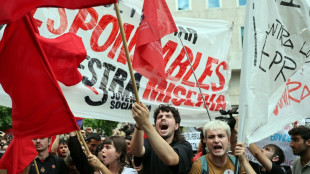 Spain's government dealt blow as lawmakers reject housing bills
On the facade of an apartment block in Tajikistan's capital Dushanbe, a giant mosaic depicting cosmonauts and engineers celebrates the scientific triumphs of the Soviet Union.
Like so many other relics of the Soviet past in Central Asia, it is doomed to vanish amid a distancing from Russia and a top-down drive to boost national culture.
"If we could only carefully remove it and put it on the building that will be built here. That would be good," said Rakhmon Satiev, who lives in the apartment.
His wish will not come true. The block is about to be demolished to make way for a gleaming new residential complex, and the mosaic is to be torn down.
Over the past decade, Central Asia has shown little interest in preserving its Soviet heritage. Architectural landmarks and art, including mosaics, frescoes and sculptures, have been rapidly demolished.
"If a building is old and does not fit into the new city plan, it is torn down. The city is being rebuilt and renovated, and the past is vanishing," Dzhamshed Dzhuraev, a mosaic artist in Tajikistan, told AFP.
Hidden from view in the courtyard behind his studio stands a monument to Vladimir Lenin, the founder of the USSR -- an awkward reminder of an era that no longer fits with the times.
- 'No longer necessary' -
The five Central Asian former Soviet republics -- Kazakhstan, Kyrgyzstan, Uzbekistan, Tajikistan and Turkmenistan -- became independent with the collapse of the Soviet Union 35 years ago.
Their urban landscapes have since turned into a chaotic mix of new high-rises, Stalin-era neoclassicism, dilapidated shacks and stalled construction sites.
Altynai Kudaibergenova, a co-founder of Artkana, a rare initiative group working to preserve Kyrgyzstan's architectural heritage, said the number of lost monuments was "striking".
She fears for the visual future of the capital Bishkek, which still has "magnificent examples of socialist-modernist architecture".
The style is popular on social media, particularly among tourists.
This architectural overhaul is being driven by ideology, which leaves no space for Soviet remnants.
The region's largely unchallenged leaders brand themselves as the founders of a new era and are cementing their own legacies with fresh symbols of power.
Few say outright that is what's going on.
Still economically dependent on Russia -- even as China muscles into the region -- officials frame the demolition drive as cost-efficient.
They say renovating crumbling Soviet-era buildings is more expensive than starting from scratch, and that the region urgently needs more housing for its rapidly growing population of some 80 million.
In the Tajik capital Dushanbe, the mayor -- the son of the president -- "is doing everything possible to make the buildings as beautiful and comfortable as he can," prominent Tajik sculptor Safarbek Kosimov told AFP.
Soviet-era mosaics were "no longer necessary," he added.
There are no such qualms about portraits of 73-year-old strongman leader Emomali Rakhmon -- which have replaced many of the torn-down facades.
- Ideological art -
Critics lament the campaign.
"Most Soviet mosaics were designed to convey an ideological message, but their artistic value is also important," activist Kudaibergenova said.
"Unfortunately, businesses are rarely receptive to such considerations. Their main priority is selling square metres at a high price."
Real-estate deals in the region are often marked by corruption and collusion between officials and business interests, according to several nonprofits and international organisations.
In Bishkek, painter Erkinbek Bolzhurov is worried about the fate of the House of Artists, which stands next to the former national printing house -- of which now only the walls remain.
"We want the city to develop, of course, but not at the expense of our memory," he told AFP.
"Great artists worked inside these walls. That is what makes the building unique -- it has a history."
Freedom of expression is tightly controlled in Central Asia, and authorities rarely consult with the public.
Despite the current trend, Tajik mosaic artist Dzhuraev wants to believe that "the time will come" when mosaics will once again adorn buildings.
"Architects and urban planners should pay them more attention," he said -- a "revival" of mosaics is still possible.
G.M.Castelo--PC