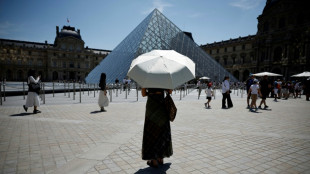
Legacy of Himalaya's 'Sherlock Holmes' lives on in digital / Photo: Prakash MATHEMA - AFP

 Split loyalties for Indian football fans at Brazil friendly

 India-Pakistan blockbuster brings cricket fever to Japan baseball field

 Wong waiting on Rafa after winning Asian Games tennis gold

 With Russia next door and rising costs, Latvia goes to the polls

 Penalty hero rues empty seats as Games hosts Japan win football gold

 North Korea fires ballistic missile after Seoul's apology demand

 US regulator finds Boeing 737 MAX software bug 'not a safety concern'

 Ohtani 'managing' injuries as Dodgers launch MLB post-season

 Botched US execution leaves murderer unconscious on ventilator: lawyers

 Cornell rape case exposes sexual violence at US colleges
 France held by Italy in Zidane's homecoming after Olise stunner

 Ethiopian pro-government militia claims Tigray airport as regional tensions spike

 Ohtani shaking off injuries as Dodgers launch MLB post-season
 Sea levels to rise in California as coastal wave surges up west coast
 New rallies urged in France as protests disrupt over 730 schools

 Djokovic survives China Open scare, Sabalenka starts strong

 King Charles to evoke colonial 'darkest days' on Caribbean tour
 Tesla shares jump after global car sales top estimates

 DR Congo Ebola outbreak killed more than 4,000: official figures

 Djokovic survives China Open scare against wildcard world no. 104

 Lula, Bolsonaro trade blows in final scramble for votes in Brazil

 New clashes erupt as protests disrupt over 560 French schools

 NY governor vows to close loophole after alleged Cornell gang rape

 Ethiopia Tigray rebels pushed back as regional tensions spike

 Stocks rise, yields fall as US job numbers disappoint

In a crowded Kathmandu restaurant far from Nepal's famed icy peaks, Billi Bierling questions climbers about their ascents, preserving each triumph in the Himalayan Database, mountaineering's revered 60-year-old register of success.
German climber Bierling, 58, inherited the stewardship of the archive from her mentor, the late Elizabeth Hawley, an American journalist who began the post-expedition interviews in Nepal while covering an American Everest expedition in 1963.
"It was her fascination," Bierling told AFP, after interviewing a Russian and a Ukrainian climber about their ascent of Manaslu, the world's eighth-highest mountain.
"She never climbed," Bierling said. "She never even went to a base camp -- but the people interested her."
Hawley's 50 years of chronicling climbs in the Himalayas earned her the moniker "the Sherlock Holmes of the mountaineering world" from Edmund Hillary, who with Tenzing Norgay made the first summit of Everest.
By the time she passed away in 2018, she had built a reputation as one of the most authoritative voices on Himalayan mountaineering.
The database she began had become the definitive record of Himalayan expeditions -- used by climbers, historians and researchers alike.
"She was very, very keen on her data, on her information," said Bierling, who first met Hawley in 2001 -- when she was in Nepal to climb the 7,129-metre (23,390-foot) Baruntse -- and began assisting her in 2004.
She described how Hawley would give the same grilling to all -- whether a climbing legend or an unknown.
"It didn't matter whether you were Reinhold Messner or you were Ueli Steck," she said, referring to the Italian great who made the first solo ascent of Everest, as well as the late Swiss speed climber.
"Or if you were Billi Bierling, a nobody," she said with a smile.
Bierling is now part of the team that continues her work, updating the vast database year after year.
At a time when each year more climbers are attempting the world's highest peaks than ever before, the task of recording the ascents is even more important.
- '40 drawers of reports'-
But times have changed.
In the 1970s, Hawley would drive to Kathmandu's airport in her blue Volkswagen Beetle, spotting those carrying the tell-tale heavy mountaineering boots as they walked off the two or three international flights a week.
Soon, it was the mountaineers who would seek her out.
In 1991, American climber Richard Salisbury, recognising the archive's historical importance and fragility, proposed digitising it.
It took nearly 11 years, Salisbury told AFP, a painstaking effort to convert "nearly 40 full file drawers" of meticulous handwritten expedition reports into a searchable digital resource.
"It was very important for a mountaineer to have their summit recorded in the Himalayan Database," said Garrett Madison, who has organised expeditions in Nepal since the 2000s, speaking to AFP from Everest base camp.
"If it wasn't recorded, it didn't happen."
Japanese climber Tatsuro Sugimoto, in Kathmandu after completing the first ascent of the 6,473-metre (21,237-foot) Jarkya, said the database was key for mountaineers seeking new records and routes.
"It is useful; we can check which mountains are unclimbed," he said.
- 'Need an army' -
Its scale, like climbing, has expanded exponentially.
Commercial expeditions now send hundreds of climbers each season, some summiting more than one peak.
"At one point I thought, 'this is no longer possible'," Bierling said. "I would be only running around. More and more mountains were being commercialised."
The database now supplements its records with official expedition numbers from Nepal's Ministry of Tourism.
"If we wanted to meet everybody in person, we'd need an army of 100 people," Bierling said. "It's all so quick. People come and go, they fly in, they fly out."
Nepal has issued a record 492 Everest permits for foreigners this season, with a city of tents set up at the foot of the mountain for climbers and support staff.
The focus has shifted to significant ascents, including first summits or new routes that push boundaries.
"The interesting climbs we chase," she said.
But the database still follows one of Hawley's key principles: first, trust the climber.
"Only when doubt arises do we dig in and look into it," said volunteer Tobias Pantel, 39.
"Then we can check the topography in their photographs and if other climbers are contradicting the claims."
As a result, some climbs are tagged "disputed", said Bierling.
"I often wonder what would Miss Hawley say," she said.
P.Cavaco--PC