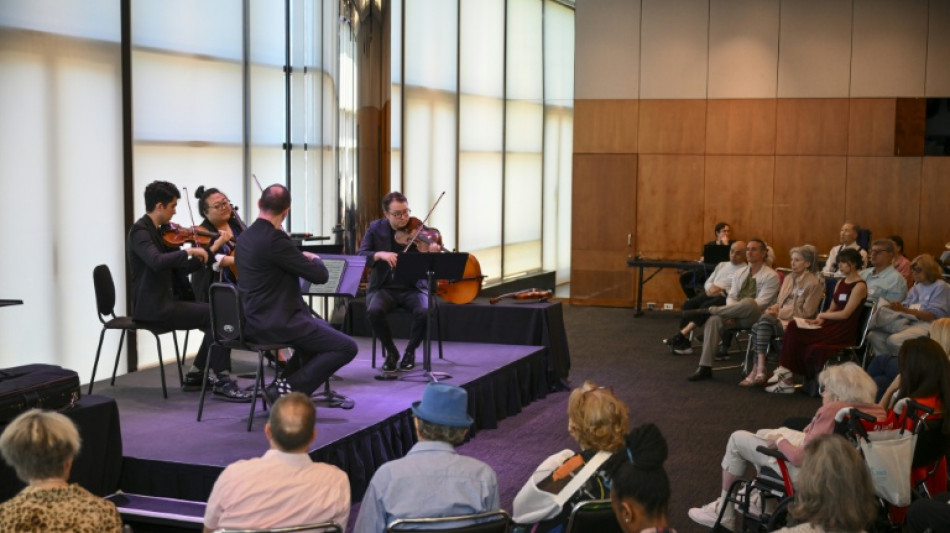
Musical therapy: Classical concerts in New York for dementia sufferers / Photo: ANGELA WEISS - AFP

 'He's here with me': Japan cycle queen dedicates gold to late brother

 Japan Olympic chief says 'lot more' athletes at Games than expected

 Asian carmakers besting US rivals at home, China poised to strike

 Widgets & Web Offers All-Inclusive Investor Relations Websites for Public Companies, IPOs and SPACs

 Adams named new US captain to 2030 World Cup

 China a better influence in Latin America than US: poll

 Judge pauses construction of border project in Texas national park

 Belgium's De Bruyne fires double to sink Turkey, France held by Italy

 US jobs data boosts stocks as oil prices dip

 US Supreme Court to hear high-stakes climate case

 Trump expected to name intel chief Clayton as AI czar: reports

 Argentina unveils passports-for-investment scheme

 Brazil election debate chaos sparks censorship row

 England's Carse charged by cricket body over nightclub incident

 Amazon vows $1 bn for data center towns, decries 'myths'

 Oil prices drop on G7 fuel release, US jobs data boosts stocks

 G7 agrees deal to ease global energy supply concerns

 Spain's government dealt blow as lawmakers reject housing bills

 Food, medicine shortages deepen in Russian-occupied Oleshky

 Man City whistleblower Rui Pinto facing 'dire consequences' - lawyers

 Russia 'tearing Kyiv apart', mayor says, as strikes paralyse traffic

 Taiwan boxer Lin wins Games gold as Japan edge North Korea on penalties

 Japan tame North Korea to win Games gold after shootout drama

 US posts weak job growth data in September

 Ethiopia's conflict: the regional dimension

In his early sixties, Rob Kaufman suffered a medical emergency that caused him to faint and hit his head on a wood floor, resulting in a traumatic brain injury.
He was put in a medically induced coma, his wife Ellen recounted to AFP, and was in intensive care for about a month. Nine weeks of extensive rehabilitation including speech therapy followed, and today he experiences significant short-term memory loss.
Music therapy proved invaluable in the rehab of the onetime studio musician who said he has played for the likes of Jimi Hendrix.
And today, the Kaufmans are regulars at a Manhattan concert program designed for individuals experiencing dementia symptoms.
The couple recently attended a 10th anniversary performance of the program that featured the Calidore String Quartet.
The musicians closed out the spring season to a packed house of some 100 people.
One audience member closed her eyes and mimed conducting as the artists played Mozart, while another tapped her caregiver's arm as if there were piano keys.
Lincoln Center, the famed arts complex on New York's Upper West Side, began the series "out of a need," said Miranda Hoffner, the insitution's accessibility director.
"We were hearing more and more from our subscribers at the Philharmonic and the Chamber Music Society that they weren't renewing their subscriptions because of dementia, as their family members were impacted," she told AFP.
"That was an audience that has really supported us for, in some cases, decades," she continued.
"We felt a responsibility to fill that gap."
- Aging population -
Dementia is an umbrella term for debilitating symptoms that can result in memory loss and impair movement and daily life.
Alzheimer's disease accounts for the majority of cases, but a range of risk factors and conditions can trigger it.
According to the World Health Organization, as of 2021 some 57 million people had dementia globally, with about 10 million new cases each year. The condition is progressive, and there is no cure.
Cases are rising in part because the Boomer generation -- people born during the post-World War II population surge -- have reached their senior years and generally are living longer than previous generations.
That means they're experiencing more of the chronic illnesses and health issues that can accompany old age.
Among them is dementia, said Emily Finkelstein, a geriatrics provider at the New York-Presbyterian medical center.
And especially in the United States -- with its expensive, sprawling healthcare system -- the broader social structures to care for this growing population of people with dementia is lacking, the doctor told AFP.
"It's a huge issue," she said.
Finkelstein pointed to copious data supporting the value of art, music and dance therapy for people with cognitive impairment.
But in the US, such programs are localized and for many people difficult to access.
"We don't have a national health program. It's much more cumbersome to streamline these types of programs, even though we know they're beneficial," Finkelstein said.
- 'Age in place' -
At Lincoln Center, the programming geared towards audience members with dementia and their caregivers is free.
An Alzheimer's caregiver support nonprofit has trained staff on how best to accommodate audiences and develop accessible shows by world-class artists.
"You will see people holding hands, you will see people tapping their feet, you will see people vocally participating in the music," Hoffner said.
Concerts are less formal and subdued than traditional classical music performances and are followed by workshops led by music therapists and teaching artists to encourage participation and imaginative engagement.
Hoffner said part of the goal is providing resources for seniors to "age in place" despite living in a famously chaotic city.
For one-time math and science teacher Rob Kaufman, now 73, the concerts have provided a means to, as his wife puts it, "come out of his shell."
"All of us are different than almost everybody else out there, so when we're in a community like this, we get to be different, and everybody's accepting," he said.
Ellen Kaufman said when she was first navigating her husband's new reality, there were less programs available.
"It means a lot for us to have this," she said. "For everyone here, it's not easy. I see what my friends are going through. They're watching their husbands change."
"But they do this with them -- they come out with them, and they're part of it."
G.M.Castelo--PC