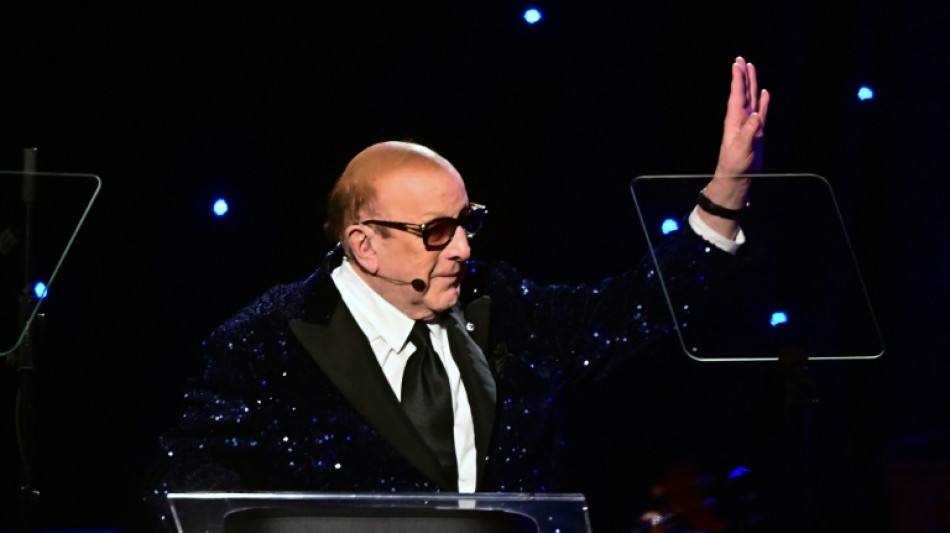
Clive Davis: the starmaker who shaped modern music / Photo: Frederic J. Brown - AFP/File

 'He's here with me': Japan cycle queen dedicates gold to late brother

 Japan Olympic chief says 'lot more' athletes at Games than expected

 Asian carmakers besting US rivals at home, China poised to strike

 Widgets & Web Offers All-Inclusive Investor Relations Websites for Public Companies, IPOs and SPACs

 Adams named new US captain to 2030 World Cup

 China a better influence in Latin America than US: poll

 Judge pauses construction of border project in Texas national park

 Belgium's De Bruyne fires double to sink Turkey, France held by Italy

 US jobs data boosts stocks as oil prices dip

 US Supreme Court to hear high-stakes climate case

 Trump expected to name intel chief Clayton as AI czar: reports

 Argentina unveils passports-for-investment scheme

 Brazil election debate chaos sparks censorship row
 England's Carse charged by cricket body over nightclub incident

 Amazon vows $1 bn for data center towns, decries 'myths'

 Oil prices drop on G7 fuel release, US jobs data boosts stocks

 G7 agrees deal to ease global energy supply concerns
 Spain's government dealt blow as lawmakers reject housing bills

 Food, medicine shortages deepen in Russian-occupied Oleshky

 Man City whistleblower Rui Pinto facing 'dire consequences' - lawyers

 Russia 'tearing Kyiv apart', mayor says, as strikes paralyse traffic

 Taiwan boxer Lin wins Games gold as Japan edge North Korea on penalties

 Japan tame North Korea to win Games gold after shootout drama

 US posts weak job growth data in September

 Ethiopia's conflict: the regional dimension

Clive Davis, the music mastermind who championed some of the globe's biggest names including Whitney Houston, Bruce Springsteen and Santana, died Monday aged 94.
An empathetic executive whose expertise transcended genres, he displayed an uncanny ability to spin talent into gold. Aretha Franklin once called him "the greatest record man of all time."
"Clive has the mind of a bank executive and the ears of a teenager," said Davis protege Barry Manilow, the singer-songwriter known for "Copacabana" and other easy listening hits.
A lawyer by education, Davis entered the music world as counsel at Columbia Records before shifting into management and in 1966 becoming president of the reorganized CBS Records.
It marked the start of a career that would come to define the modern music industry.
From Janis Joplin to Earth, Wind & Fire, Aerosmith to Billy Joel, Patti Smith to Alicia Keys, Davis discovered, mentored and catapulted an empire of artists to household name status, reigning for decades in a business where longevity is rare.
Grateful Dead singer Bob Weir even sometimes changed a lyric when performing the band's standard "Jack Straw" to honor Davis.
"We used to play for acid," he'd sing. "Now we play for Clive."
- 'No clue' -
Born April 4, 1932 in Brooklyn, Davis enjoyed music but did not see it as his professional future.
"The emphasis in Jewish families that did not have any money was that you've got to be a lawyer, or you've got to be a doctor," Davis said in the documentary "Clive Davis: The Soundtrack of Our Lives."
"I was going to be a lawyer, with no clue what being a lawyer meant."
He was a New York University student when personal tragedy struck: Davis's mother died suddenly and then his father passed within the following year.
He graduated from Harvard Law School and began working at a New York law firm. His move to CBS subsidiary Columbia Records as legal counsel proved pivotal.
"I knew nothing about music. I knew nothing about what awaited me," said Davis. "But I did seize that opportunity."
- 'Weakness for artists' -
CBS executives ultimately convinced him to change from law into management, and Davis took an interest in the burgeoning world of folk and rock.
He attended the storied Monterey Pop Festival, an experience he later described as life-changing.
Awestruck by Joplin and the social and musical revolution she embodied, Davis signed her that night.
He worked with Bob Dylan as well as Simon and Garfunkel, convincing the duo that the soft, melodic "Bridge Over Troubled Water" could be a radio hit, though it was far from the sounds on the airwaves at the time.
And Davis returned a demo to a young Springsteen, telling him it still needed a hit single.
So the rocker went to the beach and penned "Blinded by the Light" and "Spirit in the Night" in a single evening.
"That was a good call," Springsteen has joked.
Davis encouraged jazz legend Miles Davis -- who came to the executive furious that young white artists were profiting off styles pioneered by Black musicians like himself -- to play rock venues.
Shortly thereafter, the trailblazing trumpeter released "Bitches Brew," a seminal, rock-imbued album.
Davis had a "weakness for artists," said another groundbreaking musician, Patti Smith -- a Davis favorite who he signed to the record company he would eventually found, Arista.
- Whitney, his ultimate star -
Davis struck out on his own after CBS Records fired him in 1973, on charges, which Davis denied, of bankrolling personal expenses including his son's bar mitzvah.
Arista, which Davis started in 1974, featured stars including Manilow, Franklin, Dionne Warwick, Keys, The Kinks and Lou Reed.
And he made the eyebrow-raising decision to throw his weight behind Kenny G, convincing radio stations to play the solo saxophonist's music among pop songs.
Davis also forged a deal with Sean Combs -- the mogul known as "Diddy," who is now in prison on prostitution-related charges -- to start Bad Boy Records, one of hip-hop's foundational labels.
But for all the stars he launched, it was Davis's mentorship of Whitney Houston that would prove among the most significant.
She became one of the best-selling artists ever and great voices of her generation under his guidance, before her shock death the day of one of Davis's famed pre-Grammy galas.
It was another of the mogul's great personal tragedies.
"The loss of Whitney came about as suddenly as the loss of my parents," Davis said. "And profoundly reminded me how quickly and immediately vitally important people in your life can just disappear."
- Party of the year -
Married and divorced twice, Davis had four children, and publicly came out as bisexual in his autobiography.
After another skirmish with CBS over Arista and several more shake-ups and mergers in the industry, Davis landed the title of Chief Creative Officer at Sony Music Entertainment, where he remained into his later years.
His career was not without critics: an industry joke held that Davis's ego was so large he thought CDs were named after him.
But he was a music mainstay for well over half a century.
A Rock and Roll Hall of Fame inductee with an armful of Grammys, Davis for decades hosted a splashy signature pre-Grammy galas.
The bash remained one of the most coveted tickets in showbiz and included a private variety show put on by A-listers.
"Clive's Grammy parties, it's kind of more than just a party... it's kind of a historical event," said Berry Gordy, the storied founder of Motown Records.
Davis refused to retire.
"I don't continue to do things to prove a point," he told Rolling Stone in 2021. "I just do what I always did."
Ferreira--PC