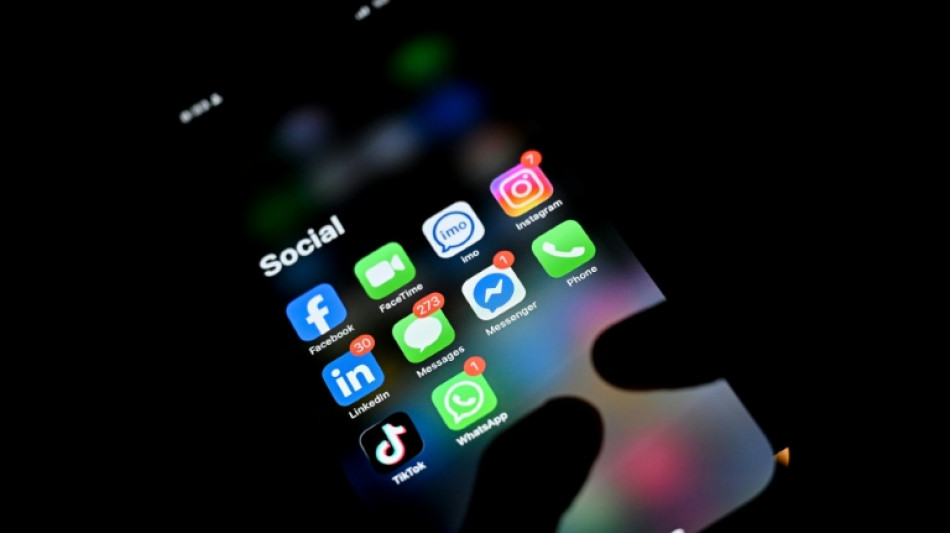
Australia teen social media ban has little impact: research / Photo: Ishara S. KODIKARA - AFP

 'He's here with me': Japan cycle queen dedicates gold to late brother

 Japan Olympic chief says 'lot more' athletes at Games than expected

 Asian carmakers besting US rivals at home, China poised to strike

 Widgets & Web Offers All-Inclusive Investor Relations Websites for Public Companies, IPOs and SPACs

 Adams named new US captain to 2030 World Cup

 China a better influence in Latin America than US: poll

 Judge pauses construction of border project in Texas national park

 Belgium's De Bruyne fires double to sink Turkey, France held by Italy

 US jobs data boosts stocks as oil prices dip

 US Supreme Court to hear high-stakes climate case

 Trump expected to name intel chief Clayton as AI czar: reports

 Argentina unveils passports-for-investment scheme

 Brazil election debate chaos sparks censorship row

 England's Carse charged by cricket body over nightclub incident

 Amazon vows $1 bn for data center towns, decries 'myths'

 Oil prices drop on G7 fuel release, US jobs data boosts stocks

 G7 agrees deal to ease global energy supply concerns

 Spain's government dealt blow as lawmakers reject housing bills

 Food, medicine shortages deepen in Russian-occupied Oleshky

 Man City whistleblower Rui Pinto facing 'dire consequences' - lawyers

 Russia 'tearing Kyiv apart', mayor says, as strikes paralyse traffic
 Taiwan boxer Lin wins Games gold as Japan edge North Korea on penalties

 Japan tame North Korea to win Games gold after shootout drama

 US posts weak job growth data in September

 Ethiopia's conflict: the regional dimension

Australia's social media ban for under 16s has had little impact on teenagers' scrolling habits, researchers said Thursday in one of the first evaluations of the world-leading measures.
Australia in December banned under 16s from the likes of Facebook, Instagram and TikTok, in a crackdown designed to protect children from online bullying and "predatory algorithms".
But there is little evidence to suggest teenagers have turned away from social media as a consequence, a team of Australia-based researchers found in a peer-reviewed study published by the British Medical Journal.
Underage users have been dodging the restrictions by using accounts registered to older people, setting up fake accounts, or by logging into private browsers.
"We found insufficient evidence to conclude that exposure to the Act had any early substantial effects on social media use among adolescents aged under 16," the researchers wrote.
There is strong global interest in whether Australia's laws could provide a blueprint for how to rein in increasingly powerful tech giants.
A growing mass of nations have either introduced or are mulling similar bans -- including the United Kingdom, Indonesia, the UAE and New Zealand.
The researchers surveyed more than 400 young social media users immediately before the restrictions came into effect, and again three months after.
There was little change for users aged 12-13, a slight decrease for the 14-15 age group, and an increase in use for those aged 16 and older.
"The findings suggest that the period immediately after the introduction of the act was characterised by limited implementation, incomplete compliance, and substantial circumvention of social media restrictions."
- Not 'impossible' -
Tech companies face fines of up to Aus$49.5 million ($34 million) if they fail to show meaningful efforts to weed out underage users.
Australia in March accused Facebook, TikTok and YouTube of failing to meet their obligations.
"Australia's world-leading social media laws are not failing. But big tech is failing to obey the laws," Communications Minister Anika Wells said at the time.
"None of this is impossible. None of this is even difficult for big tech, who are innovative billion-dollar companies."
The nation's eSafety Commission separately flagged "significant concerns" about Facebook, Instagram, Snapchat, TikTok and YouTube.
A growing body of research suggests too much time online is taking a toll on teen well-being, and Australia's ban has been hailed as a godsend for parents sick of seeing children glued to their phones.
Although platforms have pledged to abide by the laws, they have warned the measures could instead push teenagers into dark, unregulated corners of the internet.
Social media companies bear the sole responsibility for checking that Australia-based users are 16 or older, and must prove they have taken "reasonable steps" to weed out young teenagers.
Some platforms are using AI tools to estimate ages based on photos, while users can also choose to prove their age by uploading a government ID.
A.Magalhes--PC