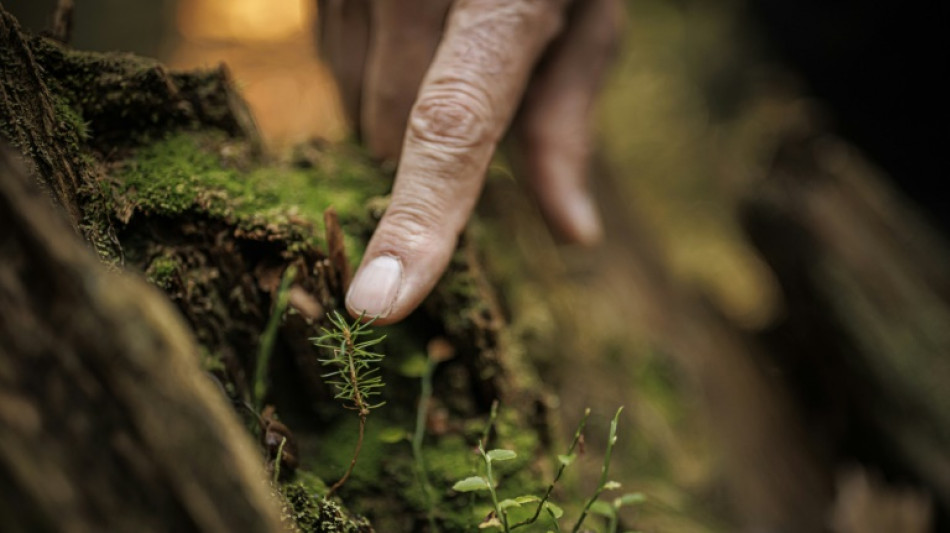
Climate's toll on trees threatens the sound of music / Photo: VALENTIN FLAURAUD - AFP

 Iran, US trade threats after fresh strikes

 US not 'stealing Venezuelan oil,' energy secretary insists

 Farming experts tout 'conscious' food systems to fix agriculture woes

 George Lucas unveils art galaxy at his new LA museum
 Veteran Wallaby Slipper targets fifth World Cup after Brumbies deal

 Sabalenka storms into US Open third round as Pegula, Medvedev advance

 Zverev looks to improve after first-round scare

 Raiders to start Cousins over top NFL Draft pick Mendoza

 Palantir chief says France's digital sovereignty push 'backfiring'

 US energy firms dominate Venezuela deals worth billions

 Iran, US trade threats after escalation in fighting

 US jury deadlocks again in Lindsay Clancy's child murder trial

 Lake America? No way, Canadians say
 Spain report flags Moroccan police failings in Ceuta migrant rush

 Tech bosses press G20 to build data centers, but split on risk

 Dolly Parton to get new Hollywood star after vandalism

 Trump 'happy' Prince Harry and Meghan have left US

 Michelson shocks Nakashima in US Open clash of rising Americans

 Another body recovered after ferry capsizes off northern Cyprus: official

 Cupertino Chamber President Claudio Bono Invited to White House with GiveaRoof 3-Year Plan to End Homelessness

 Trump floats renaming Strait of Hormuz as 'Trump Strait'

 Man City, Chelsea fuel record-breaking Premier League transfer window

 Balogun rejected Everton move over transfer 'treatment'

 Northampton seek 'happy medium' in bid to keep England star Pollock

 US energy secretary in Venezuela to sign Trump's 'biggest' oil deal

Stroking a tiny spruce sapling, Swiss forest ranger Francois Villard fears the tree will not withstand global warming and live to a ripe old age like its ancestors.
The Risoud Forest, covering the border between France and Switzerland some 1,200 metres (3,900 feet) up in the Jura mountains, is filled with spruce trees which are hundreds of years old.
Their wood is perfect for crafting acoustic guitars, violins and other string instruments, making it sought after by luthiers around the world.
But climate change has brought drier, warmer weather, threatening the special tonal qualities of the wood.
"I have never seen so many dry trees," says Villard, who is now approaching retirement.
He is saddened by the sight of so many spruces turning red, losing their needles and drying up, and by spending his days marking trees for felling.
"When I arrived here 30 years ago, there was an average annual temperature of five to six degrees Celsius (40-43 degrees Fahrenheit). Now we are well above that," he tells AFP.
Recent winters have been nowhere near as cold as before.
- Risoud resonance -
Spruces are the most common tree in Switzerland, and the hitherto stable climate in the Jura made the species perfect for producing tonewood for acoustic string instruments.
Stiff yet light softwoods like spruce are used to make soundboards -- the top of the instrument -- which amplifies the vibrations of the strings.
The soundboard must resonate easily with good tonal qualities, while resisting the strain of the strings on the bridge -- characteristics that spruce possesses better than other woods.
The trees that meet the criteria perfectly are exceptionally rare -- one in 1,000 or even 10,000, some say.
The tree must be 200 to 400 years old, and the bottom of the trunk must have a diameter of at least 50 centimetres (20 inches). It must be without knots or flowing resin.
The tree must have grown straight, slowly and, above all, with regular annual growth so that the tree rings are uniform and tight.
- Wood stock -
In the workshop of Swiss Resonance Wood, in the village of Le Brassus close to the French border, Quentin Durey sketches the outline of a guitar on a thin sheet of wood. Thousands more sheets are piled up to dry out over the years.
"There are about 2,000 guitar tops -- classical, romantic and folk guitars," explains company boss Theo Magnin.
The company sells to Europe, Japan and Mexico amongst other destinations.
But Magnin is worried.
"I don't know where people who make musical instruments are going to get their supplies in 10 or 20 years," he says.
"If there is no more wood, there will be no more instruments."
Philippe Ramel, a luthier whose workshop overlooks Vevey and Lake Geneva, makes two to four guitars a year, using spruce from Swiss Resonance Wood.
"We have to stock up, on the assumption that one day these trees will no longer be there" or will lose their special qualities, he tells AFP, noting that cedar wood from Lebanon, though not as good, could end up being the replacement.
Spruce tonewood should therefore be used wisely, he said, questioning whether factories should be churning out a thousand guitars a month.
"The guitar is a popular instrument. It may become a luxury instrument," he says.
- Music of the future -
Dry conditions weaken the spruce trees, which then attract forest-ravaging bark beetles.
And extreme weather conditions can affect their growth, altering the regularity of the tree rings.
"If it continues like this, the stress on these trees will be greater and greater and it's not clear that they will be able to get through it," Villard says.
Normally the trees bear fruit every two to three years. But they are now doing so more frequently, driven by the need to reproduce and thereby ensure they continue to exist, Villard explains.
All is not lost. Letting hardwoods, particularly beech trees, grow in the spruce forests helps to retain moisture in the soil, as their broader span and foliage helps keep the sun's rays off the ground.
Others note the millions of spruces already growing in the mountains.
"In the places which are sheltered from climate extremes, particularly north-facing ones, there really will be spruces for a very long time," forest engineer Philippe Domont tells AFP.
"With the altitude, they can take advantage of a slight increase in temperatures -- if the precipitation does not decrease too much," he insists.
But Magnin, thinking further down the line, says: "We will have to find another wood to replace spruce."
"That's the music of the future."
J.Pereira--PC