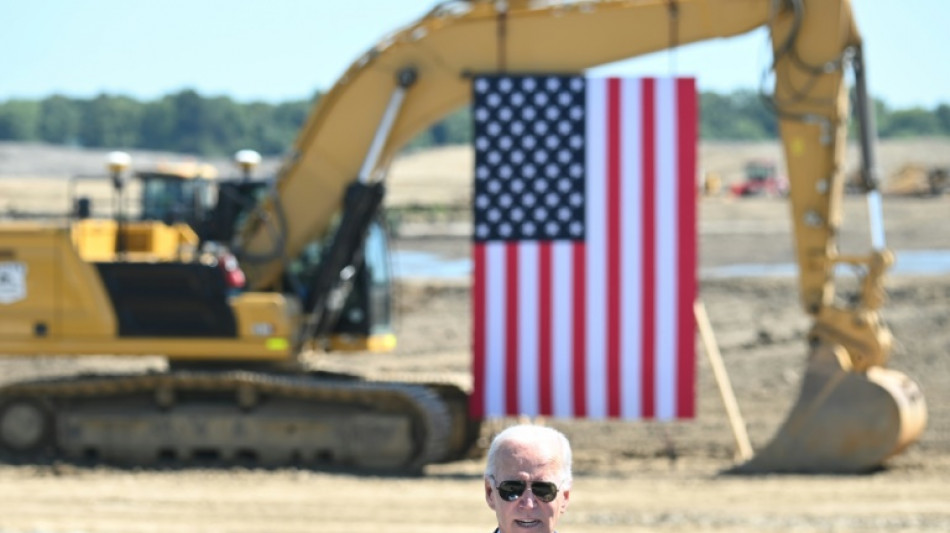
Biden celebrates giant semiconductor project / Photo: SAUL LOEB - AFP

 US Open under the influence: content creators spark debate

 NBA hammers Clippers over Leonard salary cap violations
 NBA strips five first-round draft picks from Clippers for Leonard salary cap violations

 Kane brace helps Bayern win German Cup opener

 Migrant plight, local anger divide Ceuta one month after influx

 Outrage as Maltese tycoon acquitted of reporter's murder

 Rare train of Pacific cyclones fueled by historic El Nino

 Macron, King Charles hail UK-France ties after viewing Bayeux Tapestry
 Fury hits out at 'coward' Joshua as 'Battle of Britain' talks go on

 Maltese tycoon acquitted of masterminding reporter's murder
 George Clooney: a Hollywood icon and campaigner

 Europe, US closer than they look on tech rules, says EU tech chief

 Clooney honoured as Hollywood-light Venice Film Festival kicks off
 Third-ranked Pegula, Medvedev power into US Open third round
 Davis-Woodhall a doubt for Ultimate Championship after car crash

 Third-ranked Pegula powers into US Open third round

 Uber says laying off 'about 10%' of workforce worldwide

 US judge rejects bid to break up Google's ad business

 Rupert Murdoch 'very happy' to be played by Guy Pearce in new film

 Wall Street stocks rise despite bond yields, oil rising

 Brennan claims third Vuelta victory in stage 11 sprint

 Nepal flood survivors cling to zipline to cross treacherous river

 US Treasury issues $1 coin with Trump's face on it

 Fernandez 'didn't hesitate' over record Man City move

 Dutch shift 86 tonnes of gold from US, Canada to UK

President Joe Biden flies Tuesday to Arizona to celebrate the mammoth expansion of a Taiwanese semiconductor plant, citing the project as proof that the United States is finally breaking dangerous dependency on foreign manufacturers for the vital component.
The White House announced that TSMC is unveiling plans to build a second facility in Phoenix by 2026, ballooning its investment from $12 billion to $40 billion.
The "major milestone" adds up to "the largest foreign direct investment in Arizona history and it's one of the largest in US history," White House National Economic Council Director Brian Deese told reporters.
Biden will speak at the TSMC site, accompanied by senior political figures and titans of the corporate world, including Apple CEO Tim Cook, TSMC’s founder Morris Chang and Micron CEO Sanjay Mehrotra.
The Democrat will seek to take credit for the investment influx, pointing to the effect of his signature CHIPS Act, which sets aside almost $53 billion for subsidies and research in the semiconductors sector. It's a message he'll be especially keen to spread in Arizona, which was long a Republican dominated state but has turned into a battleground where Democrats do increasingly well.
The plant expansion -- which comes on top of other significant microchip manufacturing projects dotted around the country -- is part of an overall strategy by the Biden administration to try to end reliance on foreign suppliers.
Although much of that supply comes from reliable US allies, particularly Taiwan, the Covid pandemic shutdown demonstrated how fragile those supply lines were in case of emergency. With China threatening to take control of Taiwan -- and eyeing how to ensure its own semiconductor supplies -- Washington wants to bring the vital gadgets home.
"Virtually every large tech firm, including automotive firms and any company that uses technology is sweating bullets that something's going to happen between Taiwan and China. And so there's a massive rush to shift manufacturing out of both countries," technology analyst Rob Enderle said.
- Smaller the better -
In the high-stakes world of microchips, sheer quantity is important. The miniscule, hard-to-make gadgets are at the heart of almost every modern appliance, vehicle and advanced weapon.
But quality -- and small size -- is also increasingly important for sophisticated everyday devices like smartphones and there the White House says it has good news.
The new TSMC plant will produce tiny 3 nanometer chips, while the existing facility will start reducing the size of its current 5 nanometer chips to 4 nanometers.
Building a plant, or a "fab," takes several years. But once "at scale, these two fabs could meet the entire US demand for advanced chips when they're completed. That's the definition of supply chain resilience," Ronnie Chatterji, National Economic Council deputy director for industrial policy, told reporters.
Deese, one of Biden's most senior advisors, said the broader message from the White House is that US industrial strategy is undergoing a rebirth.
For almost four decades, the idea was "trickle down," where government would "get out the way" and cut taxes for big companies to attract investment, he said.
Instead, Biden's policy -- both through the CHIPS Act and the giant Inflation Reduction Act -- uses public money to attract, or "crowd in" private investment.
The goal is not to exclude "private companies, but in fact, encouraging private investment at historic scale," Deese said.
O.Gaspar--PC