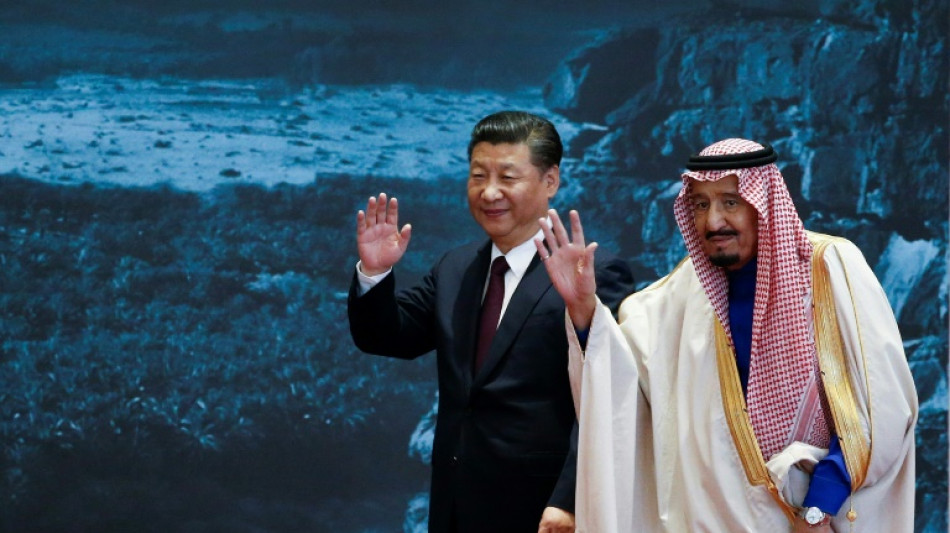
Xi visit spotlights warming Saudi-China ties, and their 'limits' / Photo: Lintao Zhang - AFP/File

 US Open under the influence: content creators spark debate
 NBA hammers Clippers over Leonard salary cap violations
 NBA strips five first-round draft picks from Clippers for Leonard salary cap violations
 Kane brace helps Bayern win German Cup opener

 Migrant plight, local anger divide Ceuta one month after influx

 Outrage as Maltese tycoon acquitted of reporter's murder

 Rare train of Pacific cyclones fueled by historic El Nino
 Macron, King Charles hail UK-France ties after viewing Bayeux Tapestry
 Fury hits out at 'coward' Joshua as 'Battle of Britain' talks go on

 Maltese tycoon acquitted of masterminding reporter's murder
 George Clooney: a Hollywood icon and campaigner

 Europe, US closer than they look on tech rules, says EU tech chief

 Clooney honoured as Hollywood-light Venice Film Festival kicks off
 Third-ranked Pegula, Medvedev power into US Open third round
 Davis-Woodhall a doubt for Ultimate Championship after car crash

 Third-ranked Pegula powers into US Open third round

 Uber says laying off 'about 10%' of workforce worldwide

 US judge rejects bid to break up Google's ad business

 Rupert Murdoch 'very happy' to be played by Guy Pearce in new film

 Wall Street stocks rise despite bond yields, oil rising
 Brennan claims third Vuelta victory in stage 11 sprint

 Nepal flood survivors cling to zipline to cross treacherous river

 US Treasury issues $1 coin with Trump's face on it

 Fernandez 'didn't hesitate' over record Man City move

 Dutch shift 86 tonnes of gold from US, Canada to UK
When Chinese President Xi Jinping visits Saudi Arabia from Wednesday, the oil-rich kingdom will seek mostly economic gains rather than a meaningful shift away from its longtime protector the United States, analysts say.
Xi will arrive on Wednesday for a three-day visit including meetings with Saudi royals, the regional Gulf Cooperation Council and other Middle East leaders, Saudi state media said.
It coincides with heightened tensions between Saudi Arabia and the United States over issues ranging from energy policy to regional security and human rights.
The latest blow to that decades-old partnership came in October when the OPEC+ oil bloc agreed to cut production by two million barrels a day, a move the White House said amounted to "aligning with Russia" on the war in Ukraine.
On Sunday OPEC+, which includes Saudi Arabia and Russia, opted to keep those cuts in place.
Yet Xi's trip to Riyadh, his first since 2016, is "not just about the United States, or signalling to the United States -- it's about Saudi Arabia itself", said Naser al-Tamimi, an expert on Gulf-China ties at the Italian Institute for International Political Studies.
"The country is changing. They're trying to change the structure of their economy, the structure of their foreign policy. The main theme for them is diversification."
China, for its part, "wants to maintain a relatively balanced strategy in the Middle East, so there are inherent limitations to how hard it will lean into the relationship with the Saudis", said Andrew Small, senior transatlantic fellow at the German Marshall Fund's Asia Program.
"Beijing is also well aware of the depth of Saudi-US ties -- despite the current tensions. But if Riyadh wants to hedge, this is a period where Beijing will be keen to take advantage of that."
- Oil and beyond -
Saudi Arabia is the world's largest oil exporter and China is the biggest importer of crude, purchasing roughly a quarter of the Saudi shipments.
The Wall Street Journal reported in March that Riyadh was considering pricing some of its oil contracts in yuan after trading exclusively in US dollars for decades. The CEO of energy giant Saudi Aramco called the report "speculation".
There is also potential for the two sides to ramp up cooperation in developing infrastructure like refineries.
China is keen on "boosting its ties with major energy suppliers at a time of continued unpredictability in the market", Small said.
Beyond energy, Saudi de facto ruler Crown Prince Mohammed bin Salman sees China as an important partner in his bid to develop other industries in line with his Vision 2030 reform agenda.
Analysts said deals announced this week could involve work by Chinese firms at the futuristic $500 billion megacity known as NEOM, including facial recognition and other surveillance technology.
Meetings between Xi and leaders of the six-member Gulf Cooperation Council could also offer a chance to revive a long-sought free trade agreement, said Jonathan Fulton of the Atlantic Council.
"China sells basically everything under the sun to Saudi," Fulton said.
"And Saudi sells oil and oil products to China, that's about it. So I think they'd like to find different ways to enter the Chinese market and not be so reliant on a single resource."
- 'Highly vulnerable' -
Yet embracing closer relations with China does not mean Saudi Arabia wants to downgrade its partnership with the United States.
Even at the height of the uproar over the oil production cuts in October, as US President Joe Biden spoke of unspecified "consequences", Saudi officials stressed the importance of their ties with Washington.
Crucially, while China and Saudi Arabia cooperate on arms sales and production, Beijing cannot provide the security guarantees that have underpinned the US-Saudi partnership since its inception at the end of World War II, analysts say.
Saudi Arabia has lived for years under the persistent threat of drone attacks from Iran-backed Huthi rebels in Yemen, where it leads a military coalition in support of the internationally recognised government.
The US said last month it had "exposed and deterred imminent threats" to Saudi Arabia from Iran.
"Improving relations with China is a priority" for the Saudis, said Soltvedt of Verisk Maplecroft.
"But there is a limit to how far they can shift away from the US as long as the regional dynamics are the way they are, and as long as they are highly vulnerable to Iranian military attacks."
R.J.Fidalgo--PC