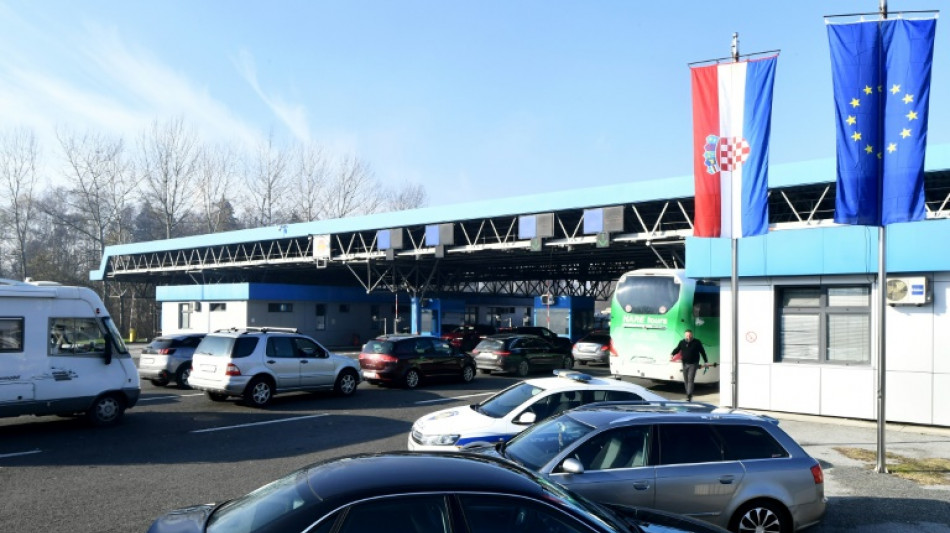
Croatia sets sights on Europe's border-free club / Photo: Denis LOVROVIC - AFP

 US Open under the influence: content creators spark debate

 NBA hammers Clippers over Leonard salary cap violations
 NBA strips five first-round draft picks from Clippers for Leonard salary cap violations
 Kane brace helps Bayern win German Cup opener
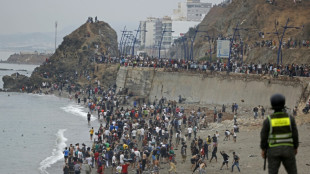
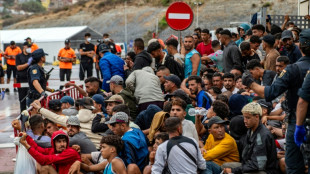 Migrant plight, local anger divide Ceuta one month after influx

 Outrage as Maltese tycoon acquitted of reporter's murder

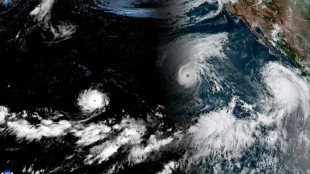 Rare train of Pacific cyclones fueled by historic El Nino
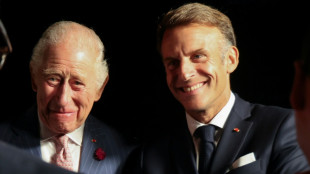 Macron, King Charles hail UK-France ties after viewing Bayeux Tapestry

 Fury hits out at 'coward' Joshua as 'Battle of Britain' talks go on
 Maltese tycoon acquitted of masterminding reporter's murder

 George Clooney: a Hollywood icon and campaigner
 Europe, US closer than they look on tech rules, says EU tech chief
 Clooney honoured as Hollywood-light Venice Film Festival kicks off

 Third-ranked Pegula, Medvedev power into US Open third round

 Davis-Woodhall a doubt for Ultimate Championship after car crash

 Third-ranked Pegula powers into US Open third round

 Uber says laying off 'about 10%' of workforce worldwide

 US judge rejects bid to break up Google's ad business

 Rupert Murdoch 'very happy' to be played by Guy Pearce in new film

 Wall Street stocks rise despite bond yields, oil rising

 Brennan claims third Vuelta victory in stage 11 sprint

 Nepal flood survivors cling to zipline to cross treacherous river

 US Treasury issues $1 coin with Trump's face on it
 Fernandez 'didn't hesitate' over record Man City move
 Dutch shift 86 tonnes of gold from US, Canada to UK

If Croatia gets approval this week to join the world's largest visa-free area, the massive queues of vehicles at the borders with its European neighbours will become history.
European Union justice ministers meet on Thursday to decide whether to admit Croatia into the passport-free Schengen zone, which enables more than 400 million people to move freely around its 26 member nations.
One of the main sticking points has been questions over Croatia's ability to police what is the 27-nation EU's longest external land border, at a time when migration remains a key challenge for the country.
Zagreb's application in 2016 to join Schengen has also come at a sensitive time for Europe.
Since 2015, millions of migrants, many from conflict zones, have risked their lives to enter the EU illegally and then the Covid 19 pandemic hit in 2020.
Both prompted Schengen countries to reintroduce certain border controls.
If on Thursday Croatia gets the green light to join Schengen -- potentially alongside Bulgaria and Romania -- the kilometres-long (miles-long) vehicle queues at the Bregana border crossing with Slovenia will become a thing of the past.
Bregana is one of 73 land crossings with EU neighbours Slovenia and Hungary that would cease to exist.
"On January 1, we will raise the barriers and border traffic will be free," the head of the national border police service, Zoran Niceno, told AFP.
At airports, the change will kick in on March 26, due to technical issues.
- Tourists and trucks-
Croatia hopes joining Schengen would boost its lucrative tourism industry.
This year, the country of 3.9 million people hosted four times as many visitors, most of them from other EU states.
Removing border controls would enable holidaymakers to reach Croatian destinations faster, the head of the national tourist board, Kristjan Stanicic, said recently.
"International carriers will be delighted," said Vladimir Jurcec of the national road hauliers' association.
Removing checks at borders will save them between six and 10 hours every week.
"No more crowds and hours of queueing," noted truck driver Filip Svetlicic, whose Italy-bound lorry was stuck in a queue several kilometres long to exit Croatia via Bregana.
On January 1, Croatia will also join the EU's single currency club, the eurozone.
- Illegal migration challenge -
Ever since the former Yugoslav republic became an EU member nearly a decade ago, it has had the onerous task of policing the bloc's longest external land border.
The border -- which rubs shoulders for more than 1,350 kilometres (about 840 miles) with Bosnia, Montenegro and Serbia -- is an area notorious for trafficking in migrants, drugs and weapons.
The most challenging is the 1,011-kilometre border with Bosnia, which is not only the longest but also consists of difficult terrain dotted with rivers and craggy mountains.
At the Stara Gradiska crossing with Bosnia, police carefully scrutinise documents and waiting vehicles.
For Malik Safeta, a bus driver from Sarajevo, such strict controls are not unusual.
"It's normal. This is the last line of defence for the EU and the Schengen zone before the eastern world, which is always a bit more problematic," he said.
The situation at Croatia's borders with its non-EU neighbours is not expected to change much after January 1 because Zagreb has already introduced the Schengen area's rules for dealing with its external limits.
"Croatia has applied Schengen procedures for years and uses all the tools required for such border controls," Niceno, the border police head, said.
Police say tackling illegal migration was and will remain the most challenging task for its force of around 6,500 border officers.
NGOs and the media have repeatedly accused Croatian police of forcing migrants back over its external borders, often violently. Zagreb strongly denies the allegations.
Croatia lies on the dangerous Balkans migrant route, which was traversed by hundreds of thousands of would-be asylum seekers from Asia, the Middle East and Africa during Europe's 2015-2016 "migrant crisis".
After the route was officially shut down in 2016, migrants seeking to enter western Europe continued to use it, although in far lower numbers.
However, this year their numbers increased significantly.
Nearly 130,000 people, including women and children, have been detected on the route since the start of 2022. That is 170 percent more than in 2021, according to EU border force Frontex.
As of November, Croatia had registered some 30,000 illegal migrants, nearly 150 percent more than over the same period last year.
The Stara Gradiska region has become a hotspot for migrants trying to cross the Sava river in small boats or sometimes even swimming despite freezing temperatures.
Croatian police and their EU counterparts say two things are key to tackling the issue -- combatting the human traffickers and cooperating between the countries the migrants are trying to pass through.
"The people we apprehend are the last ones in the (trafficking) chain -- the drivers," Niceno said.
"But with cooperation and analysis, we can catch gangs and organisers."
L.Mesquita--PC