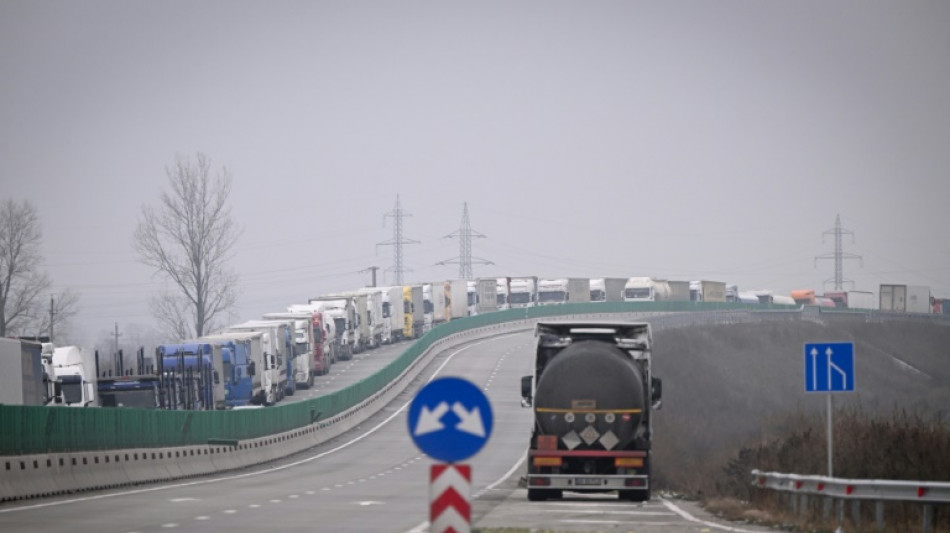
Frustration in Romania and Bulgaria after Schengen rejection / Photo: Daniel MIHAILESCU - AFP

 US jury deadlocks again in Lindsay Clancy's child murder trial

 Lake America? No way, Canadians say
 Spain report flags Moroccan police failings in Ceuta migrant rush
 Tech bosses press G20 to build data centers, but split on risk
 Dolly Parton to get new Hollywood star after vandalism

 Trump 'happy' Prince Harry and Meghan have left US
 Michelson shocks Nakashima in US Open clash of rising Americans

 Another body recovered after ferry capsizes off northern Cyprus: official
 Cupertino Chamber President Claudio Bono Invited to White House with GiveaRoof 3-Year Plan to End Homelessness

 Trump floats renaming Strait of Hormuz as 'Trump Strait'

 Man City, Chelsea fuel record-breaking Premier League transfer window

 Balogun rejected Everton move over transfer 'treatment'

 Northampton seek 'happy medium' in bid to keep England star Pollock

 US energy secretary in Venezuela to sign Trump's 'biggest' oil deal

 Branagh takes on action role in Apple's Cold War comedy 'Mayday'
 Lawson fills in again for injured Hadjar at Monza
 England omit Carse from squad for third Test against Pakistan
 Venice festival gets underway with Clooney taking swipe at US government
 DNA tests and funerals in Nepal, a week after deadly floods

 Iran threatens tougher strategy after US strikes kill 4 at wedding

 Chevron unveils deal to double Venezuela venture output in 5 years
 Uganda names its oil 'Pearl Sweet' as it prepares for first exports
 Tiger Woods driver's license suspended for five years after crash

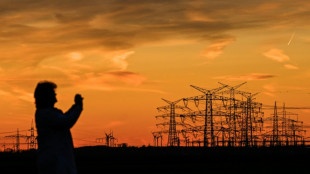 Germany probes latest sabotage attacks on power grid
 Wall Street stocks mixed as energy prices, bond yields turn lower

After more than 10 years waiting to be admitted into the Schengen zone, Bulgaria and Romania were once more turned away after two EU countries vetoed their admission.
Now some observers warn that both countries face a rising tide of euroscepticism as they remain outside the coveted zone through which passport checks are not normally required.
Romanian Prime Minister Nicolae Ciuca spoke of his "profound disappointment" after Austria blocked their admission.
In Bulgaria, President Rumen Radev regretted what he described as the "internal borders" he said were being put up with the European Union bloc.
- Long waits at borders -
Their failure to win admission to the Schengen's vast zone of free movement means that the long lines at various border crossings will continue.
At Giurgiu, for example, on the Romanian-Bulgarian border, a queue of trucks several kilometres begins forming from dawn.
Jaded long-haul drivers speaking to AFP in early December in Giurgiu, on the Romanian side, told of long hours waiting for the customs checks before they could enter Bulgaria.
Alexandru Birnea, 36, a long-haul driver for 13 years, said joining the Schengen zone would improve the lives of thousands of truckers.
"We would like to avoid losing all this time and therefore money in endless queues so that we can get back to our families more quickly," he said.
But his pessimism about the outcome of the vote turned out to be well founded.
- Austria's veto -
The European Commission has long expressed its wish for a widened Schengen zone.
But while tourist hotspot Croatia received the green light on Thursday, Romania and Bulgaria were left out in the cold.
Both countries joined the European Union back in 2007, before Croatia. Both countries met the technical criteria set out by Brussels.
But both countries were asked to make progress on judicial reform and anti-corruption efforts and were monitored for improvements.
When that process ended, both countries were hopeful that they had cleared the final hurdle. improvements.
But Austria hardened its stance, denouncing an influx of asylum seekers that it said could grow if the Schengen zone expanded.
"The migratory flows do not pass through Romania", but mainly through Serbia, Romanian Interior Minister Lucian Bode argued.
He pointing to the nearly 140,000 migrants on the western Balkan route recorded by the European agency Frontex since January.
Prime Minister Ciuca said Austria's refusal was based on "incorrect" figures.
But for political analyst Sergiu Miscoiu, Austria's veto was more a reflection of internal political pressures, given the rise in polls of the far right there.
- Expecting 'the impossible' -
The Netherlands finally changed its position and gave Romania the green-light after long being opposed. But it maintained its concerns about "corruption and human rights" in Bulgaria.
Dutch Prime Minister Mark Rutte said last week that he wanted to be assured that no-one could "cross the border with a 50-euro note".
Bulgarian Interior Minister Ivan Demerdzhiev rejected what he described as "insulting" remarks, especially given the "exceptional efforts" they had made to meet Brussels' demands.
Bulgarian weekly magazine Capital commented: "We expect the impossible from the poorest and most corrupt country in the EU: don't let migrants pass through (the country), but give asylum to every migrant who enters," it remarked.
Romanian president Klaus Iohannis also warned that rejection "might compromise European unity and cohesion, which we so need, especially in the current geopolitical context."
F.Carias--PC