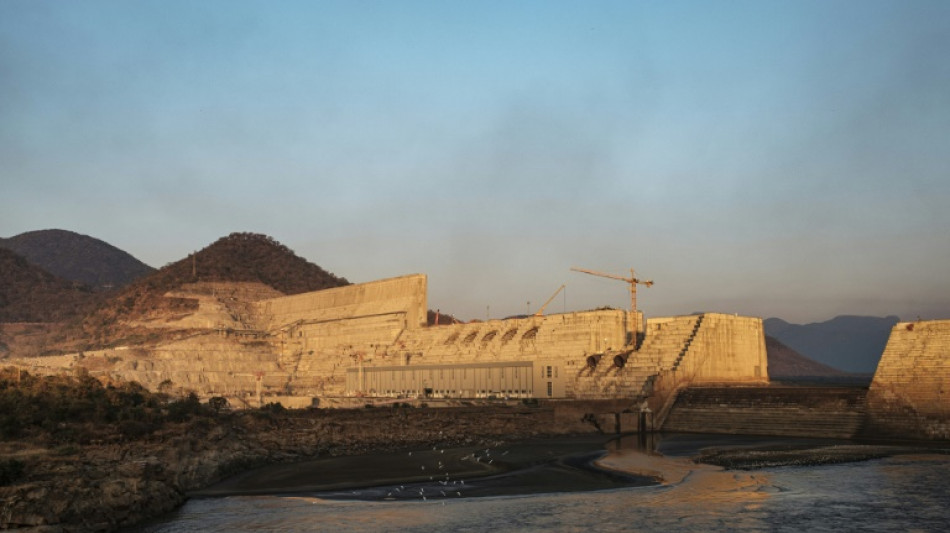
Ethiopia to start generating power from Nile dam Sunday

 Turkish Energy Minister Highlights Qatar as Key Partner for Regional and Global Energy Security

 London Museum Granted 24/7 License Ahead of November Opening

 Dana White Confirms Flight to Washington for Trump Meeting on Press Secretary Role

 Dengue Fever Expands Into High Himalayas as Climate Change Warms Nepal

 IoT Refrigerator Hacks Disrupt Blood Labs and Supermarkets Across Europe and US

 Post-election pressures complicate US and Israeli decisions on Iran

 UN members approve talks on treaty protocol against environmental crime

 Family-run West Sussex beach café prepares for first winter season

 CT scans reveal health and burial clues from Egypt’s Braided Lady mummy

 Oxford faces complaints over lecturer’s classroom attire

 Kyren Wilson and John Higgins reach International Championship snooker final
Ethiopia will start generating power from its controversial mega-dam on the Blue Nile on Sunday, government officials told AFP.
The Grand Ethiopian Renaissance Dam (GERD), set to be the largest hydroelectric project in Africa, has been at the centre of a regional dispute ever since Ethiopia broke ground in 2011.
"Tomorrow will be the first energy generation of the dam," an Ethiopian government official said on Saturday.
A second official confirmed the information. Both spoke on condition of anonymity because the milestone has not been officially announced.
Ethiopia's downstream neighbours Egypt and Sudan view the dam as a threat because of their dependence on Nile waters, while Addis Ababa deems it essential for its electrification and development.
The $4.2-billion (3.7 billion euro) project is ultimately expected to produce more than 5,000 megawatts of electricity, more than doubling Ethiopia's electricity output.
Ethiopia had initially planned output of around 6,500 megawatts but later reduced its target.
"The newly generated electricity from the GERD could help revive an economy that has been devastated by the combined forces of a deadly war, rising fuel prices and the Covid-19 pandemic," said Addisu Lashitew of the Brookings Institution in Washington.
The dam lies on Blue Nile River in the Benishangul-Gumuz region in western Ethiopia, not far from the border with Sudan.
- No breakthrough in talks -
Talks held under the auspices of the African Union (AU) have failed to yield a three-way agreement on the dam's filling and operations, and Cairo and Khartoum have demanded Addis Ababa cease filling the massive reservoir until such a deal is reached.
But Ethiopian officials have argued that filling is a natural part of the dam's construction process and cannot be stopped.
The UN Security Council met last July to discuss the project, although Ethiopia later slammed the session as an "unhelpful" distraction from the AU-led process.
In September the Security Council adopted a statement encouraging Egypt, Ethiopia and Sudan to resume negotiations under AU auspices.
Egypt claims a historic right to the Nile dating from a 1929 treaty that gave it veto power over construction projects along the river.
A 1959 treaty boosted Egypt's allocation to around 66 percent of the river's flow, with 22 percent for Sudan.
Yet Ethiopia was not party to those treaties and does not see them as valid.
The process of filling the GERD's vast reservoir began in 2020, with Ethiopia announcing in July of that year it had hit its target of 4.9 billion cubic metres.
The reservoir’s total capacity is 74 billion cubic metres, and the target for 2021 was to add 13.5 million.
Last July Ethiopia said it had hit that target, meaning there was enough water to begin producing energy, although some experts had cast doubt on the claims.
P.Serra--PC

