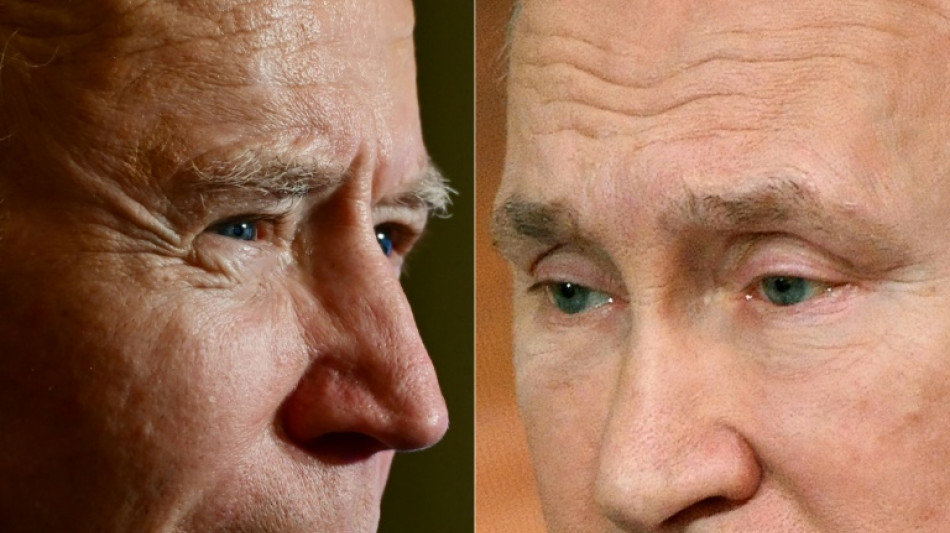
Most Asian markets rise after Russia sanctions but nerves on edge

 Turkish Energy Minister Highlights Qatar as Key Partner for Regional and Global Energy Security

 London Museum Granted 24/7 License Ahead of November Opening

 Dana White Confirms Flight to Washington for Trump Meeting on Press Secretary Role

 Dengue Fever Expands Into High Himalayas as Climate Change Warms Nepal

 IoT Refrigerator Hacks Disrupt Blood Labs and Supermarkets Across Europe and US

 Post-election pressures complicate US and Israeli decisions on Iran

 UN members approve talks on treaty protocol against environmental crime

 Family-run West Sussex beach café prepares for first winter season

 CT scans reveal health and burial clues from Egypt’s Braided Lady mummy

 Oxford faces complaints over lecturer’s classroom attire

 Kyren Wilson and John Higgins reach International Championship snooker final
Equities mostly rose Wednesday and oil prices stabilised as investors tracked developments in the Russia-Ukraine crisis after world powers imposed less harsh sanctions on Moscow than feared.
However, trading floors remain on edge after Russian President Vladimir Putin ordered his forces into Ukraine to secure the self-declared Donetsk and Lugansk rebel republics, with Western leaders warning that a war could break out imminently.
Global markets have been in turmoil since the move this week, with oil soaring towards the $100 mark not seen since 2014 and other commodities also hitting multi-year highs.
Wall Street, which was closed for a holiday Monday, tanked in early trade but saw a noticeable bounce after US President Joe Biden unveiled a series of sanctions against Russia.
The measures included moves against two Russian banks, cutting the country off from Western financing by targeting Moscow's sovereign debt, and penalising oligarchs and their families who are part of Putin's inner circle.
That came after a series of announcements in Europe with Germany halting certification of the lucrative Nord Stream 2 gas pipeline from Russia, while Britain targeted five banks and three billionaires.
Canada, Japan and Australia have since followed up with their own punishments.
The sanctions were not as bad as feared -- crucially not aiming at Russia's crude exports -- providing some much-needed breathing room for investors and halting the surge in oil prices that has seen both main contracts pile on more than 20 percent so far this year.
Brent, which touched $99.50 on Tuesday, and WTI were slightly higher in early Asian trade.
- 'Considerable risk' -
However, Biden said the moves were only a "first tranche" in response to Putin's "carving out a big chunk of Ukraine", and more penalties could follow if he does not change course.
"There's still considerable risk that oil prices may surge above $100 a barrel" if the situation escalates, said Vivek Dhar at Commonwealth Bank of Australia.
"Oil markets are particularly vulnerable at the moment given that global oil stockpiles are at seven‑year lows and that OPEC+ spare capacity is being questioned due to disappointing OPEC+ supply growth."
In early trade Wednesday, Hong Kong, Shanghai, Sydney, Seoul, Wellington, Taipei and Jakarta were all in positive territory. Singapore and Manila slipped. Tokyo was closed for a holiday.
The crisis comes just as investors prepare for a series of interest rate hikes by the US Federal Reserve as it tries to rein in 40-year-high inflation.
Commentators say that while a March hike is baked in, forecasts for further increases this year are being affected by events in Europe as officials try to assess the impact on the economy.
"How the Federal Reserve wants to handle that particular issue is really the issue that feeds through to US markets and the broader world," Steven Wieting, of Citigroup Private Bank, said on Bloomberg Television.
- Key figures around 0250 GMT -
Hong Kong - Hang Seng Index: UP 0.6 percent at 23,655.79
Shanghai - Composite: UP 0.3 percent at 3,468.53
Tokyo - Nikkei 225: Closed for a holiday
West Texas Intermediate: UP 0.3 percent at $92.14 per barrel
Brent North Sea crude: UP 0.2 percent at $97.07 per barrel
Euro/dollar: DOWN at $1.1326 from $1.1330 late Tuesday
Pound/dollar: UP at $1.3595 from $1.3588
Euro/pound: DOWN at 83.32 pence from 83.35 pence
Dollar/yen: DOWN at 115.04 yen from 115.08 yen
New York - Dow: DOWN 1.4 percent at 33,596.61 (close)
London - FTSE 100: UP 0.1 percent at 7,494.21 (close)
P.Cavaco--PC

