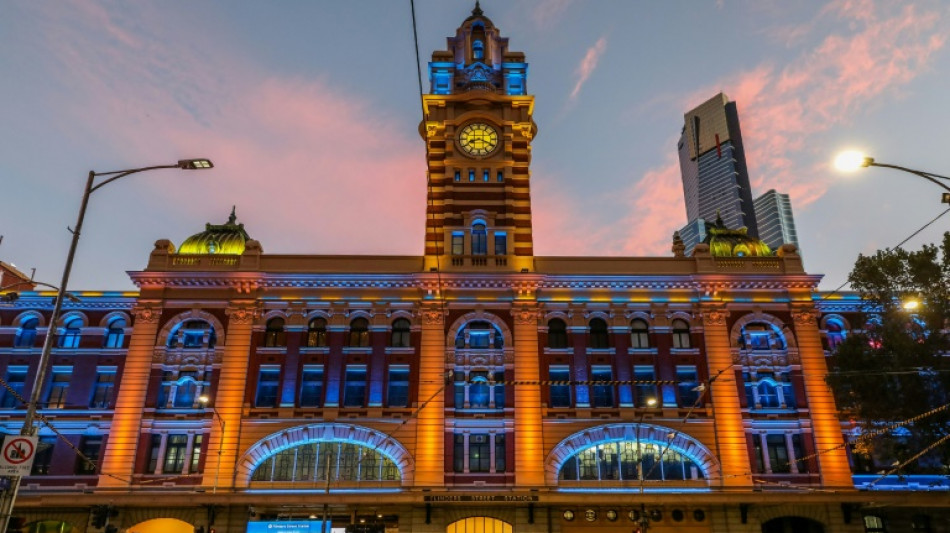
Australia slams China 'lifeline' to Russia

 Turkish Energy Minister Highlights Qatar as Key Partner for Regional and Global Energy Security

 London Museum Granted 24/7 License Ahead of November Opening

 Dana White Confirms Flight to Washington for Trump Meeting on Press Secretary Role

 Dengue Fever Expands Into High Himalayas as Climate Change Warms Nepal

 IoT Refrigerator Hacks Disrupt Blood Labs and Supermarkets Across Europe and US

 Post-election pressures complicate US and Israeli decisions on Iran

 UN members approve talks on treaty protocol against environmental crime

 Family-run West Sussex beach café prepares for first winter season

 CT scans reveal health and burial clues from Egypt’s Braided Lady mummy

 Oxford faces complaints over lecturer’s classroom attire
 Kyren Wilson and John Higgins reach International Championship snooker final
Australia on Friday pilloried China's failure to denounce the Russian invasion of Ukraine, as well as Beijing's "unacceptable" decision to ease restrictions on a key Russian export in the face of Western sanctions.
Prime Minister Scott Morrison said the world must unite to condemn Russia, voicing particular concern "at the lack of a strong response from China".
Beijing announced Thursday that it would import more Russian wheat, in stark contrast to Western countries rolling out sanctions on the Kremlin and its allies.
"You don't go to throw a lifeline to Russia in the middle of a period when they are invading another country. That is simply unacceptable," Morrison said.
Russia produces around a quarter of the world's wheat, according to UN data, a trade worth billions of US dollars a year.
Ukraine produces a further 10 percent of world supply and there are concerns that war and sanctions will strangle production and fuel already high food prices globally.
China had previously only allowed wheat imports from a handful of areas in Russia, citing disease concerns.
The deal announced by China's General Administration of Customs on Thursday, which was reportedly agreed when Russian President Vladimir Putin visited Beijing in February, allows for imports from more regions.
China has urged dialogue and expressed sympathy for what it calls the Kremlin's "reasonable" security concerns around Ukraine.
Western powers on the other hand have denounced Putin's actions wholesale -- sanctioning banks, oligarchs and government officials.
India -- a major purchaser of Russian weapons -- has also so far refrained from condemning Moscow's actions, but Morrison did not mention New Delhi.
Relations between China and Australia are at their lowest ebb in a generation.
The two sides have engaged in rhetorical tit-for-tat denunciations and Beijing has placed extensive trade sanctions on Australian goods -- though Australian wheat has so far avoided the chopping block.
Morrison has put China and national security firmly at the centre of his campaign for re-election in a vote expected this May.
The conservative leader trails in the polls to the opposition centre-left Labor Party, led by Anthony Albanese.
O.Gaspar--PC

