UK to freeze all Russian banks' assets, bars ships

 Turkish Energy Minister Highlights Qatar as Key Partner for Regional and Global Energy Security

 London Museum Granted 24/7 License Ahead of November Opening

 Dana White Confirms Flight to Washington for Trump Meeting on Press Secretary Role

 Dengue Fever Expands Into High Himalayas as Climate Change Warms Nepal

 IoT Refrigerator Hacks Disrupt Blood Labs and Supermarkets Across Europe and US

 Post-election pressures complicate US and Israeli decisions on Iran

 UN members approve talks on treaty protocol against environmental crime

 Family-run West Sussex beach café prepares for first winter season

 CT scans reveal health and burial clues from Egypt’s Braided Lady mummy

 Oxford faces complaints over lecturer’s classroom attire

 Kyren Wilson and John Higgins reach International Championship snooker final
The UK on Monday said it would freeze the assets of all Russian banks over the invasion of Ukraine, tightening the international economic stranglehold on Moscow over its "unjustified aggression".
Foreign Secretary Liz Truss said the UK wants "a situation where they (Russia) can't access their funds, their trade can't flow, their ships can't dock and their planes can't land".
More than 50 percent of Russian trade is denominated in dollars or sterling and the new powers "will damage Russia's ability to trade with the world", she told parliament.
At the same time, British Transport Secretary Grant Shapps ordered all UK seaports to turn away Russian vessels, having already barred Russian aircraft, including oligarch jets.
Britain last weekend joined the United States and Western allies in preventing the Russian central bank's ability to use reserves to support the plummeting ruble.
And it also cut selected banks from the SWIFT international money transfer system, which Truss said was only the first step in a "total SWIFT ban".
As Truss spoke in parliament, the Treasury announced asset freezes on Russia's state development bank VEB, and commercial lenders Otkritie and Sovcombank, with the rest of the freeze to come into effect "in days", Truss said.
The sanctions add to those announced last week on a series of Russian banks, businesses, billionaires, President Vladimir Putin himself and his Foreign Minister Sergei Lavrov.
- Three million businesses -
The assets freeze on Russian banks will stop the Kremlin from raising debt in the UK and will prevent more than three million businesses from accessing UK capital markets, Truss said, also promising a ban on "high-end technological equipment such as micro-electronics, marine and navigation equipment".
"This will blunt Russia's military industrial capabilities and act as a drag on Russia's economy for years to come," she said.
UK broadcasting regulator Ofcom meanwhile said it had opened 15 new investigations into the "due impartiality" of state-funded Russian broadcaster RT since the invasion of Ukraine.
London has long been accused of turning a blind eye to illicit Russian money, but Truss promised new measures would target oligarchs' "houses, their yachts and every aspect of their lives".
"I say to our Ukrainian friends, we are with you. In Britain and around the world we're prepared to suffer economic sacrifices to support you however long it takes," she added.
"We will not rest until Ukraine sovereignty is restored."
London's tough talk was blamed by the Kremlin for provoking Putin into raising the readiness level of Russia's nuclear forces -- a claim dismissed by UK officials as risible.
British Prime Minister Boris Johnson's spokesman was forced to backtrack after telling a daily briefing that the swingeing set of sanctions imposed by Britain, Europe and the United States was intended "to bring down the Putin regime".
Downing Street said that he had misspoken, and the spokesman clarified that he was talking about "how we stop Russia seeking to subjugate a democratic country".
- 'Moving and courageous -
In his latest call with Ukraine's President Volodymyr Zelensky on Sunday evening, Johnson praised the "heroic" resistance of Ukrainians, according to Downing Street.
Johnson was to visit Poland and Estonia on Tuesday, two NATO allies bordering Russia where Britain has been stepping up military support.
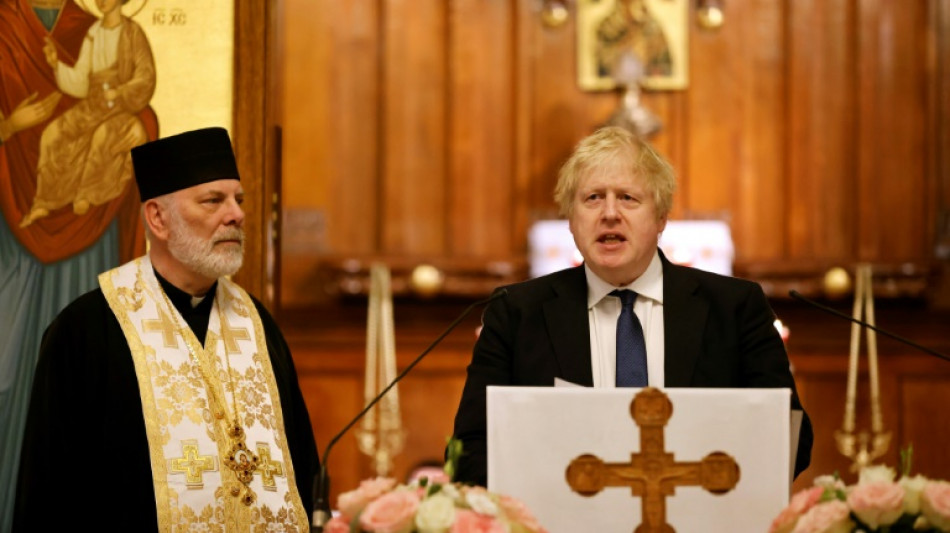
The prime minister released a further £40 million ($54 million) in humanitarian aid for Ukraine, after giving an emotional address at London's Ukrainian Catholic cathedral on Sunday.
"Never in all my study, my memory of politics and international affairs, have I seen so clear a distinction between right and wrong, between good and evil, between light and dark," he told the congregation.
The cathedral's Bishop Kenneth Nowakowski said that he had been blessing Ukrainian men and women who were en route to defend their homeland.
"People have come and told us they're returning back to Ukraine to fight and wanting us to pray for them and give them our blessings," he told journalists.
"It's very touching, very moving and very courageous," he said on Monday.
E.Ramalho--PC

