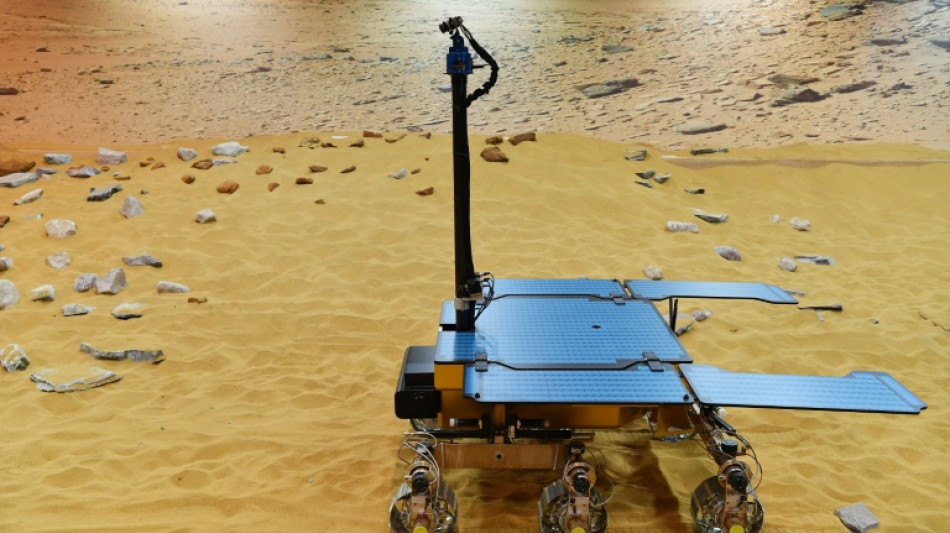
Russian-European Mars rover 'very unlikely' to launch this year

 Turkish Energy Minister Highlights Qatar as Key Partner for Regional and Global Energy Security

 London Museum Granted 24/7 License Ahead of November Opening

 Dana White Confirms Flight to Washington for Trump Meeting on Press Secretary Role

 Dengue Fever Expands Into High Himalayas as Climate Change Warms Nepal

 IoT Refrigerator Hacks Disrupt Blood Labs and Supermarkets Across Europe and US

 Post-election pressures complicate US and Israeli decisions on Iran

 UN members approve talks on treaty protocol against environmental crime

 Family-run West Sussex beach café prepares for first winter season

 CT scans reveal health and burial clues from Egypt’s Braided Lady mummy

 Oxford faces complaints over lecturer’s classroom attire

 Kyren Wilson and John Higgins reach International Championship snooker final
A Russian-European mission to land a rover on Mars is "very unlikely" to launch this year due to sanctions over Moscow's invasion of Ukraine, the European Space Agency said.
The launch of the Rosalind Franklin rover, whose mission is to drill into Martian soil to seek out signs of life, was originally planned for 2020 but postponed due to Covid-19 and technical delays.
In January the ESA declared the ExoMars mission was ready to launch this September, with Russia providing the launcher, descent module and landing platform.
However after Russia shocked the world by invading Ukraine last week and the European Union responded by targeting Moscow with a massive package of economic punishments, the ESA said "the sanctions and the wider context make a launch in 2022 very unlikely".
"We are fully implementing sanctions imposed on Russia by our member states," the ESA said in a statement on Monday.
"We deplore the human casualties and tragic consequences of the war in Ukraine. We are giving absolute priority to taking proper decisions, not only for the sake of our workforce involved in the programmes, but in full respect of our European values."
The ESA also said it took note of the Russian space agency Roscosmos' decision over the weekend to suspend launches and withdraw its workers from Europe's spaceport in Kourou, French Guiana, over the EU sanctions.
It will "consequently assess" future planned operations using Russian launchers, including the deployment of two satellites for Europe's Galileo GPS system planned for this year.
The invasion of Ukraine and responding Western sanctions have raised a question mark over joint space programmes with Russia, most notably for the International Space Station, where astronauts and cosmonauts work side-by-side.
After Moscow raised the prospect of withdrawing from the ISS over US sanctions, NASA said Monday it was exploring ways to keep the space station in orbit without Russian help.
T.Resende--PC

