As Ukraine pushes oil over $100, Nigerians see mixed blessings

 Zambia voters weigh Hichilema's economic record

 SBCFX to Showcase Trading Innovation, Regional Growth Strategy, and Future Vision at iFX EXPO Asia 2026
 Hodgkinson sets up Werro showdown after Euro 800m drama

 'How many will die?': the mysterious ailment killing Kenyan elephants
 Arteta coy over Lewis-Skelly's Arsenal future after 'emotional' celebration
 Romania shuts down nuclear plant as Danube drops

 German steel giant Thyssenkrupp weighs options as Rhine drops

 US ambassador denounces settler siege as Israel dispatches troops
 Hasan takes 6-55 as Bangladesh claim opening day of Australia Test

 Taiwan says AI agents used in cyberattacks targeting island
 Japan protests Putin's first visit to disputed islands

 Kiss wants fit-again Wallabies playmaker Gordon to 'open up' Japan

 British eccentrics push humble garden shed to new heights

 Zambia votes with president's economic record on the line

 Germany's dry rivers spark battle on engineering vs restoration
 Senators demand inquiry into conditions aboard USS Abraham Lincoln

 All Blacks' Proctor out of South Africa series, Mo'unga called up

 Bangladesh quick Hasan reduces Australia to 74-4 at lunch

 Seoul tech leads Asian stock gains as traders cheer US inflation
 Farage and Count Binface go head-to-head in snap UK poll
 Afghan students divided over smartphone ban at universities

 Japan go back to school for second Australia Test
 Matthew McConaughey on his sweet return to the big screen

 President's economic record on the line as Zambia votes

 U.S. Polo Assn. Takes No. 1 Spot for All Sports Brands and Climbs to No. 22 Overall on License Global's 2026 'Top Global Licensors' Ranking

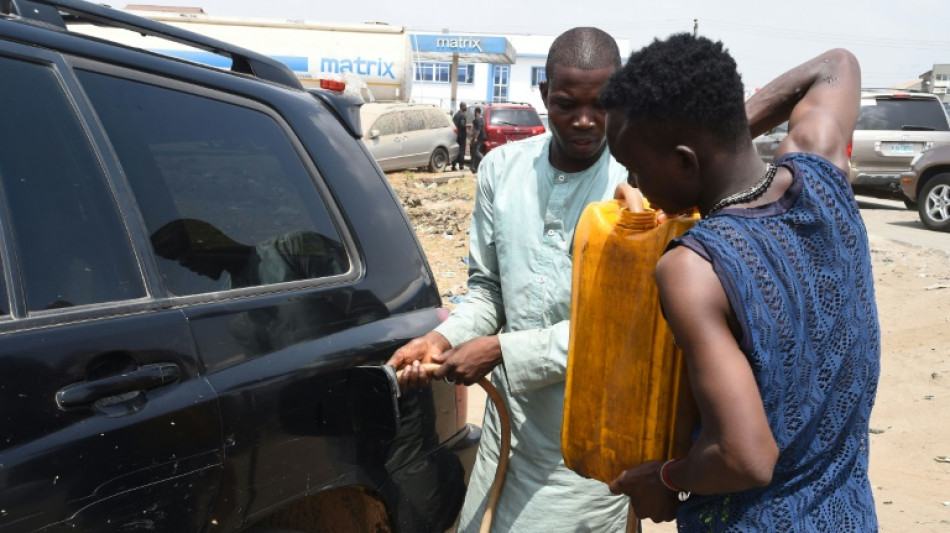
Weaving in between the Lagos traffic, hawkers selling plantain snacks and water more recently offer drivers another treat: jerry cans filled with petrol to help with fuel shortages.
Petroleum-producing nations may be reaping extra revenue since Ukraine's crisis pushed oil prices above $100 a barrel, but Nigerians this week were struggling with yet another round of fuel scarcities.
President Muhammadu Buhari says Africa's top producer has a "great opportunity" with higher oil prices, but that was a hard sell for Lagos accountant Abdulazeez Oyefeso after three hours in a line for fuel.
"It's more revenue for the country, but it doesn’t get down to the common man," Oyefeso said, leaning against his Lexus among the cars snaking along Lagos’s main Alfred Rewane road near a gas station.
On the opposite side of the major avenue, touts carrying plastic jerry cans filled with yellow fuel and funnels crafted from water bottles flagged down passing cars offering to fill tanks for a premium.
Oil sales account for nearly 90 percent of Nigeria's export revenue. But soaring prices -- the highest in ten years after the invasion -- are a mixed blessing.
OPEC member Nigeria has little capacity to refine its own crude and relies heavily on fuel imports so higher oil prices mean more budget spending.
Nigeria also operates a byzantine system of fuel subsidies that costs the state billions of dollars to artificially keep fuel costs low.
In place since the 1970s, fuel subsidies are politically sensitive and Nigeria's import reliance also leaves the domestic market open to sporadic fuel shortages.
Currently, a litre of gasoline costs an average of 165 naira (40 US cents). On the black market this week it was fetching between 350 to 500 naira.
Since last month, the government said a batch of adulterated fuel was removed from the market, causing a shortfall.
State-run Nigerian National Petroleum Corporation chairman Mele Kyari on Thursday said measures were in place to get adequate supplies to depots.
"I am very sure that very soon we will see relief from this," he told reporters.
- Sleeping in car -
Unruly lines of cars searching for fuel caused massive traffic jams earlier this week in Lagos and other cities. Motorbikes ferrying men on the back clutching four or five jerry cans to find fuel were a common sight.
Some commuters just walked. Others jumped off Lagos' typical yellow Danfo minibuses caught in jams to continue on foot.
"My gauge was on reserve when I left home early this morning but the car stopped mid-way. Luckily, I have a small keg," said one Lagos driver Onifade. "The government has to do something."
Around Awolowo district of Lagos, where several filling stations operate, roads were blocked early in the week. Drivers wait on the sidewalk under the sun. Some had slept in the line overnight.
"People that had fuel this morning are the ones that slept in the queue yesterday night," taxi driver Ali said. "And those people you see right now might sleep here tonight."
- More budget costs -
Nigeria approved a long-awaited new oil law last year that aims to improve operating conditions to bring in more foreign investment to the flagging sector.
But some of Nigeria's production is tied up in deals with refining companies for fuel and swaps for infrastructure projects so oil high prices are not the revenue boon they should be.
Today, most of Nigeria's 1.4 million barrels per day oil output comes from off-shore "deep water" projects, where the government takes only 20 to 30 percent of revenue, said Bismarck Rewane, an economist at Financial Derivatives Co.
"The increase in price is not enough to compensate for the loss in production," Rewane said. "Theoretically the picture looks great, but in reality it is more complicated."
Nigeria's finance minister last year suggested the costly fuel subsidy programme would end in June as urged by the World Bank and IMF.
But in January, ministers delayed the plan, saying the timing was problematic.
Less than a year from an election, ending subsidies could be costly as Nigerians see cheap fuel as one tangible they get from oil wealth.
"Nigeria, however, is in the uncanny position of being stuck in a subsidy arrangement that guarantees that high oil prices leads to an exponential rise in government expenditure," said local risk analyst group SBM Intelligence.
"Momentary gains in the government’s coffers, therefore, might not make a big dent in the fiscal deficit."
Lagos hawkers, though, did not let macroeconomic concerns deter them from a another chance for a fast buck.
Sitting on an empty blue 10-litre jerrycan on the roadside, Ahmed said he came just to make cash to supplement his carpet business.
"This is just a hustle," he said. "This is our oil, and it's a way to make quick money."
F.Cardoso--PC