US consumer prices hit new 40-year high as Ukraine shock looms

 Turkish Energy Minister Highlights Qatar as Key Partner for Regional and Global Energy Security

 London Museum Granted 24/7 License Ahead of November Opening

 Dana White Confirms Flight to Washington for Trump Meeting on Press Secretary Role

 Dengue Fever Expands Into High Himalayas as Climate Change Warms Nepal

 IoT Refrigerator Hacks Disrupt Blood Labs and Supermarkets Across Europe and US

 Post-election pressures complicate US and Israeli decisions on Iran

 UN members approve talks on treaty protocol against environmental crime

 Family-run West Sussex beach café prepares for first winter season

 CT scans reveal health and burial clues from Egypt’s Braided Lady mummy

 Oxford faces complaints over lecturer’s classroom attire

 Kyren Wilson and John Higgins reach International Championship snooker final
US consumer prices hit a new 40-year high last month as the world's largest economy continued to be battered by a surge of inflation, which the fallout from Russia's invasion of Ukraine is expected to worsen.
The consumer price index (CPI) was 7.9 percent higher in February compared to the same month last year, its biggest jump since January 1982 as costs for gasoline, food and housing rose, the Labor Department said Thursday.
The Federal Reserve is expected to increase interest rates next week for the first time since the pandemic began to fight the price increases that have marred the recovery from Covid-19. But analysts warn of another shock to come from the sanctions imposed on Russia, a major producer of oil and gas.
"The Russia-Ukraine war adds further fuel to the blazing rate of inflation via higher energy, food and core commodity prices that are turbo charged by a worsening in supply chain problems," Kathy Bostjancic of Oxford Economics said.
The inflation spike has proven to be a liability for President Joe Biden, who has already seen his approval ratings sink as price rose throughout 2021.
He has characterized cost increases brought about by the Western response to Russia's invasion as the price of "defending freedom" in Ukraine.
Rubeela Farooqi of High Frequency Economics warned that the combination of higher interest rates to be brought about by the Fed and rising prices because of the Ukraine crisis could curb consumption.
"The commodity price shock from the war in Ukraine -- if it persists -- is likely to push price metrics even higher," she said in an analysis.
"Further increases are a downside risk for household spending, at a time when the Fed is getting ready to act to slow demand."
- Rising rents -
Prices have risen as the US economy recovered from the crisis caused by Covid-19, driven by a combination of snarled supply chains, shortages of components and labor and strong demand from American consumers after government spending fattened their wallets.
Compared to January, the CPI rose 0.8 percent, according to the data, which was within expectations but nonetheless higher than the 0.6 percent increase the month prior.
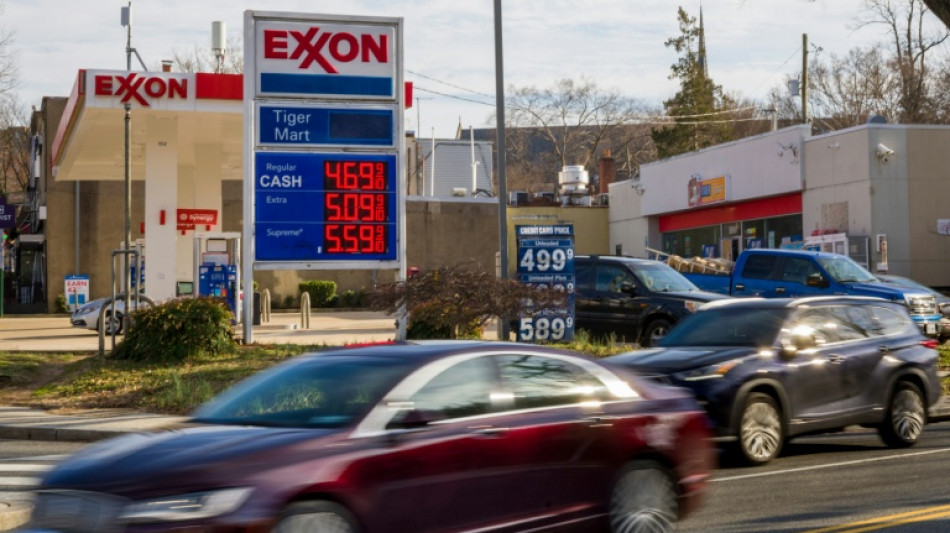
A 6.6 percent jump in gasoline prices accounted for a third of the monthly CPI increase, while overall food costs rose one percent and groceries rose 1.4 percent, the largest gains in both categories since April 2020.
Housing costs such as rent rose 0.5 percent compared to January and were up 4.7 percent in the latest 12 months, the report said.
"A further sustained acceleration in rents would be a real problem, but our medium-term model, driven by home prices and wages, among other factors, suggests this is unlikely," said Ian Shepherdson of Pantheon Macroeconomics, noting that rents make up a large part of CPI.
Excluding volatile food and energy prices, CPI saw a monthly gain of 0.5 percent last month, slightly less than in January, and increased 6.4 percent over the past year.
- Fed to the fight -
The most potent actor against inflation is the Fed, whose top officials have made clear they will hike interest rates from zero, ending the easy money policies put in place as the pandemic began, which have been blamed for causing the price surge.
Bostjancic predicted the Fed would raise rates repeatedly this year, but warned "the heightened uncertainty and current shock to financial markets from the Ukraine war" will make them proceed cautiously.
She also predicted that the spike in oil and gas prices caused by the war and sanctions on Russia, a major producer, "will lead to a higher near-term peak in inflation and a slower descent through 2022 than previously envisaged."
A.S.Diogo--PC

