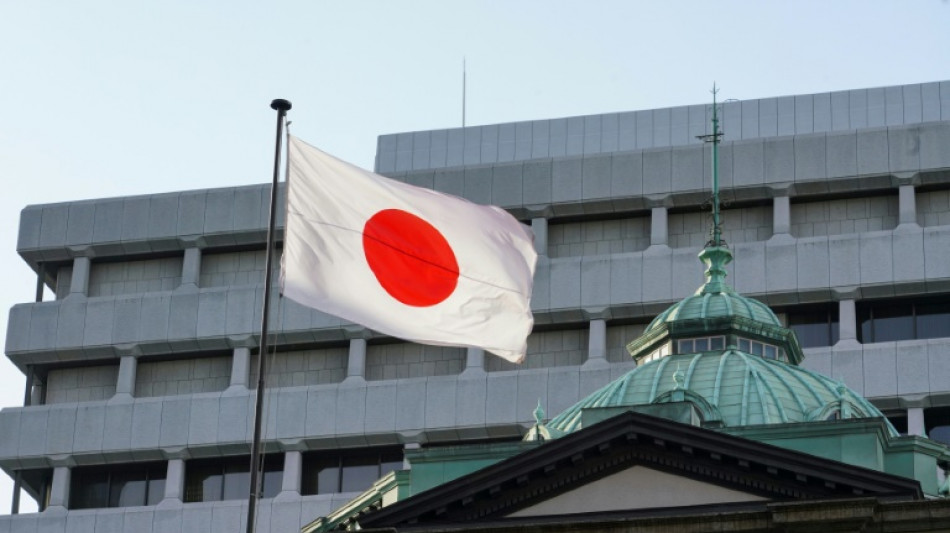
Bank of Japan to allow 'greater flexibility' in controlling bond yields / Photo: Kazuhiro NOGI - AFP

 Germany could miss climate goal in 2026 for first time: think tank

 New flood risks impede Nepal, Tibet rescue

 Kolbe back as Springboks change two for All Blacks Test

 Europe's monarchs, world leaders mourn Norway's King Harald

 Jamie Vardy channel to broadcast Bundesliga games

 STARCARES Completes Basketball Court Revamp in the Philippines, Benefiting Nearly 20,000 People

 Norway's new Queen Mette-Marit, a fairytale beset by woe

 Nepal orders rescuers to safety as overflow brings new flood risks

 Norway's King Harald V, unifying force who weathered family storms

 Australia's McKeown vows to reclaim backstroke world records

 Boston Legacy FC Delays White Stadium Debut to 2028

 Cancer fears stalk Kosovo's coal heartland

 Gladys Knight to Reduce Tour Schedule Amid Health Concerns

 Galápagos Coral Fossils Reveal Global Warming Intensifies El Niño Cycles

 Springboks 'old guard' seek revenge over All Blacks

 'Find your own room': Japan says can't handle added Asian Games numbers

 Fresh flood warnings for disaster-hit Nepal and Tibet, 1,400 still missing

 Most Asian stocks advance as attention turns to Warsh speech

 US mother's child murder trial puts spotlight on postpartum psychosis

 'End of an era': Players lament decline of the disc at Gamescom

 Air traffic controllers left early before deadly NY crash: report

 Golf media firm loses Callaway, PGA Tour deals over violent ad

 US to push economic pressure on Iran at G20 finance talks

 Kiss rotates Wallabies forwards for Argentina Test

 Guns, drugs and car chases: GTA 6 preview lands on Netflix after leaks

The Bank of Japan on Friday eased its grip on its ultra-loose monetary policy in a small step towards normalisation as inflation accelerates and the yen comes under pressure against other major currencies.
The central bank has for years embarked on a process known as yield curve control (YCC) whereby it allows government bonds to move in a narrow band as part of a drive to boost the long-struggling economy.
However, after a closely watched meeting, it said it would allow "greater flexibility" in the market as it hiked its inflation forecast for the current fiscal year.
Still officials said it did not mean the bank was abandoning its monetary policy -- which analysts have warned was looking increasingly unsustainable -- saying it would maintain its massive asset-buying measures.
Ten-year JGB yields would be allowed to "fluctuate in the range of around plus and minus 0.5 percentage points from the target level", the bank said in a statement.
But it will "conduct yield curve control with greater flexibility regarding the upper and lower bounds of the range as references, not as rigid limits", it said.
Market expectations fluctuated in the lead up to the meeting over whether the bank would tinker with its signature stimulus policies after the two-day meeting chaired by governor Kazuo Ueda, who took the helm in April.
The yen initially weakened to 139.95 per dollar after the announcement, from around 139.12 yen in the morning, before climbing to around 138.50.
The currency has been hammered for more than a year as the BoJ refused to shift from its policy, even as central banks around the world pushed up interest rates to fight surging inflation.
The benchmark Nikkei index sank more than two percent at one point on the prospect of higher borrowing costs.
The BoJ took a similar measure in December when it expanded the YCC range to around plus or minus 0.5 percentage points, from a range of plus or minus 0.25 percentage points.
The central bank faces the challenge of balancing the need to shore up the economy and keep its monetary policy sustainable in the long term.
Analysts have said YCC is increasingly harming the economy by skewing the bond market and accelerating the yen's weakness, prompting inflation of imported goods.
"The latest tweak will work as a cushion of a shock (for the markets) when or if the BoJ abandons the YCC in the future, compared with a case if the YCC is abandoned without today's measure," NLI Research Institute senior economist Taro Saito told AFP.
In its latest quarterly report, the bank said Japan's recent inflation rates were "higher than projected" three months ago, while wages had increased, partly on the back of this year's annual negotiations between trade unions and companies.
But it warned of "extremely high uncertainties for Japan's economic activity and prices" including the impact of a tightening of global financial conditions.
The "sustainable and stable achievement of the price stability target of two percent, accompanied by wage increases" remained elusive and it would need to continue with monetary easing, the bank said.
It also raised its inflation forecast for the fiscal year to March 2024, with prices excluding food expected to rise 2.5 percent, up from its previous estimate of 1.8 percent.
For the year to March 2025, however, inflation is expected to slip back to 1.9 percent, against the previous estimate of 2.0 percent.
Inflation is expected to slow even further in the following year to 1.6 percent.
A.Motta--PC