Ukraine economy could collapse if war drags on: IMF

 Turkish Energy Minister Highlights Qatar as Key Partner for Regional and Global Energy Security

 London Museum Granted 24/7 License Ahead of November Opening

 Dana White Confirms Flight to Washington for Trump Meeting on Press Secretary Role

 Dengue Fever Expands Into High Himalayas as Climate Change Warms Nepal

 IoT Refrigerator Hacks Disrupt Blood Labs and Supermarkets Across Europe and US

 Post-election pressures complicate US and Israeli decisions on Iran

 UN members approve talks on treaty protocol against environmental crime

 Family-run West Sussex beach café prepares for first winter season

 CT scans reveal health and burial clues from Egypt’s Braided Lady mummy

 Oxford faces complaints over lecturer’s classroom attire

 Kyren Wilson and John Higgins reach International Championship snooker final
Ukraine's government continues to function, the banking system is stable and debt payments are viable in the short term, but the Russian invasion could plunge Ukraine into a devastating recession, the International Monetary Fund said Monday.
And it warned that the war could have broader repercussions, including threatening global food security due to rising prices and the inability to plant crops, especially wheat.
At a minimum the country would see "output falling 10 percent this year assuming a prompt resolution of the war," the IMF said in an analysis of the economy in the wake of the Russian invasion.
But the fund warned of "massive uncertainty" around the forecasts, and if the conflict is prolonged, the situation will worsen.
Citing wartime data for conflicts in Iraq, Lebanon, Syria and Yemen, the IMF said the "annual output contraction could eventually be much higher, in the range of 25-35 percent."
The country's economy grew 3.2 percent in 2021 amid a record grain harvest and strong consumer spending.
But in the wake of the Russian invasion on February 24, "the economy in Ukraine dramatically changed," said Vladyslav Rashkovan, alternate executive director for Ukraine on the IMF board.
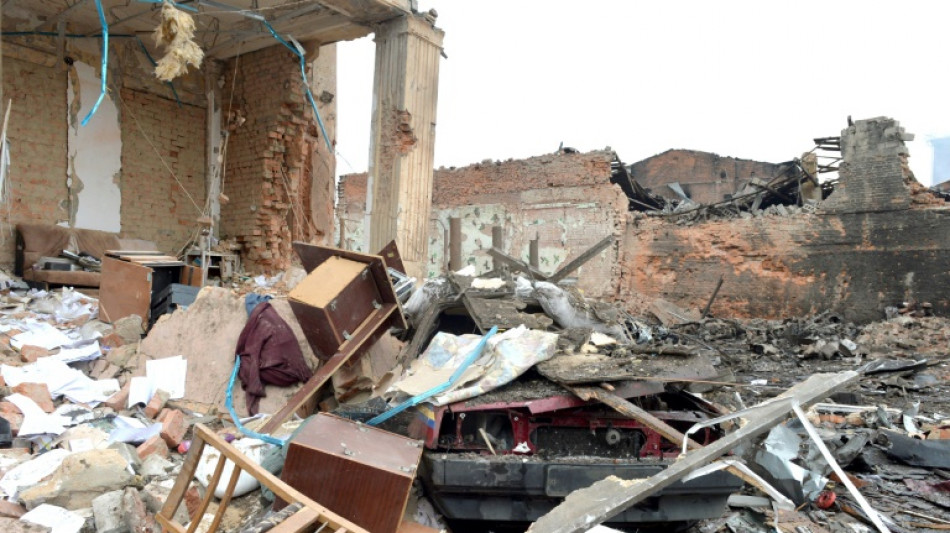
"As of March 6, 202 schools, 34 hospitals, more than 1,500 residential houses including multi-apartment houses, tens of kilometers of roads, and countless objects of critical infrastructures in several Ukrainian cities have been fully or partially destroyed by Russian troops," the official said in a statement.
Ports and airports also have been closed due to "due to massive destruction," he said.
Oleg Ustenko, economic adviser to Ukraine's President Volodymyr Zelensky, last week estimated the damage at $100 billion so far.
- 'Hunger in Africa' -
Despite the extensive damage, the government and the country have continued to function.
"Banks are open, working even during the weekends," Rashkovan said in the statement dated March 9.
As of March 1, the country held foreign reserves of $27.5 billion, "which is sufficient for Ukraine to meet its commitments," he said.
The IMF, which last week approved a $1.4 billion emergency aid program for the country, said given large reserves and significant financial support "debt sustainability does not appear to be at risk" in the short term, although there are "very large" uncertainties.
Beyond the human and economic losses in Ukraine, the IMF cautions about the spillovers from the war to the global economy.
Since the conflict began, the prices of energy and agriculture have soared and the fund warned they could worsen, fueling rising inflation.
"Disruptions to the spring agriculture season could also curtail exports and growth and imperil food security," the report said.
Ukraine and Russia, considered the "breadbasket of Europe," are among the largest wheat exporters in the world. Most Ukrainian wheat is exported in summer and autumn.
The initial impact will be on prices, which would also push prices of other food like corn higher, according to the IMF.
But an extended conflict could hit supplies if farmers are unable to plant.
"War in Ukraine means hunger in Africa," IMF Managing Director Kristalina Georgieva said Sunday on CBS.
The UN World Food Program in a report Friday cautioned that "Export disruptions in the Black Sea have immediate implications for countries such as Egypt, which heavily rely on grain imports from Russia and Ukraine."
And countries that rely heavily on imported grain will also feel the pain, including "hunger hotspots such as Afghanistan, Ethiopia, Syria and Yemen."
L.Carrico--PC

