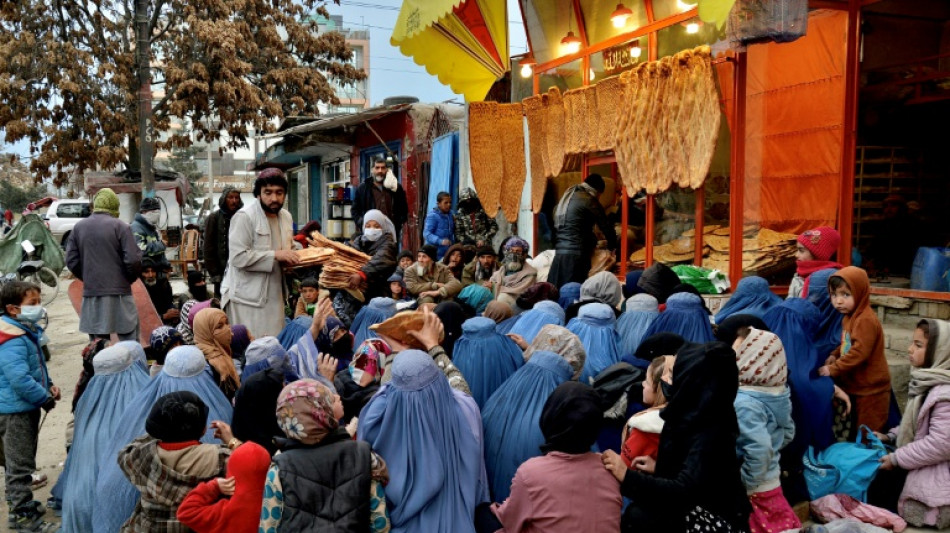
Food security worsens in Afghanistan as wages fall: World Bank

 Turkish Energy Minister Highlights Qatar as Key Partner for Regional and Global Energy Security

 London Museum Granted 24/7 License Ahead of November Opening

 Dana White Confirms Flight to Washington for Trump Meeting on Press Secretary Role

 Dengue Fever Expands Into High Himalayas as Climate Change Warms Nepal

 IoT Refrigerator Hacks Disrupt Blood Labs and Supermarkets Across Europe and US

 Post-election pressures complicate US and Israeli decisions on Iran

 UN members approve talks on treaty protocol against environmental crime

 Family-run West Sussex beach café prepares for first winter season

 CT scans reveal health and burial clues from Egypt’s Braided Lady mummy

 Oxford faces complaints over lecturer’s classroom attire

 Kyren Wilson and John Higgins reach International Championship snooker final
Food security in Afghanistan has deteriorated sharply since the Taliban took power in August, while wages have fallen "dramatically" for more than two-thirds of workers, a World Bank survey said Tuesday.
The report found 70 percent of the households surveyed said they were unable to meet their basic needs for food and other essentials, twice as many as in a previous survey conducted in May 2021.
There also was a "significant" decrease in both the quality and quantity of food consumed.
"The results suggest that while the Afghan population is still able to find work and access some key public services, the situation is quite fragile," according to the report, which was based on data gathered by telephone between October and December 2021 of nearly 5,000 Afghan households.
The World Bank warned "that an imminent and dramatic decline in welfare outcomes and access to services could occur unless salaries, at least for key services, can be restored and food security improved."
Afghanistan has been gripped by an economic crisis since the Taliban takeover after countries cut off development programs and froze its foreign reserves, though some humanitarian aid flows have resumed.
Wages have declined markedly across industries and regions, and more Afghans are looking for work in both urban and rural areas than a year and a half ago, the survey said.
The quantity of available jobs has increased in the countryside, but has decreased in the cities and suburbs.
The share of public sector jobs shrank, and a larger proportion of households reported being self-employed, according to the data.
However, more Afghan children are attending school, and more girls are attending class than in the previous survey on the subject conducted two years ago, though their enrollment remains lower than boys and has not improved in urban areas, especially for secondary school.
"While disparity in overall school attendance by gender remains high, data indicate that at the primary level, more girls are in school, with attendance levels overall higher for both boys and girls, compared to the situation in the fall of 2019," the report said
"The share of households reporting sending their girls to school also increased by 10 percentage points in the same time period, but there are large differences between rural and urban areas."
Girls also are leaving school earlier, since in urban areas, "the share of households sending their girls to both primary and secondary school declined."
The survey also found 94 percent of people were able to obtain medical attention over the period surveyed, with little difference between gender or location.
V.Fontes--PC

