Japan issues power warning after quake hits supply

 Municipal Elections: How Service Failure Becomes a Public Health Crisis in South Africa

 Rene Eyre Revisits Autobiographical Performance 'Say A Little Prayer' in London

 UAE's HCT Holds Record Graduation and Announces Major Training Expansion

 NASA Awards $10B Lunar Contract Framework to SpaceX, Blue Origin

 Katy Perry Tells Fans Ex-Husband Russell Brand 'Should Be in Jail' During UK Concert

 South African election results renew debate over identity-based voting

 South African voters report smoother local election but declining IEC trust

 Dolly Parton museum and Nashville hotel open after singer’s death

 George and Amal Clooney attend New York political-comedy reading
Japan's government warned on Tuesday of possible widespread electricity outages for Tokyo and its surrounding regions as power plants hit by last week's powerful earthquake struggled to meet surging demand caused by a cold snap.
Overnight, the government issued its first-ever electricity crunch warning for the capital and other regions, with supply dented because several thermal power plants remain offline after the quake.
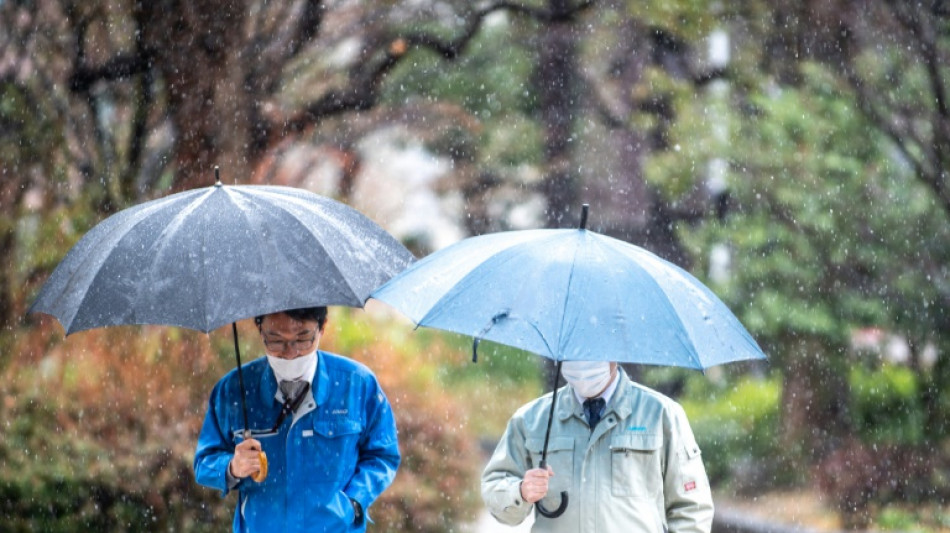
The industry ministry called on people to conserve energy throughout Tuesday, but with sporadic snowfall and unseasonably cold temperatures in the capital, demand remained strong.
"We're only achieving power-saving of around 1.5 million kilowatts, which is two to 3.5 million kilowatts less than the target level," warned Koichi Hagiuda, Japan's minister of economy, trade and industry.
"If this continues, we are unfortunately approaching a situation where we will have to carry out widespread power cuts, as we did on the day of the earthquake, in order to prevent a total blackout."
The crunch is believed to be the toughest power situation in the Tokyo area since March 2011, when rolling blackouts were instituted after a quake-triggered tsunami crippled the Fukushima nuclear plant and other nuclear facilities were shut down.
The current supply shortages have been caused in part by a powerful 7.4-magnitude earthquake off northeast Japan last week that killed at least two people and damaged several thermal power plants.
Operations at six plants are currently suspended because of damage to boilers, transformers and turbines, an industry ministry official told AFP.
While some are expected to resume operation by the end of March, for others the repairs could take several months, the official said.
The tight supply comes as temperatures in Tokyo hovered as low as two degrees Celsius (35 Fahrenheit), unseasonably cold and far below temperatures seen in recent weeks.
S.Pimentel--PC


