
Russia default would have 'limited' global impact: IMF official

 Municipal Elections: How Service Failure Becomes a Public Health Crisis in South Africa

 Rene Eyre Revisits Autobiographical Performance 'Say A Little Prayer' in London

 UAE's HCT Holds Record Graduation and Announces Major Training Expansion

 NASA Awards $10B Lunar Contract Framework to SpaceX, Blue Origin

 Katy Perry Tells Fans Ex-Husband Russell Brand 'Should Be in Jail' During UK Concert

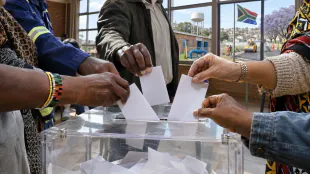 South African election results renew debate over identity-based voting
 South African voters report smoother local election but declining IEC trust
 Dolly Parton museum and Nashville hotel open after singer’s death

 George and Amal Clooney attend New York political-comedy reading
The consequences for the global financial system if Russia cannot pay its foreign debts are likely to be "limited," a senior IMF official said Tuesday.
The United States and its allies have imposed tough financial sanctions on Russia in retaliation for its invasion of Ukraine, but Moscow so far has made debt payments despite concerns about its ability to continue to service its loans -- especially after the May 25 expiration of a US exemption that allows the transactions.
"If there were a default, I think the direct effect on the rest of the world would be quite limited, because the numbers that we're looking at are relatively small from a global perspective," said Gita Gopinath, the number-two official at the Washington-based crisis lender.
"It is not a systemic risk to the global economy," although some banks have "greater exposure," she said in a discussion with Foreign Policy magazine.
The sanctions have effectively severed Russia's ties to the global financial system, prohibiting most transactions except for debt payments and oil purchases.
The measures also froze the government's stockpile of $300 billion in foreign currency reserves held abroad.
Moscow last week avoided default after it made a $117 million interest payment on two dollar-denominated bonds, sending funds through JPMorgan and Citigroup, which confirmed with the US Treasury Department that the transactions were allowed.
A source close to the matter told AFP on Tuesday that JPMorgan received another $66 million payment in US dollars, although the source could not confirm if the funds had been sent to Citi.
Moscow had initially indicated that it would pay in rubles, which debt ratings agencies said would be considered a default.
Russia last defaulted on its foreign currency debt in 1918, when Bolshevik revolution leader Vladimir Lenin refused to recognize the obligations of the deposed tsar's regime.
The government missed payments on domestic, ruble-denominated debt in 1998 amid a financial crisis.
A.Silveira--PC


