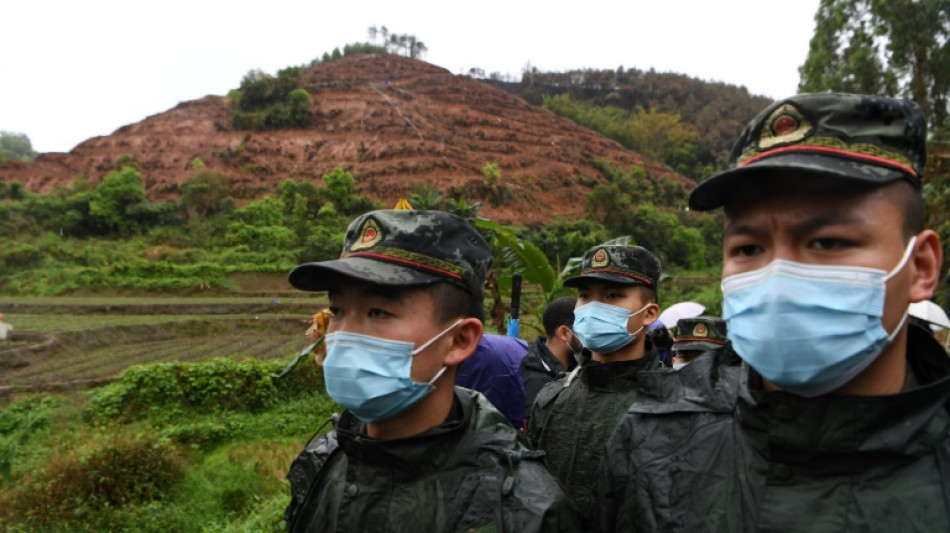
Drones, thermal scanners scour China Eastern crash site

 Municipal Elections: How Service Failure Becomes a Public Health Crisis in South Africa

 Rene Eyre Revisits Autobiographical Performance 'Say A Little Prayer' in London

 UAE's HCT Holds Record Graduation and Announces Major Training Expansion

 NASA Awards $10B Lunar Contract Framework to SpaceX, Blue Origin

 Katy Perry Tells Fans Ex-Husband Russell Brand 'Should Be in Jail' During UK Concert

 South African election results renew debate over identity-based voting

 South African voters report smoother local election but declining IEC trust

 Dolly Parton museum and Nashville hotel open after singer’s death

 George and Amal Clooney attend New York political-comedy reading
Recovery teams deployed drones and thermal imaging equipment Thursday across a mountainous area where a China Eastern plane inexplicably crashed with 132 people on board.
Four days after flight MU5735 ploughed into rugged terrain near Wuzhou in southern China, officials are still yet to declare all of the 123 passengers and nine crew dead.
The velocity of the crash cut deep wounds into the muddy ground and scattered plane parts and passenger belongings across a vast area, dashing hopes of finding survivors in what will almost certainly be China's worst air crash in three decades.
Wiping tears from her eyes, her arms supported by two men, a distraught relative arrived at the entrance point to the crash area on Thursday morning, according to an AFP reporter.
Under pouring rain, she joined scores of firefighters, paramilitary police and reporters to trudge across the rough terrain to where eviscerated chunks of jet have been found.
Officials late Wednesday said human remains have been found, but on the ground searchers have not ruled out finding survivors trapped on the densely forested, mud-slicked slopes.
The "mission is mainly focused on searching for victims and saving lives," Huang Shangwu, of Guangxi Fire and Rescue Force told reporters, citing instructions "from headquarters."
"We are using thermal imagers and life detectors to search the surface... we also use manual searches and aerial drones."
At the same time, teams are scouring the landscape for the remaining black box - after a damaged voice recorder was recovered on Wednesday and sent to Beijing for analysis.
Experts hope it will yield clues to the cause of the crash, which saw the Boeing plane - flying between Kunming and Guangzhou - drop tens of thousands of feet in just minutes.
Tracking website FlightRadar24 showed the plane rapidly dropped from 29,100 to 7,850 feet (about 8,900 to 2,400 metres) of altitude in just over a minute.
The stricken jet was equipped with two recorders: the cockpit voice recorder and the other one in the rear passenger cabin tracking flight data.
The crash provoked an unusually swift public response from President Xi Jinping who ordered a probe into its cause, as aviation authorities vowed an extensive two-week check-up of China's vast passenger fleet.
The safety message has rippled out across sectors after the MU5735 crash. A notice from the State Council and Ministry of Emergency Management on Wednesday called for industries across the board to "rectify potential safety hazards".
US officials - Boeing is an American company - were also waiting for clearance to enter China, according to the US National Transportation Safety Board.
"We are working with the Department of State to address those issues with the Chinese government before any travel will be determined," it told AFP Thursday in a statement.
Aviation authorities have said the captain of the ill-fated jet had more than 6,700 hours of flight experience and the first co-pilot had more than 31,000 hours of flight time.
There was a second co-pilot on board, with more than 550 hours of flight time - all three were in good health with no known personal problems.
C.Cassis--PC


