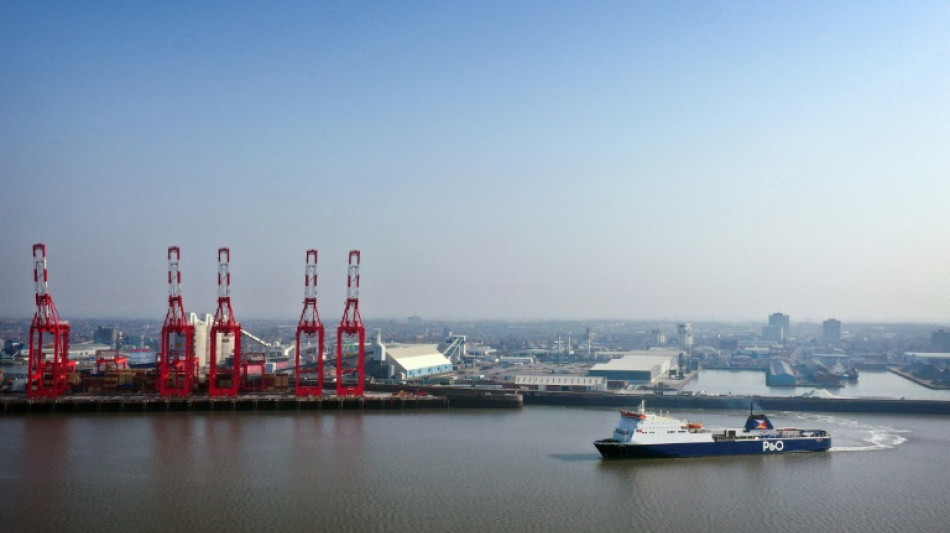
P&O Ferries admits breaking law over sackings

 Municipal Elections: How Service Failure Becomes a Public Health Crisis in South Africa

 Rene Eyre Revisits Autobiographical Performance 'Say A Little Prayer' in London

 UAE's HCT Holds Record Graduation and Announces Major Training Expansion

 NASA Awards $10B Lunar Contract Framework to SpaceX, Blue Origin

 Katy Perry Tells Fans Ex-Husband Russell Brand 'Should Be in Jail' During UK Concert

 South African election results renew debate over identity-based voting

 South African voters report smoother local election but declining IEC trust

 Dolly Parton museum and Nashville hotel open after singer’s death

 George and Amal Clooney attend New York political-comedy reading
Scandal-hit P&O Ferries on Thursday admitted that the company "chose" to break UK employment law when it fired 800 seafaring workers without notice last week.
The shock move last Thursday sparked angry protests at the group's facilities across the country and also prompted a legal challenge from the UK government.
Chief executive Peter Hebblethwaite, appearing before a parliamentary hearing, conceded P&O failed to consult trade unions as required by law -- and revealed that replacement agency crew are paid far below minimum wage.
"There is absolutely no doubt that we were required to consult with the unions. We chose not to do that," Hebblethwaite told a joint hearing of the transport and business select committees.
"We chose not to consult and we are, and will, compensate everybody in full for that."
The loss-making firm, owned by Dubai's DP World, sparked outrage when it told workers in a video-conference call that a quarter of P&O jobs were going with immediate effect.
Unions were further angered as P&O replaced crews with cheaper agency workers from overseas -- and encouraged sacked staff to re-apply for posts under a so-called "fire and rehire" policy.
In a further blow, Hebblethwaite told lawmakers that the new agency crews were being paid far below the UK's hourly minimum wage apart from on domestic routes.
He insisted this was allowed under international maritime rules.
Hebblethwaite, who earns a basic salary of £325,000 per year, added that the average hourly pay for the new crew stood at just £5.50 per hour.
Britain's minimum wage for people aged 23 years and above currently stands at £8.91 per hour.
- Prosecution -
The P&O chief insisted that transport minister Grant Shapps knew about the intention to cut jobs in November last year, but the Department for Transport denied this.
The sackings sparked extraordinary scenes of security guards scaling vessels to remove sacked staff, as some refused to leave.
Cancellations of services saw long tailbacks on roads leading to Channel ports.
Prime Minister Boris Johnson had attacked the company's actions as "callous" on Wednesday.
"I think that it is no way to treat hardworking employees and... we will not sit by because under section 194 of the Trade Union and Labour Relations Act of 1992 it looks to me as though the company concerned has broken the law.
"We will be taking action, therefore, and we will be encouraging workers themselves to take action under the 1996 Employment Rights Act," Johnson said.
The Trade Union and Labour Relations Act states that employers wanting to make 20 or more employees redundant in less than 90 days have to hold talks with their staff representatives to either agree an alternative or avoid the job losses.
As part of the process, the employer has to inform the government at least 30 days before the first dismissal is due to take effect.
V.Fontes--PC


