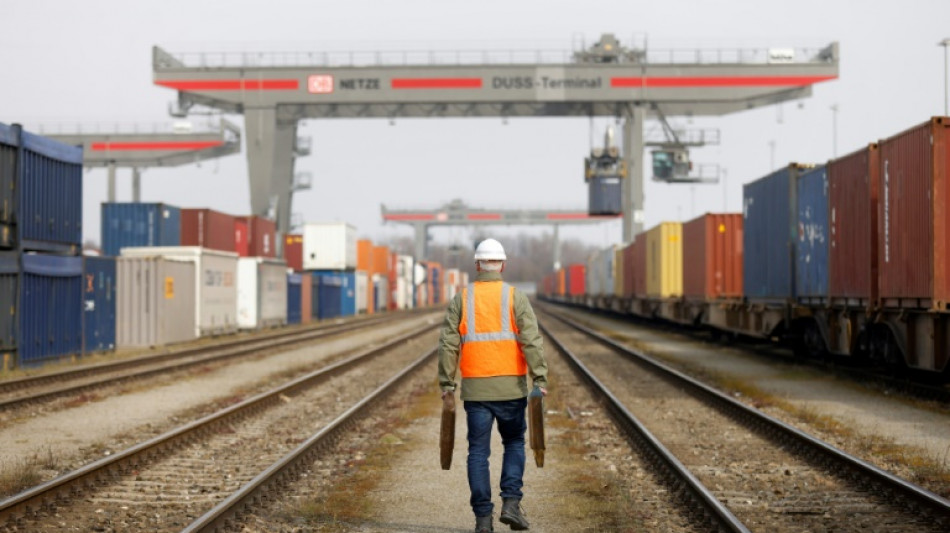
Historic German 'rail bridge' aids war-ravaged Ukraine

 Municipal Elections: How Service Failure Becomes a Public Health Crisis in South Africa

 Rene Eyre Revisits Autobiographical Performance 'Say A Little Prayer' in London

 UAE's HCT Holds Record Graduation and Announces Major Training Expansion

 NASA Awards $10B Lunar Contract Framework to SpaceX, Blue Origin

 Katy Perry Tells Fans Ex-Husband Russell Brand 'Should Be in Jail' During UK Concert

 South African election results renew debate over identity-based voting

 South African voters report smoother local election but declining IEC trust

 Dolly Parton museum and Nashville hotel open after singer’s death

 George and Amal Clooney attend New York political-comedy reading
The convoy rolls slowly out of the heart of Berlin, its eight cars tethered to a bright red locomotive. Destination: Ukraine, thanks to a historic "rail bridge" delivering humanitarian aid to the besieged country.
Four days' journey, more than 1,000 kilometres (600 miles) travelled and at the end of the line, tonnes of food and other essentials delivered to people in need.
The operation of the Deutsche Bahn (DB), the German rail company, echoes the famous Allied airlift -- known as the "air bridge" in German -- during the Cold War to help the city of Berlin during a Soviet blockade.
"It only took four days" to set up this cooperation with the Polish and Ukrainian railways which now allows this "rail bridge" to operate regularly, explains Sigrid Nikutta, head of DB Cargo, the freight service of the public company.
Every other evening, a convoy leaves the German capital after having collected donations from companies and individuals throughout the country, at dedicated points or directly from manufacturers and supermarket chains.
Pallets of baby food, boxes of sanitary pads and tampons, small electrical appliances, medical equipment, floor mattresses, blankets... the outpouring of generosity is so overwhelming that the containers fill up rapidly.
"Each container is a message to Ukrainians: 'We aren't leaving you on your own!'," Nikutta says.
Among the DB staff, morale is high. Employees take convoys to Poland where they then hand off to local drivers.
The containers must later be unloaded and transferred because the width of the rails in Ukraine is different.
When the train arrives in Ukraine, the national railway takes over.
- 'Respect' -
The unfailing commitment of the employees of the Ukrainian national company to transport food and refugees from one end of the country to the other has earned the admiration of their colleagues to the west.
"They have my respect but also my concern because we all know that this is dangerous," Nikutta says.
However the risks for the "rail bridge" are limited, says DB Cargo spokesman Michael Schmidt.
"We do not transport weapons, no oil", he stresses, noting that since the start of the Russian offensive, attacks on the Ukrainian rail network have been rare because "the Russians need to keep this infrastructure in good condition".
All the convoys, sent to various Ukrainian cities and towns, have so far arrived safely, Nikutta says with pride.
She even received a photograph of the arrival of the containers in Kyiv sent by the mayor of the capital, the charismatic ex-boxer Vitali Klitschko.
"Many Ukrainians feel today, after four long weeks of war, what the Berliners felt at the time of the blockade by the Soviets" in 1948-1949, says the Ukrainian ambassador to Germany, Andriy Melnyk, who attended the departure of a convoy this week.
"Without the enormous effort of the Allies at the time, what would this beautiful city have become?" he asks.
"We now need other solid bridges, including political ones, and the most important would be a prospect of EU membership for Ukraine", says the ambassador, giving the starting signal to the locomotive stamped with the slogan "We stand with Ukraine".
Nogueira--PC


