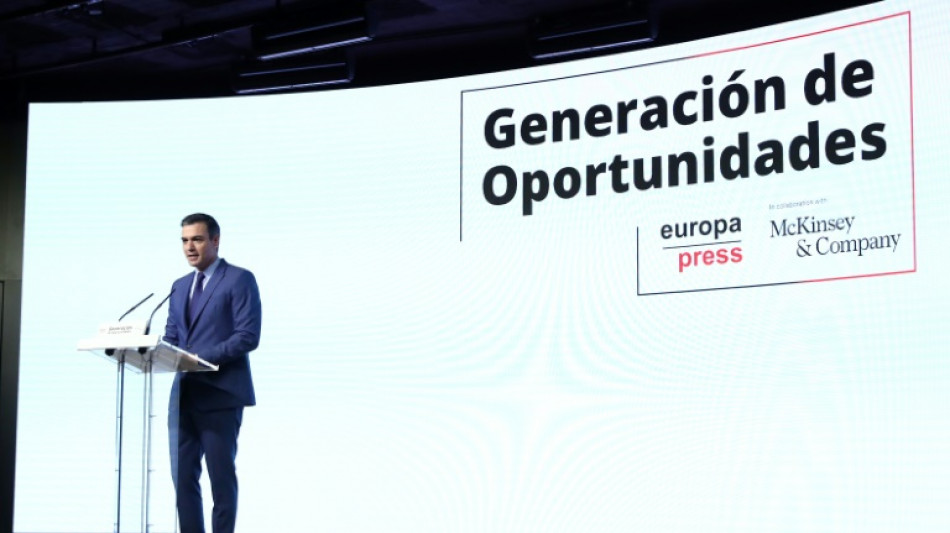
Spain unveils economic plan to ease Ukraine war impact

 Municipal Elections: How Service Failure Becomes a Public Health Crisis in South Africa

 Rene Eyre Revisits Autobiographical Performance 'Say A Little Prayer' in London

 UAE's HCT Holds Record Graduation and Announces Major Training Expansion

 NASA Awards $10B Lunar Contract Framework to SpaceX, Blue Origin

 Katy Perry Tells Fans Ex-Husband Russell Brand 'Should Be in Jail' During UK Concert

 South African election results renew debate over identity-based voting

 South African voters report smoother local election but declining IEC trust

 Dolly Parton museum and Nashville hotel open after singer’s death

 George and Amal Clooney attend New York political-comedy reading
Spanish Prime Minister Pedro Sanchez unveiled plans Monday to offer 16 billion euros ($17.5 billion) in direct aid and loans for families and companies hit by the impact of Russia's invasion of Ukraine.
Details of the long-awaited emergency response plan came as Spain struggles with a wave of social unrest over runaway inflation and rising prices, with lorry drivers striking, production stoppages and mass protests by farmers and fishermen.
The plan, which will be approved at Tuesday's cabinet meeting, will release "approximately 6.0 billion euros in direct aid and tax rebates and 10 billion euros in state-guaranteed loans to cushion the impact of the crisis on families and businesses", Sanchez told a business forum.
The measures, which will remain in place until June 30, will include "a minimum reduction of 20 cents per litre of fuel", Sanchez said, indicating that 15 cents would be financed by the government and five cents by the oil companies.
But Spain's consumer watchdog FACUA denounced the measures as "totally inadequate" for easing the impact of record light and energy prices.
On Monday, average petrol prices in Spain ranged between 1.84 and 1.98 euros per litre, while diesel stood at between 1.86 and 1.95 euros, according to dieselogasolina.com.
Last week, the government announced a similar reduction but only for lorry drivers, with the new reduction to impact everyone.
Reducing fuel prices by 20 cents per litre was "very low when taking into account the brutal price rises of recent months", FACUA said.
It attacked the government for "not imposing a special tax on electricity and petrol firms and other large companies whose profits had increased enormously".
- 'An exceptional situation' -
The plan also extends until the end of June tax cuts already in place such as the reduced rate of VAT on energy and a suspension of tax on electricity production.
It also includes a 362-million-euro aid package for the agriculture and farming sector, 68 million euros for the fishing and aquaculture industries, a two percent cap on rental increases and a 15 percent increase in the income support to help the most vulnerable.
In total, it was an investment of 16 billion euros to "ease the impact on families and businesses," Sanchez said.
"This situation is absolutely exceptional and the steps we're taking will, I think, offer us a way out of this huge crisis," said Labour Minister Yolanda Diaz, who is also one of Sanchez's deputies.
But the right-wing Popular Party said Sanchez had failed to make good on a commitment to reduce taxes.
"There is no reduction in taxes as was initially promised and... we will have to wait for an explanation of exactly what is going to be done after a year in which prices increased by 7.6 percent," said incoming PP leader Alberto Nunez Feijoo.
Spain saw consumer prices surge to their highest level in almost 35 years, with inflation jumping to 7.6 percent in February, against a backdrop of soaring energy costs, worsened by the war in Ukraine.
On March 14, lorry drivers launched an open-ended strike over mounting fuel prices, staging roadblocks and picket lines and leaving supermarkets with empty shelves and several sectors struggling to cope.
Fishermen also staged a mass strike last week over diesel prices, while the livestock and farming sector have also hit the street in protest over rising costs, including that of animal feed costs.
T.Batista--PC


